

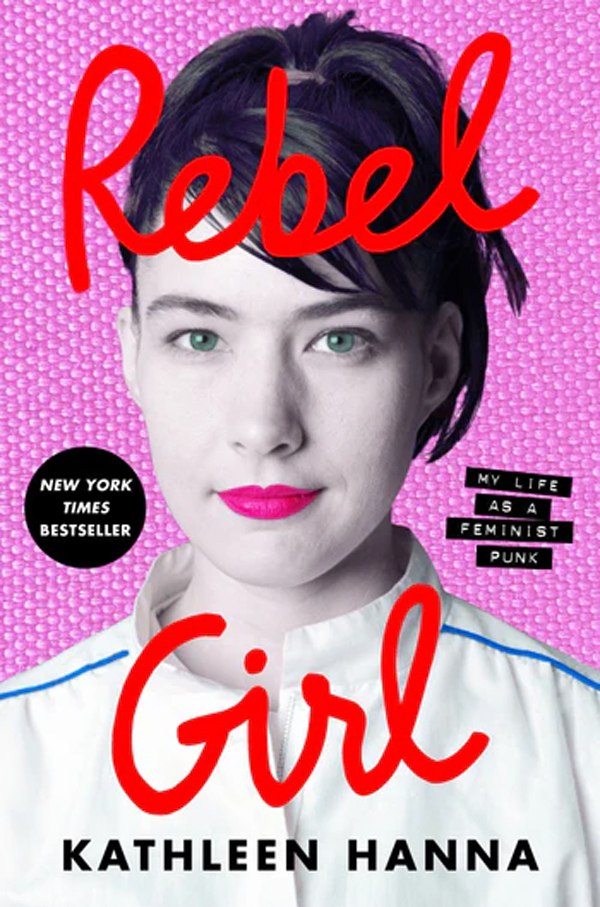
Rebel Girl chronicles the life of Kathleen Hanna, frontwoman of Bikini Kill, Le Tigre, and The Julie Ruin. Hanna was at the forefront of the third-wave feminism movement of the 1990s — known as riot girl, often spelled “riot grrrl” — that flourished in the Pacific Northwest and D.C. areas. This is the journey of a punk, frontwoman, photographer, zine writer, and activist who worked alongside icons such as Joan Jett and Kurt Cobain.
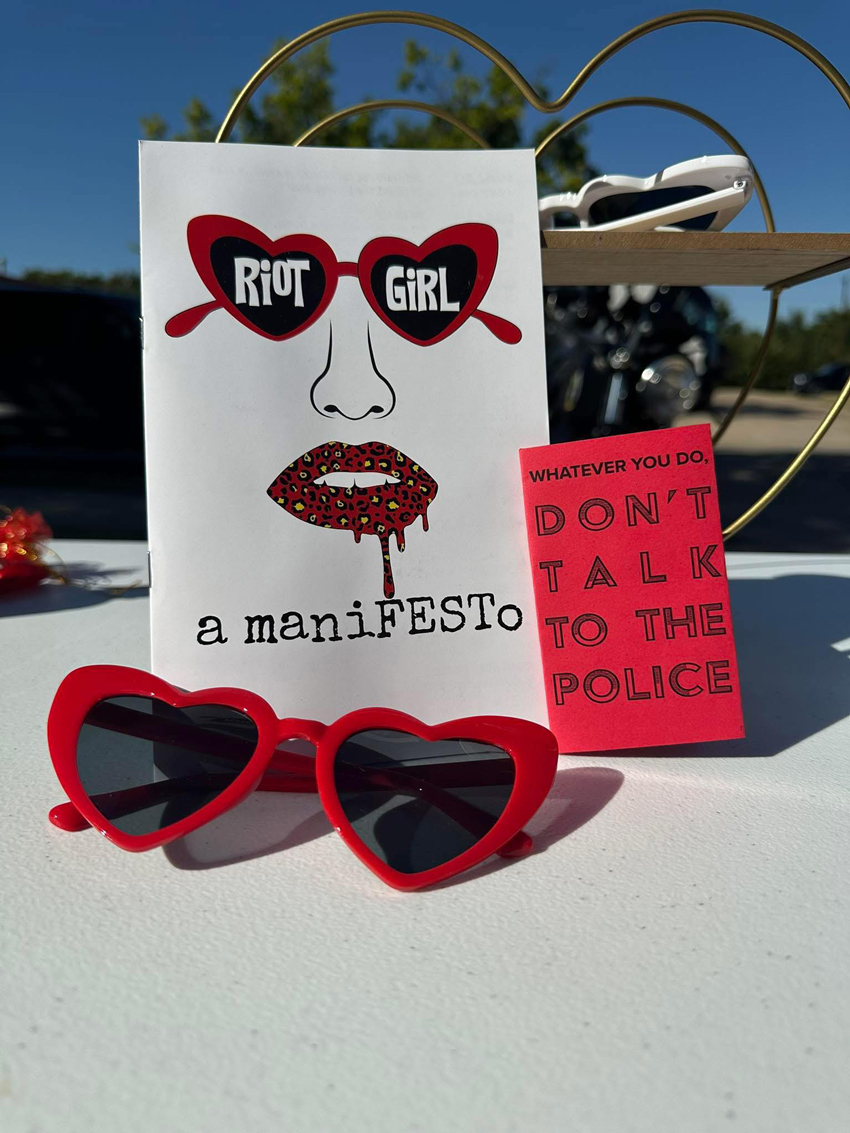
I’m either the best or worst person to write this review. I drank the Kool-Aid. I’m the curator of the Riot Girl maniFESTo zine, the leader of a feminist punk band, and the organizer of a festival.
While chronological, Hanna chooses to format the stories in bite-sized chunks, making the content more digestible. The stories are shared in an honest, approachable language, including the occasional F-bomb. The ebb and flow of details echoes a face-to-face conversation, in which one might trail off or go silent when exploring the intimate details of a situation they’re discussing. In the prologue, Hanna admits to this, saying she leaves some portions of the story on “the cutting room floor.”

“These are the things that shaped me,” she writes. However, they are also “things that keep me up at night checking and rechecking the locks on the doors.”
Courtesy the author
I’d be remiss if I didn’t warn you that at times, the content of her life is hard to consume. On more than one occasion, I found myself setting the book down to process what I’d just read. The tragedies and few victories of her childhood were guttural. While I was aware of some of this history from the lyrics of Bikini Kill, the retelling of the stories made them visceral: talk of incest, multiple sexual assaults, and drug use.
Until I cracked open the pages of the book and started my journey, I had never heard anyone else say they remember best through sound. In keeping with this theme, there is a Spotify playlist of the songs which includes all the ones referenced throughout the book. It works to ground the reader in the experience, using the manner that Hanna finds most visceral. I recommend listening to it between reading the book.
This is also the story of a friendship gone cold. These themes are set against the background of the often dangerous and revolutionary alternative and punk scenes of the day. This left me wanting a deeper, more introspective look at Hanna’s sordid relationship with Cobain. Credited with inspiring “Smells Like Teen Spirit,” Hanna was friends with him until around the time he became addicted to heroin.
“When we listened to music together, Kurt was obsessive,” she writes, later lamenting how she felt like “he had died partially because he was sick of being exploited.”
Some juicy bits about the feud between Cobain’s partner, Courtney Love, and Hanna are included. There were altercations. At one point, Hanna writes, Love got in Hanna’s “face and started hissing like a cat.”
Rebel Girl is also a love story. Hanna has been married to Adam “Ad-Rock” Horovitz of the Beastie Boys since 2006. Hanna talks about reconciling the fact that as a hardcore feminist she has found herself with a musician whose career to that point had been littered with misogyny. This caused flashbacks to a previous relationship in which I had encountered the same issue. The reconciliation of her persona and her personal life was a point of connection I did not expect. There is a maze that female musicians are asked to navigate, especially in the 1990s but still today. These challenges are discussed openly in the book, and the clear message is that following your heart is more important than anyone’s opinion. A wise lesson for us all.
Hanna articulates her point of view while making you grin ear to ear with the silliness of young love and the tender caregiving role that Horovitz plays for her after their relationship matures and Hanna’s battle with Lyme disease becomes nearly unmanageable. “I was beautiful even when I was drooling and unable to talk,” she recalls Horovitz saying.
The harshest part of Rebel Girl came for me in the post-Bikini Kill era of Hanna’s life. She explicitly says that she does not want to see the riot girl movement continue. My heart sank as my eyes took in those words. How could this be? In a small portion of a memoir, everything in my world changed. I was now faced with the realization that my idol did not appreciate my efforts, but I turned to another recurring theme of the memoir: “Feminism 101,” Hanna writes, “is rarely perfect.” While this may not be a legacy that Hanna sees moving forward, she repeatedly insists that it was not hers to begin with. Rather, the idolization was thrust upon her while she still managed to stay in some sort of underground yet famous role.
If you’ve ever had your worldview changed by a song, a scene, or a stubborn belief that things could be louder and better, this book is calling your name. This is not just a revisit of one person’s life. It is a brave confession and a deeply human story of someone at the forefront of a revolutionary time in music and counterculture. Set against backstage grit and drama, Rebel Girl is not just for the riot girl enthusiast. It is a story for anyone who insists that feminism, art, and healing are a lifelong journey.
Jennifer Zooki Sturges is curator of Riot Girl maniFESTo zine, the leader of a feminist punk band, and the organizer of the Riot Girl Festival.
Rebel Girl: My Life as a Feminist Punk, by Kathleen Hanna
HarperCollins Publishers
336 pps.
$29.99