

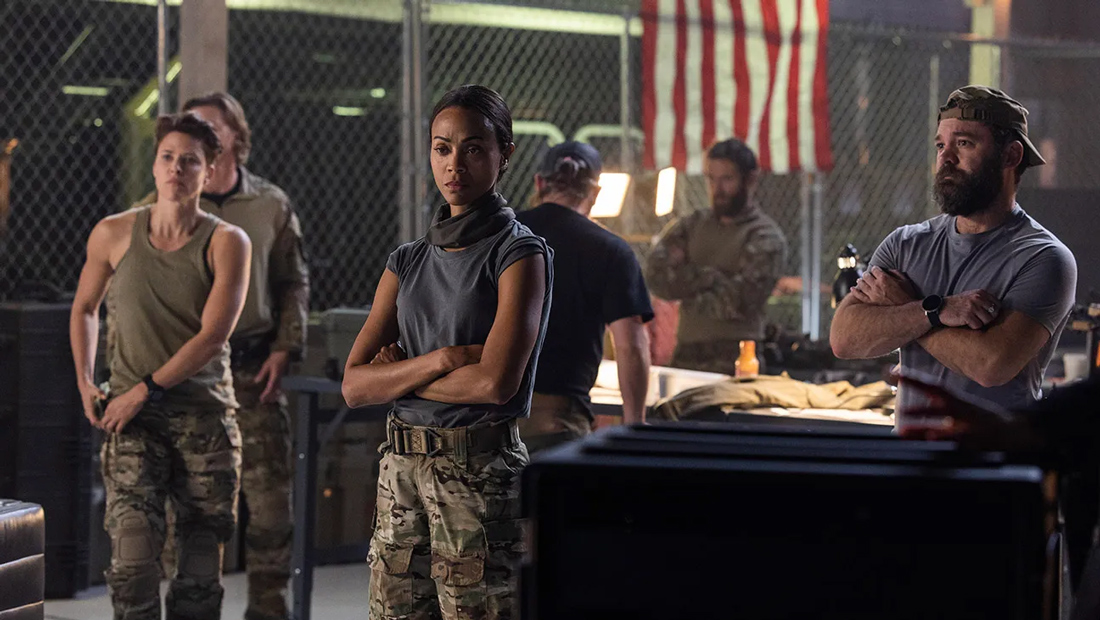
Taylor Sheridan’s Western TV smash Yellowstone and its many spinoffs tend to lean toward stories about men, so Lioness is a complete change of wardrobe. It’s a nonstop action-packed series centered on a CIA program that employs the charms of women operatives to lead the agency to their terrorist targets.
Although I appreciate the amount of jobs and projects that Sheridan has brought to North Texas and hints of film incentives coming this way because of him, I can say that I am not a big fan of his work. I made it through two episodes of Landman before recognizing its failure at evolving past cliches, which put me off trying some of his other shows. Sheridan is everywhere, though, and he’s hard to avoid. Yellowstone, 1883, 1923, Landman, Tulsa King, and Mayor of Kingstown are all his handiwork and do have large fanbases, for whatever that’s worth.
With the new incentives funded by the state, Sheridan’s shows can qualify for and bring big money to the film industry in Texas. They’re also a good fit for his key audience. Most of his dramas feature the oil industry and rich ranchers and ranch hands, with female characters mostly serving as lushes, gold diggers, or objects to lust after. I was keen to give Lioness a chance after seeing it stars heavy hitters Zoe Saldaña, Nicole Kidman, and Morgan Freeman. What could go wrong?

I spent the big freeze binging Seasons 1 and 2 to give it a fair shot. (Season 3 is expected later this year.) Lioness has enough plotline to move past most of the cheap tricks and female eye candy that is completely gratuitous yet expected to maintain the attention of a certain viewing demographic, but they weren’t enough for me to call out this stuff for what it is.
There has been much talk about representation in TV and film, and this show is a spin rather than step forward in evolution. In looking into whether Lioness would pass the Bechdel Test, for which a story must have more than two female characters who talk to each other about something other than men — in other words, have real story arcs and fully developed personas themselves — I learned that there are many other tests.
One is the Castellini Test. This creation of writer/director/podcaster Bri Castellini adds a crucial third condition: Two named women must have at least five lines of dialogue each and talk to each other about something other than a man, and at least one woman must be integral to the plot, ensuring the character’s significance beyond just being a talking woman. It addresses the Bechdel Test’s limitation of focusing only on numbers by demanding actual plot relevance and deeper conversation, moving beyond superficial representation.
The Sexy Lamp Test, created by comic book writer Kelly Sue DeConnick, is the one that no show or film should fail, but I am sure many do. In this test, if you can replace the character with a sexy lamp and not damage or alter the plot, the production has failed the Sexy Lamp Test.
Finally, the Mako Mori test is another well-known means of checking for fairness in film. Named after a character from Pacific Rim, the woman character must have her own story arc that is not to support the story arc of any male character. Basically, she must be her own person with her own mission and not solely a potential lover.
So, putting Lioness to the tests, there are plenty of strong female characters, though many follow the tropes of the femme fatale or ice queen. They do pass the Sexy Lamp Test and serve an important role in the nonstop gritty action. I would say they also pass the Bechdel Test and at times the Castellini and Mako Mori tests.
However, Sheridan undermines these steps forward by falling back onto the old trick of showing only women’s skin without advancing the plot. Watering down the marriage of main character Joe (Saldaña) to physical contact yet expecting viewers to believe she holds profound guilt about being absent from her family feels unconvincing and serves only to create an excuse for intimate scenes. Painting the teenage daughter as a whiny brat and the younger daughter as barely a ghost shows an underdeveloped family that is supposed to be causing Joe’s inner struggle, yet we don’t see who the girls actually are. Introducing new operatives just to carry high-level missions while at the same time using them as eye candy for intimate scenes with other women is not a moral issue at all. It is just making sure to feed the eyes of viewers to keep them watching. Giving most of the main female characters typically male names also makes me wonder if Sheridan simply cannot accept these characters as women at all.
The truth probably lies in between the two scenarios: actual representation and a simultaneous lack of depth. What is true is that Sheridan does not write real women. He writes women that men want to watch. That’s all.
The series itself is watchable, but there is definitely room to fully flesh out the leads in a way that leaves out the flesh. Taylor Sheridan may have wanted to push boundaries here and is sometimes successful, but maybe adding a woman writer might add the depth needed for Lioness to be a truly female-forward show.
Special Ops: Lioness
Starring Zoe Saldaña, Laysla de Oliveira, and Nicole Kidman. Directed by Taylor Sheridan. Written by Taylor Sheridan. Rated TV-MA.