


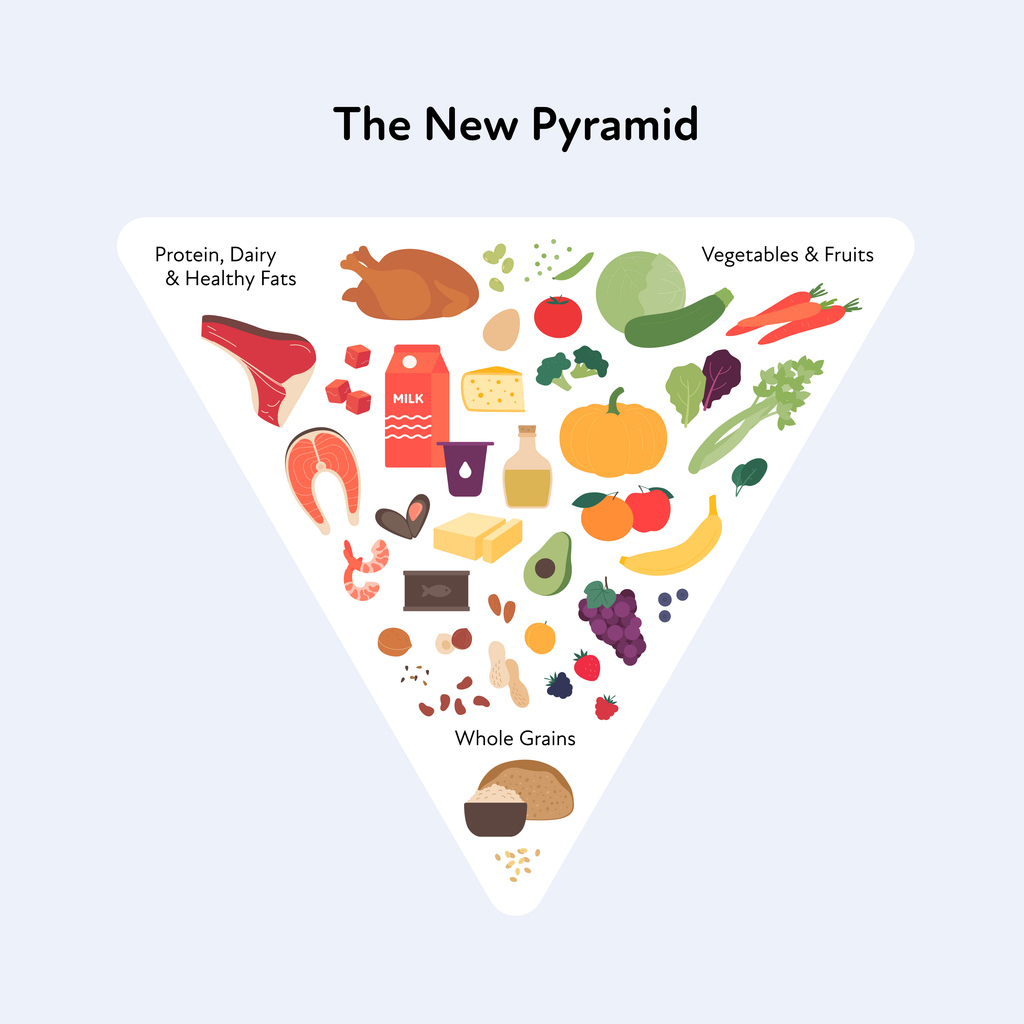
“We are ending the war on protein.”
With those words, U.S Secretary for Health and Human Services Robert F. Kennedy Jr. and U.S. Department of Agriculture Secretary Brooke Rollins announced dramatic changes to what was formerly known as the Food Pyramid, also known as the Dietary Guidelines for Americans 2025-2030, earlier this year.
“For decades, we’ve been fed a corrupt food pyramid that has had a myopic focus on demonizing natural, healthy saturated fats, telling you not to eat eggs and steak and ignoring a giant blind spot — refined carbohydrates, added sugars and ultra-processed food,” said U.S. Food and Drug Administration Commissioner Dr. Marty Makary at the January 8 briefing announcing the new government guidance.

Carbohydrates, fats, and proteins make up what scientists call macronutrients. Carbohydrates are the first-line energy for your muscles and the central nervous system during movement and exercise. Fats serve as an energy reserve, help insulate and protect your organs, and are needed to absorb what are called fat-soluble vitamins, like vitamins D and K. Less than 10% of total daily calories should come from saturated fats –– fats that are generally solid at room temperature.
The American Heart Association says saturated fats — most often found in beef, pork, poultry, full-fat dairy products, eggs, and tropical oils like coconut and palm — can cause problems with your cholesterol levels, specifically your low-density lipoprotein (LDL). All of this may increase your risk of heart disease. It’s worth noting that nuts, nut butters, soybean, and olive oils, and even hemp, also contain saturated fat.
Protein provides structure to tissues like cell membranes, organs, muscle, hair, skin, nails, bones, tendons, and ligaments, along with maintaining some of your metabolic functions. At the January briefing, Commissioner Makary alleged Americans were significantly deficient in protein.
“The old guidelines had such a low protein recommendation that we are increasing that by 50% to 100% — kids need protein,” Makary said. “The old protein guidelines were to prevent starvation and withering away. These new protein guidelines are designed for American kids to thrive, and they’re based on science, not on dogma.”
But that’s not reality. Most reputable nutrition professionals agree that most Americans consume more protein than we need, albeit not necessarily in the form of lean meats and legumes. It is true that the first Food Pyramid (1992) was definitely heavier on the carbs –– the then-guidance called for up to 11 servings of grains. The 2025-2030 visual guidance turns this relic upside down, but in reality, most people who spend any time talking about health or nutrition in recent years used the USDA’s updated My Plate model, which was an easier-to-communicate visual, focusing on portion size in relation to a dinner plate, with more emphasis on lean protein, veggies, and fruits than bread. Fifty percent of any My Plate meal was meant to be fruit and vegetables.
I’m a nurse who’s spent the bulk of my career talking about how to reduce what the feds are now calling ultra-processed food. I’ve also spent the last decade covering the Blue Zones movement for the Weekly. I’ve worked with families who don’t know where their next meal is coming from, people who have way too much access to food, and critically ill people whose medical conditions are adversely affected by the consumption of too much protein, fat, or sugar.
But even nurses need the advice of an actual Dietitian. Samantha Davis has been a licensed and Registered Dietitian Nutritionist (RDN) since 1991. Davis is currently Professor of Professional Practice in Texas Christian University’s Department of Nutritional Sciences, part of the Davis College of Science & Engineering. Previously she was a licensed Dietitian for Meals on Wheels of Tarrant County, a clinical Registered Dietitian at Harris Downtown Fort Worth, and the assistant chief clinical Dietitian at Montefiore Medical Center at the Albert Einstein College of Medicine in the Bronx. Davis teaches nutrition, medical nutrition therapy, and nutrition counseling, encompassing a complex combination of chemistry and physiology, at TCU.
RDNs complete a master’s degree in nutrition or dietetics and a supervised internship and pass a national exam. Unlike Karen from the Healthy Mom’s Raw Milk Fan Club, RDNs are required to maintain continuing education to remain registered and licensed, and they’re health-care professionals who can provide medical nutrition therapy, so when you have questions, they may have the best evidence-based answers.
Davis agrees that the information in the new Food Pyramid is confusing to anyone who doesn’t have a background in nutrition science. She concurs that we should take aim at ultra-processed food, including sugary beverages and high-calorie, nutrition-sparse snacks. And that means watching the hidden sugars or salt content especially in easy-to-grab prepackaged snacks.
“Nobody disagrees about reducing the processed foods and sugar,” Davis said. “We’re all for whole foods, but on a consistent basis, if one takes in more calories than their body burns, this can lead to health consequences down the line.”
Part of the confusion here is that any suggestions regarding the number of calories needed in a day are highly individualized. This is where an RDN can help a person based on their medical condition and activity (or lack thereof).
The new USDA guidelines emphasize 1.2-1.6 grams of protein per kilo for adults, almost doubling the previous guidance on protein. If you learned the metric system in grade school but have never used it since, a kilo is 2.2 pounds. A 150-pound person is approximately 68 kilos and, by this guidance, would need around 109 daily grams of protein. A 200-pound person would need 145 grams of protein daily.
The new guidance on protein consumption has increased from the previously recommended 0.8 grams per kilo, although Davis says that most Americans were getting much more protein in their diets than that. “Protein deficiency is not an issue in this country.”
The previous recommendation for protein works out to about 54 grams of protein a day. That’s the normal recommendation for a sedentary adult, based on a study by Harvard University. Older adults at risk for muscle breakdown that may come with aging need as much as 1.2 grams of protein per kilo, and if you exercise moderately, your protein need may go up about 100 grams of daily protein for that 150-pound adult. One size definitely doesn’t fit all.
“There is no one guidance,” Davis said. “It’s not down to so many grams of each nutrient but a general percentage that is calculated on an individual’s needs.”
This is why working with a RDN would help –– they can do the math quicker than you or I could.
Unfortunately, foods high in protein may also contain saturated fat, especially if you’re reaching for large amounts of animal sources in your diet, and the American Heart Association (AHA) continually urges Americans to limit saturated fat. That advice hasn’t changed. So, the math isn’t really math-ing, Davis says.
“When a person consumes a diet high in animal protein and the recommended number of servings from animal sources, then for a 2,000-kcal diet, the saturated fat content would be 20% of your intake,” Davis said.
In addition to being one of the most overconsumed nutrients by Americans, protein has a rep as a muscle builder. Davis debunks that. “The only thing that makes muscle is exercise.”
Protein, she goes on, is “important to maintain and repair muscle tissue and has a multitude of other functions. Protein is not the major fuel source for exercise, and neither does a bunch of protein land on your arm to make a bicep. Exercise does that, and protein supports it.”
I questioned the idea of including beef tallow — which is essentially rendered, saturated beef fat, similar to lard — in the new Food Pyramid.
“Tallow does have some stearic acid that has been researched as being neutral in terms of saturated fat,” Davis said, but tallow also has more palmitic than stearic acid, which does increase LDL.
“When you hear someone say, ‘I grew up on the farm, and I drank raw milk, and we used lard, and that’s how we should eat,’ they are talking about farmhands cleaning out stalls, bringing in crops, being active all day,” Davis said. “If you want to eat like that, you have to move like that.”
The best practice would be to match your diet with your activity level, Davis said.
There’s the science of individual body chemistry. The National Institutes of Health says that about one in seven Americans have chronic kidney disease (CKD). People with Type 2 diabetes and those with uncontrolled high blood pressure are at higher risk, and CKD is often silent. Per the National Kidney Foundation, if you have CKD and consume the amount of protein in the new dietary recommendations, your kidneys may not be able to clear all the waste and byproducts of protein breakdown. If your kidneys are already under stress, you might experience nausea, loss of appetite, weakness, or ultimately kidney failure.
The U.S. Centers for Disease Control and Prevention cites heart disease as the leading cause of death in America for both men and women –– about one in every three people who die in the U.S. die from cardiovascular disease. The AHA lauds the dietary guidelines for focusing on the reduction in added sugars and ultra-processed foods, but cardiologists call the emphasis on red meat and whole milk (both containing saturated fat) “upside-down thinking,” said the AHA’s companion release shortly after the release of the new dietary guidelines for Americans.
“Promoting saturated fat and increasing the amount of protein goes against all nutrition and cardiology science,” said Dr. Kim Williams, a cardiologist and chair of the department of medicine at the University of Louisville.
The AHA started a campaign in 1961 to encourage Americans to limit saturated fat, like lard and tallow.
“We’ve been researching this for decades,” Williams said, “and we definitively know saturated fat — such as butter fat, beef tallow, red and processed meat — are all closely associated with more deaths from cardiovascular disease.”
All types of fat can play a role in a healthy diet, said preventive cardiologist Dr. Andrew Freeman, director of cardiovascular prevention and wellness at National Jewish Health in Denver, “but the emphasis is on polyunsaturated and monounsaturated fats. That’s what the Mediterranean diet and other plant-predominant diets have shown.”
RDN Davis still believes there is merit to the Mediterranean Blue Zones-style of food consumption, where plants and grains make up more of the plate and proteins are more fish and plant-based.
“Where the [new Food Pyramid] guidelines are confusing is, it looks like they’re promoting more of the meat as opposed to promoting fish and plant sources of protein,” Davis said.
In places where the Blue Zones-type diets are popular, the populations live longer and healthier.
“It’s not just the food,” she said. “It’s connection and movement and exercise.”
Figuring out your dietary needs is going to require a visit with a health-care provider. Getting a consult to an RDN may be as easy as going to the website EatRight.org and following the steps to find an RDN in your ZIP code. Anyone seriously considering changing the way they eat ought to know some basic lab numbers, including your A1C (the marker of blood sugar stability over three months, not just 24 hours), kidney and liver functions, your blood pressure, and your total fasting cholesterol. Because one (serving) size definitely doesn’t fit all in the “war” to make America healthy.