


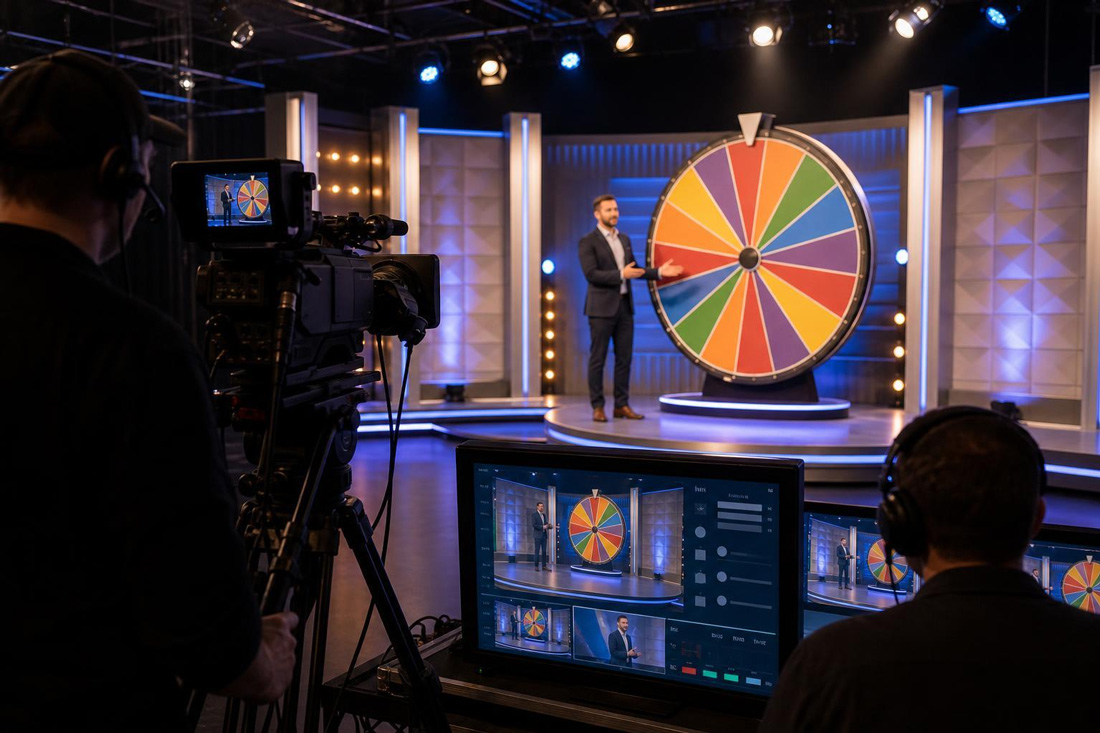
The wheel slows beneath a flapper. A camera moves in for the result, lights flash, and the presenter talks the audience through what happens next. Anyone who grew up watching game shows knows the rhythm.
That sequence now plays out on phones and computers, with buttons and text chat alongside the picture. Some streams let adults wager on the action. Others gather viewers around old television episodes, with a creator hosting the conversation. Both give familiar game-show scenery another job.
The Familiar Stage Moves Online

An online television adaptation launched in May 2019 kept the numbered briefcases, banker’s offers, theme music and presenter-led reveals. Its live portion used 16 briefcases and three offers, while software handled qualifying rounds and prize adjustments.
Those details carry much of the format’s identity. The briefcases give the camera something to reveal; the presenter guides participants through each decision.
Ontario’s provincial lottery corporation lists live game-show productions in a dedicated catalogue. The format also appears in live casino ontario offerings, where studio footage runs alongside betting controls.
For participants, the screen brings the show and the means of taking part into one place. For producers, that requires coordination between the studio action and the software surrounding it.
Wheels, Close-Ups and Computer-Created Worlds
The mechanics can be physical. A wheel production introduced in February 2017 used a custom-built vertical wheel with 54 equal segments. Pins separated the outcomes, and a flapper marked the result. Multiple HD cameras provided changing angles and close-ups, with lighting and sound synchronized to the action.
A wheel spin supplies a sequence for the cameras: movement, a slowing pace and the final stop. Close-ups let remote viewers follow those details.
Later productions added animated settings and software-generated multipliers. Some connected physical wheels to three-dimensional bonus sequences. A fishing-themed production that reached the United States in November 2026 uses a virtual wheel with 53 segments.
The presenter connects these different parts, explaining the action as the screen moves between a studio view and computer-created scenes.
A Conversation Beside the Controls
Participation happens through the interface. Players make game decisions and place wagers while watching the video, with account information available on screen. Text chat gives them a way to address the host and other participants.
The host can read those messages and answer aloud. Participants contribute through text, so the conversation has its own pace: a written comment reaches the studio, and the presenter’s reply becomes part of the broadcast.
That exchange gives the host another task alongside conducting rounds and explaining results. The audience can speak into the show through a channel the presenter follows.
Real-money participation carries financial risk. Adults who choose to gamble should set spending and time limits, keep gambling within an entertainment budget and take breaks. Ontario’s official guidance describes tools for setting limits and voluntarily excluding oneself from gambling.
Old Episodes, New Company
A different kind of exchange takes place around archive television. Fremantle’s partnership with Gaggl brings licensed episodes into creator-hosted streams, where viewers can follow the program and join a live conversation.
A 2024 campaign scheduled 15 two-hour Twitch streams from May 30 through June 5. Several creators took part in the announced lineup, including BBJess, who was scheduled to stream from DreamHack Dallas.
The North Texas connection makes the arrangement easy to picture: a creator hosts an online gathering around television footage, with viewers responding as the episode unfolds.
The original contestants remain on the recorded stage. The creator and online audience add their reactions around them, giving an old reveal a fresh group of people to watch it together.
What Happens Behind the Picture
These forms of participation operate under different conditions. The Texas State Law Library explains that gambling is generally illegal in Texas, with specified exceptions including the lottery and charitable bingo. Ontario’s regulated online market requires participants to be at least 19 and physically in the province when wagering. Operators there work within that framework. ToonieBet, launched in 2024 under Canadix Limited with AGCO registration OPIG1280338 and an iGaming Ontario agreement, lists live game-show and live-dealer formats among more than 3,000 casino titles.
Regulated live-game studios also have responsibilities beyond keeping a show moving. Ontario’s Registrar’s Standards for Internet Gaming cover surveillance of live-dealer games, controlled access to gaming supplies and records capable of supporting an audit. Elsewhere, Michigan’s framework sets a general retention requirement of at least 90 days, with provisions covering investigations.
The framework also calls for equivalent-quality audio and video feeds and controls that prevent access to a result before a wager is finalized.
Behind each reveal sits that less visible work: recording the action, managing decisions and keeping the broadcast aligned with the game. The wheel and presenter still draw the eye. The systems around them give the audience a place in what happens next.