

“Praise be” was the text message I received from my former TCU roommate while preparing after-church lunch for my family on Sunday. I knew with no context other than those two words combined with the sender what that meant. I turned immediately to my wife, a TCU alumnus as well, and said, “Wow, Dykes is out!”
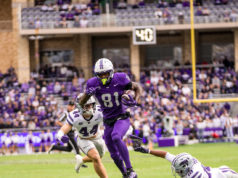
Saturday night in many ways was a microcosm of Sonny Dykes’ tenure as head coach of the Horned Frogs. The second-ranked Utes visited for a night game that started even later thanks to a lightning delay. Backup quarterback Adam Schobel (#11) was in for the injured Jaden Craig (#1), and immediately the Frogs went, unsuccessfully, to the air. The continually dominant TCU defense kept the ship from capsizing after an interception and punt return gave Utah back-to-back short fields and 10 points. The purple offense did almost nothing the entire first half, and eventually TCU retreated to the locker room down 17-0 in a game that felt as though it might already be finished.
The second half proved the Frogs had plenty of fight left, as TCU stormed back with a rushing attack absent almost the entire season to tie the game at 17 and were close to taking the lead if not for a ticky-tacky penalty against the linemen and a blundered catch during a throw-back pass for a would-have-been touchdown. Sadly, for fans and Dykes alike, Utah did what they’ve done all season and showed that while they may not be the most talented team, they know how to win in the fourth quarter. The U proceeded to pile on 21 points in the final half of the fourth quarter. TCU did what they’ve done all season, which is fail to perform at the end of games. That was Dykes’ tenure: hope, frustration, and surprises.
No one can ever take away Sonny’s first season in Fort Worth, a cardiac event of mostly close victories — similar to what Utah is experiencing this season — that was followed by the only playoff win for TCU since the college football format changed, immediately followed by the most humiliating national championship loss on record, but he was there. Critics will cling to the fact that the team was mostly left behind after Patterson’s departure, which is somewhat true but also irrelevant. Dykes was the coach, the players found ways to win with his leadership, and the penultimate position in the country is something most programs would write a blank check for no matter how or what deity they needed to bow in front of to get there.
By the numbers, Dykes’ hiring was and should be considered a success. His 41-23 overall record is not hall-of-fame worthy, but it’s proficient to say the least. The 26-19 conference record speaks to a team that is more average but far from losers. TCU will reportedly pay Dykes more than $20 million to cut the coach loose and satisfy his multiyear extension negotiated back in April.
The most valid knock against Dykes is that he is not a great evaluator of talent but was supposed to be. Dykes has had several stops as a head coach, gaining a reputation as a “quarterback whisperer” of sorts, but fans in Funkytown have never experienced that.
Football is different from many sports, especially as it pertains to data and evaluation. The gridiron is so multifaceted, and combinations of factors can really muddy the perception of what is happening on the field. Baseball, basketball, hockey, soccer, tennis — these sports give coaches and analytics nerds so many more opportunities to crunch numbers and evaluate talent during real full-speed competition. College football doesn’t allow for exhibitions or scrimmages, and you play a maximum of 15 games a year, and that is only recently. Head coaches and coordinators must be able to pick and find players who will be able to perform without actually seeing them in full-speed competition, and Dykes proved himself poor in that regard, especially when it came to quarterbacks and coordinators alike.
Famously, Max Duggan was not the slated starter during TCU’s magical run during Season 1. Chandler Morris’ injury forced Dykes to call on the experienced ginger to put the offense on his back and plow them toward a title appearance during a Heisman campaign. Dykes also made the unpopular decision of hiring Kendal Briles after Garrett Riley left for Clemson, got fired, then moved onto Missouri. Briles, as my dedicated readers know, was huge on the stats and not so much on the wins, and so went the second quarterback during Dykes’ tenure, Josh Hoover. Hoover’s stats attracted significant attention as a sought-after transfer, and the University of Indiana was willing to pay him to replace their Heisman winner, who departed for the NFL. Indiana should make the playoff again this year, but Hoover has been benched more than once, and his performances have been uneven. Briles left TCU for South Carolina last year, and the Gamecocks are 6-5 and in the bottom half of the SEC standings.
Then came Craig, who was supposed to be an elder statesman, NFL prospect, and the best quarterback to ever come out of Harvard. Pair him with Gordon Sammis from UConn, and TCU’s offense — which had been productive albeit frenetic — was supposed to be a perfect complement to an improving Andy Avalos defense. Sadly for Dykes and Sammis, what resulted was the worst scoring offense wearing a Texas Horned Lizard on their helmet in 30 years. It’s a pretty big whiff in an era that demands you bring in game-ready players without delay.
Perhaps even worse was Schobel, or at least that he hadn’t played until now. Schobel has seen a few plays this season, but his confidence starting against a very competent Utah team was a reminder that Dykes does not evaluate talent well. Yes, he threw two interceptions and completed slightly fewer than half his passes. Still, he looked in command despite the offensive game plan not setting him up for success. Using Schobel’s athletic ability to run the ball, along with a seemingly healthy Jeremy Payne (#26), delivered the Frogs back into a seemingly lost game. It was when the offense reverted to the first half’s zero-production strategy that the game fell apart, again. It was obvious by Week 5 that Craig’s rostering was a miss, and being that he has no more eligible seasons to play, there was no reason to continue down that jagged road. Schobel could be as good or better than Craig in five conference games, but the fact that he wasn’t starting until Dykes’ hand was forced by injury reeks of Colorado in 2022.
Schobel is also part of one of TCU football’s most dynastic families. He has a cousin on the team, and three other Frog family are lettermen, all of whom played in the NFL. In an era where you’re likely to lose a talented player in the transfer portal for more money every season, Schobel is a safe exception and is an opportunity to develop an elite player over time that shouldn’t be squandered but was in the process.
That leaves TCU in flux during a short week as they prepare to travel to Lubbock to play the Red Raiders on the evening of Thanksgiving Day. Avalos has been handed the keys as interim head coach — a position he held at Boise State for three seasons before coming to Fort Worth — and is a serious candidate to replace Dykes. The Red Raiders have plenty on the line during this game. The Frogs are fighting for bowl eligibility against a ninth-ranked team that clinches a spot against Utah in Arlington for the Big 12 conference championship with a win. Tech just beat Baylor 20-10 in Waco, so I wouldn’t call them unbeatable, but TCU’s struggles against midrange and deep passes — as well as their lack of offense in general — don’t bode well for their chances. Yet sometimes the energy of a program in transition combined with the general volatility of the sport can make for entertaining upsets. If the Frogs beat TTU in Lubbock, and BYU beats Cincinnati, the Big 12 championship would be a Holy War rematch between Utah and the Cougars.
As for Dykes’ replacement, Avalos is a legitimate contender as someone with head coaching experience who has done a superior job building a defense that had been one of the worst in the country to statistically the best in the conference this season. Avalos’ record with Boise was good enough, but TCU is a different animal, with more money, and I think the young and hard-nosed coach should be seriously considered to fill the role and rebuild a team culture more familiar to millennial Frogs.
Obvious outside candidates are UTSA’s Jeff Traylor, who is the hottest non-Power Four commodity in the country and a leading candidate for the open Baylor position already. GJ Kinne from Texas State has in-state recruiting connections and has built the Bobcats into a competitive PAC-12 squad but is not a splashy hire. Lincoln Riley’s name will be thrown around, but, honestly, I don’t know why he’d leave USC for a school with less national cache, though the Big 12 is an objectively easier conference and path to the playoff. Manny Diaz at Duke is also considered the next prospect for a bigger job but has a fat contract and already passed on an offer from Florida State.
Fans should know more in the coming weeks as Athletic Director Mike Buddie should be eager to solidify a replacement as the general transfer window opens shortly after the new year and as the new coach will be tasked with trying to retain difference makers as well as bring in new players to shore up the obvious struggles on offense.
In the meantime, give thanks to Dykes for taking the impossible task of replacing a Hall of Fame coach in Gary Patterson while leading TCU during what was the most exciting and productive seasons for the Frog faithful in the modern era, even if follow-up campaigns fell short of what were inevitably impossible expectations.