


Hidden fees are usually easy to miss. They can show up as a $3 withdrawal charge on a $15 cashout, a 3% currency conversion markup hidden in the exchange rate, or an inactivity clause that drains a forgotten balance at $10 per month. Even when casinos disclose these costs, they are not always shown clearly at the moment players make a payment. As a result, players who focus only on bonuses and game selection often pay more than they expect because the relevant terms are buried in sections most people barely read. Wagering requirements, payment restrictions, and dormant account policies often sit in different parts of the site. The harder they are to notice, the easier it is to lose money to them. This guide explains where common casino fees usually appear, which payment methods tend to cost less, and what to check before depositing so you keep more of your winnings.
The Most Common Hidden Fees in Online Casinos
Deposit Fees
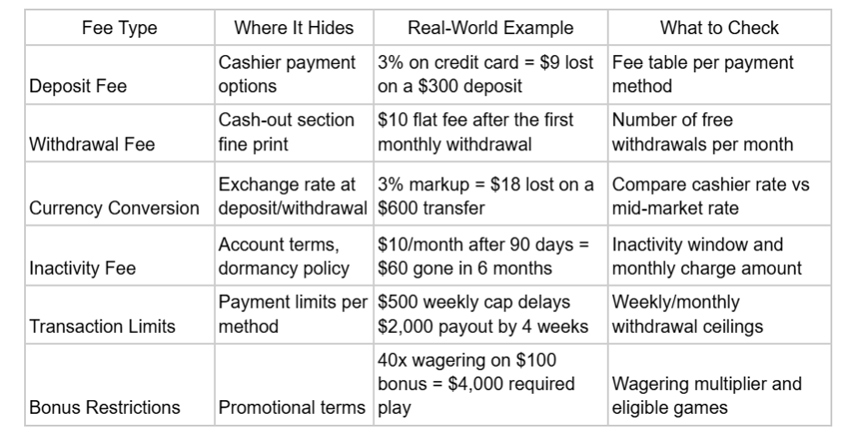
Many players assume depositing money into a casino account is free. Often it is, but that depends on the payment method you choose. Credit cards and some e-wallets may come with processing fees, sometimes around 1.5% to 4% per transaction, charged by the casino, the payment provider, or both. On a $300 deposit with a 3% fee, $9 disappears before you place a single bet. Some casinos display this charge at the cashier. Others apply it less clearly, leaving players to notice the difference only after the deposit is completed. A safer approach is to check the payment method fee table in the cashier section before confirming any deposit, not after.

Withdrawal Fees
Cashout charges are where most players first notice that something is off. A common setup is one free withdrawal per calendar month, with every extra request carrying a flat $5 to $15 charge. Some casinos apply a percentage-based fee, often around 1–2%, regardless of how often you withdraw. Minimum withdrawal thresholds create another problem: if a casino requires at least $50 per cashout and your balance is $30, you cannot withdraw until you raise the balance or deposit again. That minimum effectively traps small balances inside the account.
Currency Conversion Fees
A casino that accepts multiple currencies does not necessarily offer fair exchange rates on all of them. Most platforms apply a proprietary markup of 1–4% over the mid-market rate, and this difference never appears as a labeled fee. A player depositing €200 into a USD-based casino account might receive $208 instead of $214 based on the real market rate. A $6 difference may seem minor, but across ten transactions it becomes $60 in invisible costs. The easiest way to check this is to compare the cashier rate with a live rate from Google Currency Converter before confirming the transaction.
Inactivity Fees
Dormant account charges are among the least-discussed fees in online gambling because they only affect players who have already stopped paying attention. Most casinos begin applying monthly maintenance deductions after 90 days without a login, though some start as early as 30 days. The charge typically runs between $5 and $20 per month and continues until either the player returns or the balance hits zero. A $60 balance sitting untouched for six months at $10/month is gone entirely, with no notification required in many jurisdictions. If you create an account to test a casino and do not plan to return regularly, withdraw your remaining balance and close the account before the inactivity window opens.
Transaction Limits and Bonus Restrictions
Transaction limits create indirect costs by controlling when and how much money you can withdraw. Weekly withdrawal caps of $500 to $1,000 are common, meaning a player with $2,000 in winnings may need four weeks to fully access their own money, with potential fees on each separate request. Bonus restrictions can make this worse. Some promotions block withdrawals until wagering requirements are fully met, which can take dozens of sessions depending on the multiplier and the games you play.
How to Read Casino Bonus Terms Without Missing the Catch
Bonus terms follow a consistent pattern across most online casinos, which makes them easier to decode once you know what to look for. The problem is that the most important numbers are often buried in dense paragraphs that many players scroll past before clicking “claim.” The wagering requirement is the single most important figure in any bonus offer. It tells you how many times you must bet the bonus amount before you can withdraw any winnings from it. A $100 bonus with a 35x requirement means $3,500 in total wagers before you see a cent.
What makes this harder than it sounds is that games contribute differently toward that total: slots typically count as 100%, blackjack as 10%, and roulette as 5%. Before accepting any offer, check the game contribution table, not just the headline multiplier.
Many casinos also impose a separate cap on winnings derived from bonus funds, commonly 3x to 5x the original bonus amount. A player who turns a $50 bonus into $600 may find that only $150 can be withdrawn once the cap applies, while the remaining $450 is voided at cashout. Some deposit methods create another problem. Skrill, Neteller, and Trustly are excluded from bonus eligibility on some platforms, and this restriction may not appear clearly at the point of deposit. You fund your account, the bonus does not appear, and only a support chat reveals the exclusion buried deep in the terms.
One of the easiest ways to understand typical bonus conditions is to compare several offers on one page before choosing a platform. Comparing all Spin City promo codes on one page, for example, makes it easier to spot differences in wagering multipliers, withdrawal caps, and payment restrictions. Once you see these details side by side, strict or unusual terms become easier to spot without reading every offer from scratch.
Which Payment Methods Usually Have Lower Fees
The payment method you choose at an online casino directly affects both your costs and the speed at which you can access your funds. The differences between methods are significant enough that selecting the wrong one can cost more than a modest bonus is worth. E-wallets such as PayPal, Neteller, and Skrill typically offer the lowest combined fees for casino transactions. Many casinos process e-wallet withdrawals within 24 hours, and internal transfer fees are usually lower than those applied to card transactions. However, moving casino winnings from an e-wallet back to a bank account may involve extra fees, so the final cost depends on what you do after the withdrawal.
Visa and Mastercard withdrawals remain popular, but they often come with higher processing fees on the casino side. Withdrawal times can also stretch from three to seven business days, depending on the issuing bank. Some banks also apply their own cash advance or gambling-related transaction fees, which are entirely outside the casino’s control and rarely disclosed in advance. Cryptocurrency transactions are popular with some players who want faster transfers and fewer currency-conversion issues. Bitcoin, Ethereum, and stablecoins like USDC allow almost instant transfers with fees determined by network conditions rather than casino policy. For international players, crypto may reduce casino-side currency conversion markups, although exchange fees can still apply. The downside is price volatility for non-stablecoin assets and the technical knowledge required to manage a wallet correctly.
Prepaid cards and vouchers such as Paysafecard usually work for deposits but often cannot be used for withdrawals. That forces players to choose a second cashout method, which can add another layer of fees.
Warning Signs That a Casino May Have Unfair Charges
Not every casino that charges fees does so transparently. Some platforms spread fee information across multiple pages, making it harder for players to notice costs before money has already moved. These are the patterns worth identifying before you register, not after your first withdrawal request.
Vague terms and conditions are one of the clearest early warning signs. A properly licensed casino has no regulatory reason to omit specific fee amounts from its payment terms. Language like “fees may apply” or “charges vary by method” without clear figures should make you cautious. Platforms operating under stronger regulators, such as the MGA or UKGC, are generally expected to present payment terms clearly. If the wording is vague, it is worth checking the license details before depositing.
Withdrawal delays on verified accounts can be a warning sign, especially when the casino gives no clear reason. Once KYC is complete, verified accounts should usually stay within the stated processing window. Repeated delays, especially when paired with requests for documents already submitted, are a serious red flag. This pattern is more common on platforms with weak oversight.
Inconsistent fee information across pages is easy to test before depositing. If the FAQ states one withdrawal fee, the Terms and Conditions list a different figure, and live chat support gives a third answer, the platform either cannot maintain its own policies or is not trying to. That inconsistency makes formal dispute resolution nearly impossible because there is no single authoritative source to reference.
Missing or unverifiable licensing details are another major warning sign because they leave players with little outside protection. Casinos licensed by the MGA, UKGC, or Gibraltar Regulatory Authority are subject to audits and mandatory player dispute channels. If a casino lists a license number that does not appear in the regulator’s public register, treat that as a serious warning sign. The same applies to licenses from jurisdictions with no clear public complaint process.
Bonus terms that contradict each other across pages signal the same underlying problem as inconsistent fee policies. If the promotional banner advertises a 20x wagering requirement but the full terms state 40x, the higher figure is the one that will be enforced at the point of withdrawal, and the discrepancy will not be resolved in your favor.