


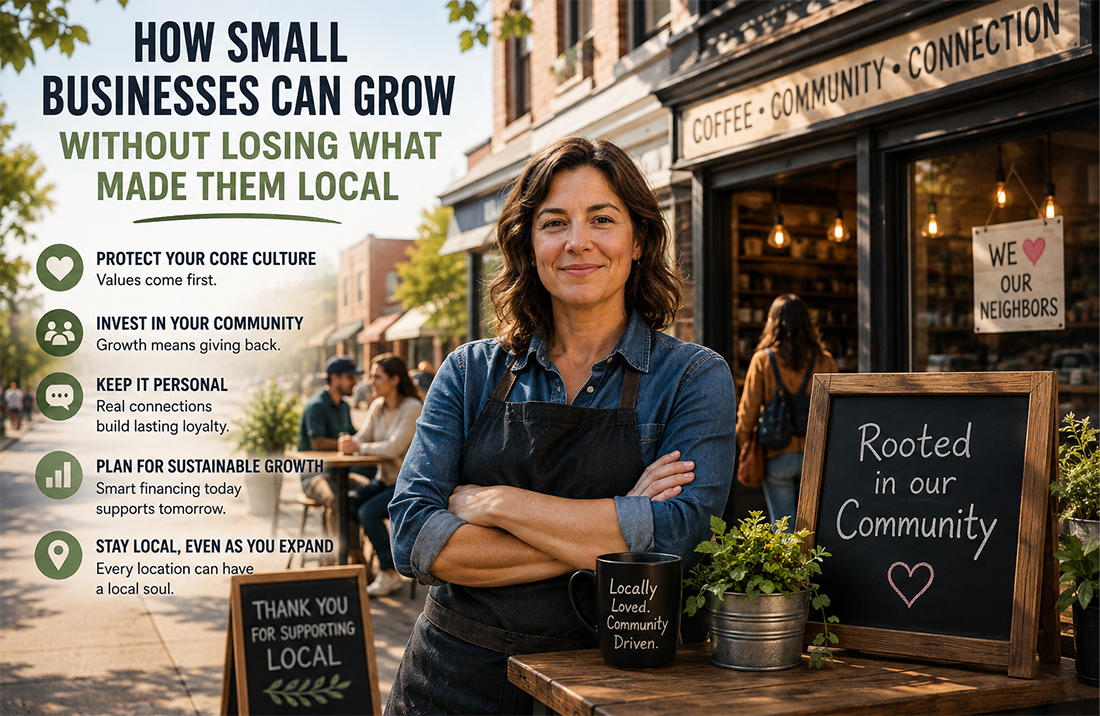
There is a distinct magic to a neighborhood business. It’s in the quiet hum of the espresso machine early in the morning, the sound of the door chime ringing when a regular walks through, and the owner knowing customer orders by heart. Honestly, it is that quiet understanding that this place belongs to the community just as much as the community belongs to it. Local businesses build neighborhoods. They give streets their personality and create spaces where people feel truly connected.
Growth, however, is a natural part of running a business. At some point, every successful local owner faces a critical decision point. Demand increases, operations expand, and the desire to reach more customers becomes real. I guess, at least in my experience, expansion always brings a subtle fear. Many owners worry that scaling up means watering down the very soul of what made them special in the first place.
How do you grow bigger without getting colder?

Growing your business doesn’t have to mean selling out or losing your core identity. It’s entirely possible to expand your footprint while keeping your roots firmly planted in the community that built you. You know, it takes intention. Real, deliberate intention.
The Challenge of Scaling Local Charm
Why do so many businesses lose their local feel when they grow? Usually, it comes down to standardizing too quickly. When companies expand, the immediate impulse is often to turn every process into a rigid template. Efficiency becomes the top priority, and personal touch points get trimmed away to save time or reduce costs.
When efficiency completely replaces connection, customers notice immediately. The friendly conversation at the counter turns into a transactional script. The unique local offerings are replaced by uniform inventory. The business begins to feel less like a neighborhood pillar and more like an interchangeable chain.
And that changes everything.
To scale successfully, you’ve got to separate your core values from your daily operations. Your operations should become more efficient, but your values need to remain completely unchanged. You can update the tools without changing the heart behind them. I really believe that.
Protecting Your Core Culture
Before taking any steps toward expansion, take a clear inventory of what makes your business feel personal. Ask yourself what your customers love most about their experience with you. Is it your deep involvement in local events? Is it your hands-on customer service? Or maybe it is your commitment to sourcing materials locally?
Once you identify these non-negotiables, build your expansion strategy around protecting them.
1. Hire for Values First
When you start adding staff or opening new locations, your team members become the guardians of your culture. You can teach a new employee how to use your point-of-sale system, but you can’t easily teach them to care about your community. So, look for people who naturally share your appreciation for personal connection and service. Give them the freedom to make customers feel valued without locking them into rigid scripts.
2. Double Down on Community Relationships
Growing beyond your original walls doesn’t mean leaving your neighborhood behind. In fact, scaling gives you more resources to invest back into local causes. Continue sponsoring the youth sports teams, partnering with neighboring shops, and hosting community gatherings. Show your original customer base that expansion means more capability to support the area, not less. And that’s the point, really.
3. Keep Communication Human
As customer volume increases, automated communication becomes necessary. Late-night emails, scheduling systems, and online order confirmations help keep operations running smoothly. But automation should support human connection, not replace it. Write your automated messages in the same warm tone you use in person. Ensure that a real person is always easily accessible when a customer has a genuine question or concern.
Managing the Logistics of Sustainable Growth
Expanding requires clear physical and financial planning. Growth almost always demands capital, whether you’re taking on a larger commercial lease, upgrading equipment, hiring key personnel, or increasing inventory.
Securing the right business financing is a critical piece of this puzzle. Having stable financial backing allows you to grow at a thoughtful, controlled pace rather than rushing the process out of pressure. Controlled growth gives you the breathing room needed to keep quality standards high and customer relationships strong across every new channel.
What does sustainable pacing actually look like for your business?
When planning your financial roadmap, make sure your expansion budget accounts for maintaining quality control. Rushing to scale without proper backing often leads to cutting corners.
That damages trust fast.
Preserving the Local Feel Across Multiple Locations
If your growth plan involves opening additional locations, avoid making every store a carbon copy of the original. While brand consistency matters for quality and recognition, allowing each location to reflect its immediate neighborhood keeps the local spirit alive.
Let local managers make decisions that fit their specific area. Source products from nearby vendors in each new city or neighborhood. Feature local art on the walls. When each location feels connected to its immediate surroundings, customers view the business as a genuine part of their community rather than an outside intruder.
Measure Success Beyond Revenue
Finally, rethink how you track the success of your growth strategy. Financial metrics like revenue, profit margins, and sales volume are vital for sustainability, but they don’t tell the whole story.
Track qualitative metrics as well. Pay attention to customer retention rates, local community feedback, and employee longevity. Are your long-time regulars still visiting? Are your staff members proud of where they work? Is your business still viewed as a positive local asset?
Growth should enhance your impact, not dilute it. By keeping your values clear, choosing smart financial pathways, and maintaining strong human connections, you can scale your business while keeping the heart and soul that made it special from day one.