

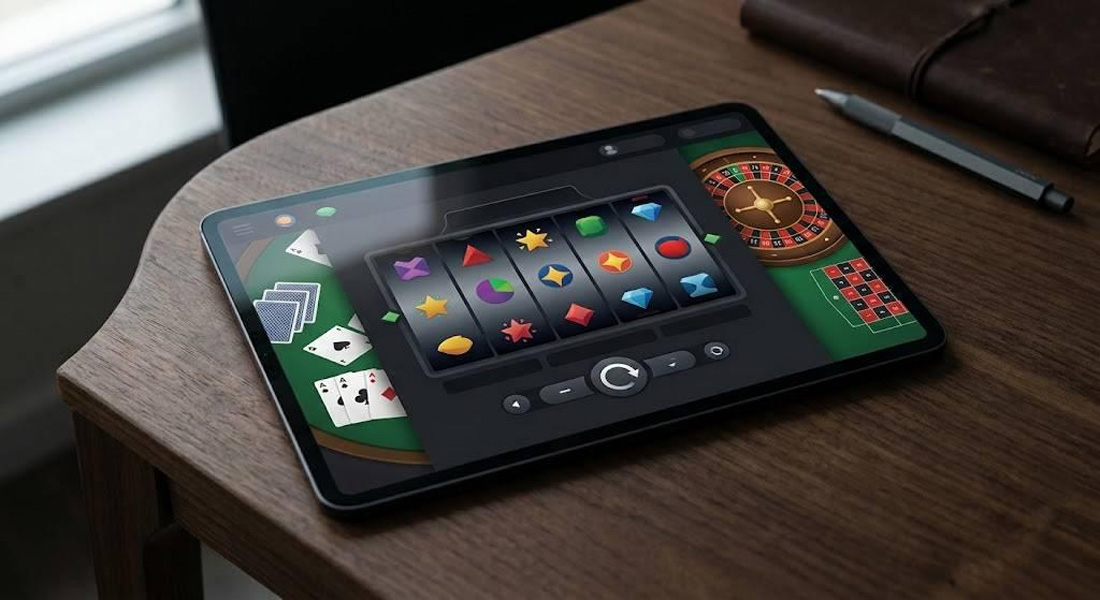
They share little beyond a screen, and in some cases cards. Each game has its own unique parameters, rules, and customs. Each game is visually, spatially, and kinematically separate from the rest. Similar to how a movie or television series is split into episodes, digital gambling has to find a way to make each game feel separate from the others. Sometimes a solution can be found in how the disparate elements of design, such as hierarchical ordering, spatial relationship, and movement, are considered with respect to the limits and constraints of each game.
With online gambling, game designers have to compress multiple games into a single narrow video frame. Digital designers have to find creative ways to fit a rectangular poker table and a roulette wheel, along with a plethora of flashing and blinking lights, within the confines of a video frame. The designers are certainly up to the challenge. Understanding the unique design constraints of online gaming provides insight into how ingenious and creative digital designers really are.
A game’s design extends beyond the confines of that game. Lobby design can and does transmit design signals as well. Betinia New Jersey uses these kinds of design signals in its lobby. Let’s take a look at some of those choices.

Rhythmic, gently animated design choices are embodied in their slots. A game of blackjack, on the other hand, is calm and collected as is evidenced by the blackjack lobby design choice. Roulette employs a cool blue-green palette that gives the tile a calmer visual tone. Players can figure out which game suits them best by observing lobby design.
Some of these choices are specifically implemented to communicate to the player what kind of game they are about to play. Kinetic slot design gives way to a structured and thoroughly considered wheel game. Lobby design is working to segment and group games based on their core mechanics to provide a proper and intuitive user experience.
Now that we understand the lobby, let’s analyze the design choices that distinguish the various game formats.
Designing Slots
While it’s somewhat reductive to think of a digital slot machine as just a rectangle within a rectangle, that fundamental truth is useful when discussing design. The outer edge of the design is the confines of the digital display, and the inner edge is where the designers of the game place the symbol grid. What goes in that frame is determined by design. The industry standard design of 5 vertical columns and 3 horizontal rows of symbols is the industry starting point. Designs that challenge that standard can range from a single column of three symbols to 7×7 or 8×8 configurations. Designs affect pace and overall mood of a given slot game.
Designers of slot games tend to use between 9 and 12 unique symbols in a given slot game. Card ranks (As, Ks, Qs, Js, 10s and 9s) are representative low-paying symbols. Designers tend to use themed illustrations for mid-paying and high-paying symbols. The only two symbols in slot games that deviate from the pay ladder are the Wild and the Scatter. The Wild substitutes for other symbols and is designed to stand apart from the standard pay symbols. The Scatter represents a game’s bonus feature and is designed to stand out so that its purpose is clear.
Motion is the best storyteller. Cascading Reels are also known as Tumbling Reels or Avalanche Reels, but mechanics vary little. A slight pause is added to give weight to the win, and to give the player time to decipher the win location. Chaos is avoided thanks to the pause. Each win is accompanied by sound effects, and the pauses help align the sound to the win animation. The accompaniment of sound and animation gives players a sense of pace.
Design a SLOT MACHINE UI in Photoshop – From Blank Canvas to Casino-Ready!
The Table That Fits in Your Hand
Card games share a common reference point, the table. Games like poker and blackjack all share a felt surface, which gives players a familiar way to read and interact with the game space. Because of these shared ideas of space, these games feel related, even if their rules are dissimilar.
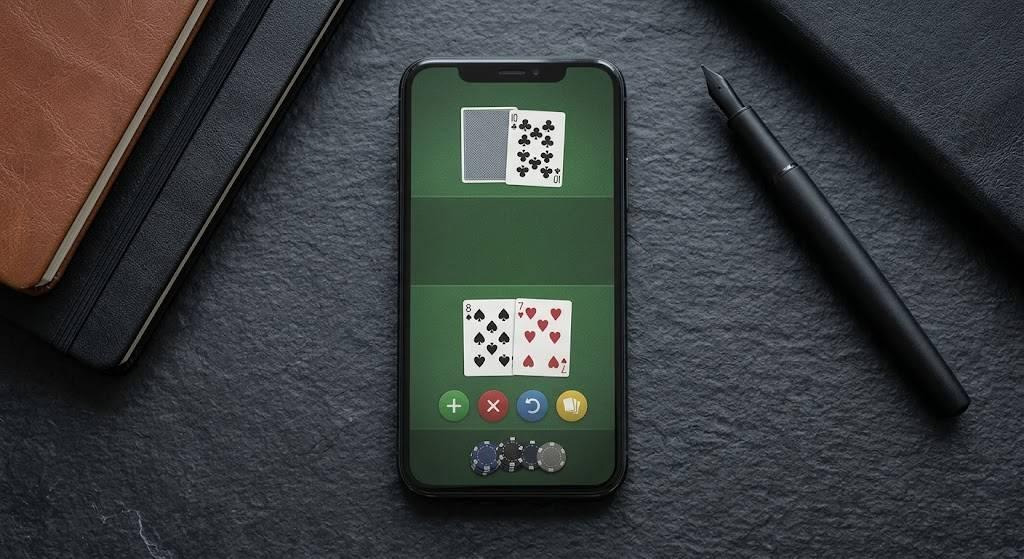
Blackjack uses the same structure as the actual table, splitting the screen in two. The portion of the screen dedicated to the dealer is located at the top, and the player area is at the bottom. As on the physical table, the felt between the two hands signals turn structure and separates what the house holds from what the player holds. The game gives the player options, like hitting or standing. Each of these is shown in relationship to the hand it acts upon.
Side bets and insurance are displayed next to the other controls and do not displace the primary controls.
Poker builds upon these ideas with a more aggressive branching of information. The center of the screen is reserved for information relevant to all players. The bottom is for each player’s information and controls. The space in between is for interaction. Like with Blackjack, the spatial relationships reflect the same things most players are familiar with.
Unlike blackjack and other games in which players play individual hands, in baccarat, players bet on which of two hands will win. The game also differs from blackjack in that players are not dealt a hand. Rather, two hands are dealt to positions on the table. Baccarat interfaces differ from blackjack and other table games by representing the two dealt hands in the same way, requiring players to decide which of the two hands they wish to bet on. In all game representations, the card is depicted the same way, and the surrounding layout is altered to reflect the potential choices for that game.
Roulette’s Unique Challenges
Roulette has similar design challenges to Blackjack, but it offers more complexity in spatial logic due to the inclusion of the wheel. The wheel interface presents a challenge in design due to the circular and continuous nature of the wheel. The betting surface is a labeled rectangular grid used for placing bets. The goal is to create a user interface that provides an accurate representation of the wheel in relation to the betting surface. The wheel must be large enough to be legible to the user, and the betting surface must provide an area large enough to accommodate numerous types of bets.
The standard solution gives you a split-screen, with the wheel in one section and the betting area in the other. The proportional size of the wheel is important, particularly on a mobile device. A wheel that is too small doesn’t convey a good sense of momentum. The betting area also needs to be a good size, as users need to be able to place chips in the area they wish to bet on precisely. Some mobile interfaces allow users to toggle between enlarged wheel and betting views by tapping them.
The racetrack and wheel bets offer a third way to navigate the betting area. The racetrack display shows bets in a more wheel-like arrangement and is usually presented in a curved, oval form. Selecting a region of the racetrack places chips in the associated wheel pockets. The racetrack is usually displayed close to the main betting area. Different logic systems (i.e. wheel logic vs. category logic) are at work in the same display and design, and various elements (i.e. bets) are displayed in a different fashion throughout the system.
There are a variety of reasons for the use of various fonts on the display. The most obvious is readability. However, for the betting system to work, users must be able to indicate their bets with precision. This means that the elements need to be large enough to touch accurately, with colors and design cues that correspond to the wheel.
Design Tools Used Throughout The Gambling Industry
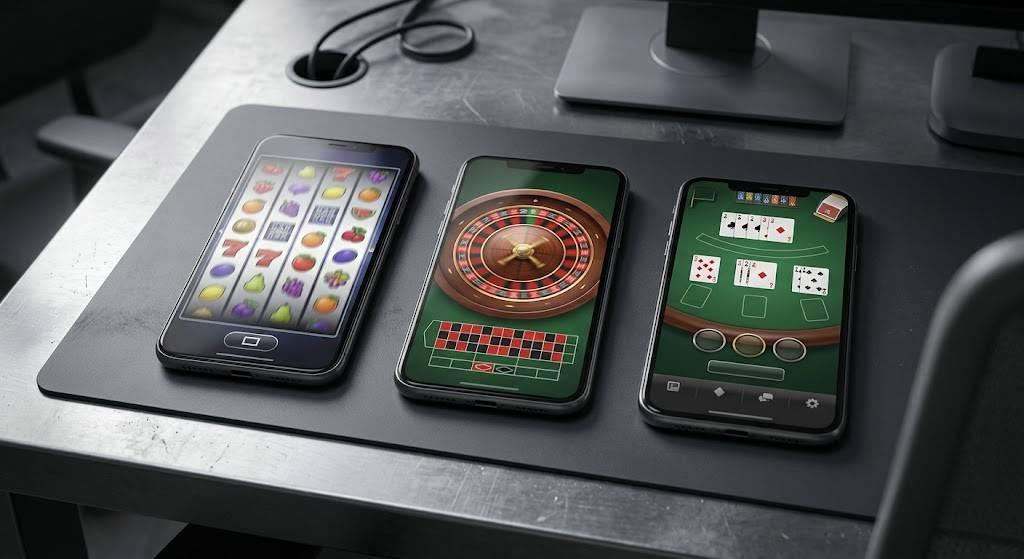
Three game formats, slots, card games and roulette, share the same set of game design tools. These are spacing, movement, hierarchy and control architecture. These design tools are used in different ways in different games, but are present in all formats.
Of all the design elements in a game, hierarchy is what ultimately defines what the game is about. Slots are all about spinning the reels. Therefore, the design element, hierarchy, determines what the user looks at first, which in this case is the reel grid. In blackjack, the game design hierarchy is determined by the two hands, and the action buttons. In roulette, the design hierarchy is determined by the wheel and the betting layout.
Spacing is another design element that is equally important. In blackjack, the distance between the dealer and the player defines the turn order in the game. In a slot, the space between the reels and the control panel is the delineation between the game’s spectacle and the player’s input. In a wheel game, the spacing between the numbers on the betting layout determines if a bet is placed on the correct number. Misalignment by a single pocket can result in an incorrect bet.
Movement is the most important way to differentiate a game. Slot games move constantly, with reels spinning, and symbols cascading. Other games move less, like Blackjack, which moves when cards are dealt or the player acts. Roulette moves during the spin, then holds still while bets are placed. Rules of a game can impact how a game moves, but even before rules are considered, different game formats already evoke various emotions because of how quickly or slowly a game moves.
How Different the Controls Can Be and How Important They Are
Controls are pretty modest in slots, where the player is generally only concerned with bet size and spin, though there are other options. Blackjack is pretty controls-heavy, with a branching decision tree concerning the next move. Roulette is pretty controls-heavy as well, as the player must first place bets, which requires spatial reasoning within a grid. Each of the games lends itself to unique control layouts, button sizes, and thumb-reach zones
.
Similar Constraints Allow Games to Differentiate Themselves
All games lend themselves to a unique style and symbolism within a strict rectangular play zone. If games were to break away from this rectangular constraint, designers could lean on the shape of the play zone to represent meaning. This is not the case. Designers must find other means to differentiate their game, including symbolism, animation tempo, controls, layout, and style.
It creates a focused game design. Every game needs to visually identify itself within a few short seconds. If it doesn’t, players won’t give it a chance. Slot games have to rely on motion and animation. Card games rely more on the visual authority of the table, while roulette relies on the wheel and betting layout. The game board creates a clear compartmentalization of game components. Design constraints require a straightforward, easy-to-read interface.
Although casino games are a small subset of digital entertainment, they are a good case study to analyze user interface and design constraints. Since there is very little space to work with, designers and programmers can’t bury decisions or rely on users to figure things out. Everything has to be self-explanatory. Designers have to utilize every ounce of space available.