

At its core, college football is about tradition. Mine — at least as an adult — is texting my former Clark Hall dorm roommate midway through the second quarter about all the ways the Horned Frogs are disappointing us and kissing my wife when the Frogs score a touchdown. Saturday was no different.
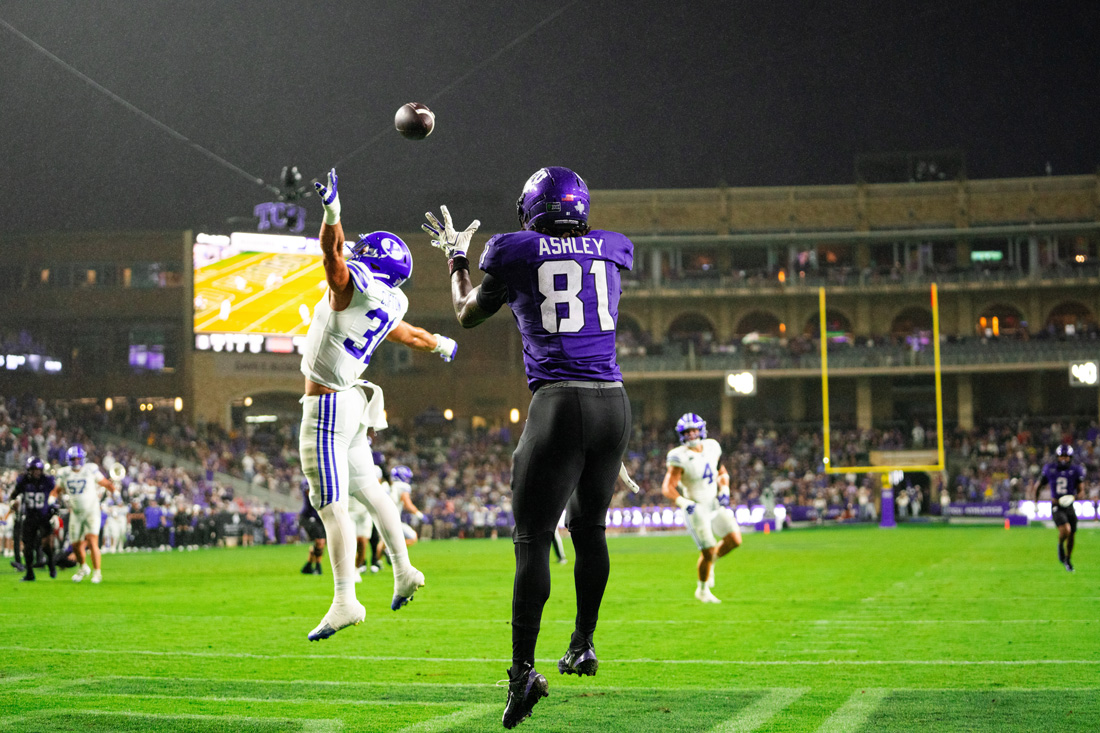
I’m beyond feigned modesty at this point. As I affirmed last week, the TCU offense needed 21 points to have a chance to beat BYU, which would have done the job, but managed only 10. We won’t focus this week on the shortcomings of QB Jaden Craig (#1) — who did toss his first meaningful touchdown pass of the season against the Cougars — but more on how the rest of the season must go for these Frogs to be watchable and Dykes to stay in the boosters’ good graces.
Sunday, the day on which I normally pen Buck U, is generally a time to catch up with your family unit about what happened in the previous week, what’s coming up, and how routines and ruts need to be adjusted or abolished for the good of everyone. TCU had similar meetings heading into this game: a captain’s meeting, then a players-only meeting. Yet the problems with the Frogs — and specifically the offense — can’t be fixed by those wearing pads alone.

Defensively, TCU continued their streak of stinginess without being opportunistic. The only takeaway of a moist Texas evening was an interception off Craig which set up BYU for their only touchdown of the first half, thanks to their best field position of the entire game, not the fault of Andy Avalos’ unit. The Frogs’ suspect pass defense was masked behind an underperforming Bear Bachmeier (#47), who struggled in the rain and completed fewer than half his throws, though the opportunistic quarterback did rush Tim Tebow-style for both their touchdowns. The entire Cougar offense managed barely more than 200 yards, but 154 came on the ground with Bachmeier accumulating 66 of them (more than double the next rusher), which eclipsed his passing total, with all of the rushes seemingly coming at key moments to either score, extend drives, or avoid huge losses during the course of several bad snaps.
By the numbers, the TCU defense is allowing fewer than 18 points per game against like opponents this season while surrendering an average of 268 yards, statistically good if your offense isn’t hapless at scoring. The defense needs — out of necessity — to take the ball away more often. These defensive Frogs have recovered four fumbles this season, two against both UNC and UCF, but are yet to intercept a power-four quarterback. A fumble doesn’t inherently count for less than an interception, but we saw how BYU flipped the field on a return against Craig, who has now thrown twice as many interceptions as touchdowns against like opponents.
Yes, the defense has allowed last-drive kills during the last two games, yet they’ve also kept their counterparts within one score in the fourth quarter during all three games this year, and the TCU offense scored literally their very first final-quarter points against a like opponent all season, a field goal when they were trailing by 10 with very little time remaining. The Horned Frog offense is still searching for their first second-half touchdown of the season against a power-four opponent and are averaging only 11 points per game so far. That’s not good enough to beat anyone remaining on their schedule, and I’m not getting nearly enough kisses.
The Gordon Sammis experiment can’t be ruled a failure yet (too early to blame a lingering yards-don’t-become-points problem on him). The Frogs have outgained everyone this year with the exception of UNC during Week Zero, but points on the board are tough to find. During three meaningful games, the Frog rushing attack is averaging 70 yards per with the majority coming against the Tar Heels. For a team that strives for balance and to lean on the rushing attack, it seems like a failure, and it’s easy for average onlookers to scream shame toward the offensive line. That isn’t really what’s happening. Defenses are not respecting the threat or aggressiveness of the air game, and a spread or spread-adjacent running attack is not designed to stand by itself. It’s an accessory. Six blockers are not equipped to stop a box of seven defenders where safeties are hair-triggered and ready to scream into run support because there is no motion, effective run fake, or threat of a quarterback meaningfully running with the ball.
What should be done? It must start or end with Craig as the engine of the offense, ignited by Sammis and Sonny Dykes. Craig must be launched from his protective nest and forced to challenge the defense down the field, and the results will speak for themselves. Craig seems to be a fine young man, but I’ve seen nothing to suggest he’s even a practice-squad-NFL talent. His playing career will be over — one way or another — after this season unless something miraculous happens. This offense is simply not good enough to be successfully conservative, and the impetus of the coaches and playcalling needs to start reflecting that. Backup quarterback Adam Schobel (#11) might not seem a better game-ready option to the staff, but it’s also valid to question Dyke’s evaluation of quarterback talent after starting Chandler Morris over Max Duggan during his first year in Fort Worth, and now what we’re seeing from Craig. Even in this NIL era of players (transferring every season as their value grows), Schobel, who has as much TCU family lineage as anyone, might be an exception to this new maxim, and it would be worth developing him during actual games for subsequent seasons.
Last week, the players were trying to cut out the noise and be honest about who and where they are in the season, and this week it needs to be program-wide. Unless there’s some in-house disaster and the Frogs go POTUS on everyone’s media credentials, TCU can’t lose during the bye week. But the Baylor Bears are waiting to host them on the road the following Saturday, and it needs to be a game where the offense goes big early and often. The Bears lost a sloppy Week 1 game against Auburn by one point but are undefeated in conference right now and just hung 55 points on Arizona State in Tempe. Their confidence is at least trending in a positive direction.
Baylor HC Dave Aranda and Dykes are in identical situations as both experienced tremendous success early in their similarly long tenures but heightened expectations combined with down-the-line performance have ultimately disappointed their hungry fanbases. Dykes is 3-1 against the Bears and has never lost in Waco, but this is also the least productive offense he’s coached to this point. Excepting some sort of follow-up tropical storm, I think the Frogs need to more than double their current average production, scoring 27 points to have a chance to win. The Baylor game is the most meaningful rival on TCU’s schedule this season and, excluding Utah in the Mountain West’s heyday, the only rival at all other than Texas Tech during the last conference game.
At two conference losses already, the Frogs are outside the conversation to challenge for a conference-championship appearance, especially considering the product they’ve shown on the field thus far, but a victory over Baylor has a way of baptizing the sins of past weeks in a game that still matters to a lot of people and revives the suggestion of pride and tradition buried under transfers and stacks of money.