


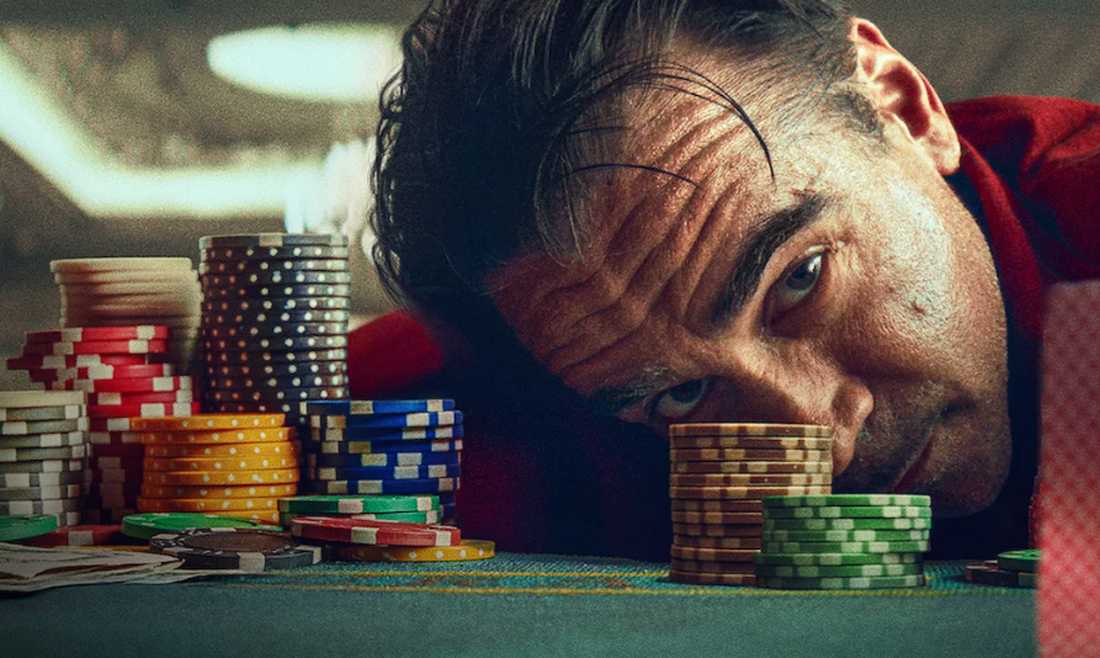
Colin Farrell’s latest role in Ballad of a Small Player may be one of his most inward. He plays Lord Doyle, a British gambler drifting through Macau’s casinos in search of an impossible win. The Netflix drama, directed by Edward Berger, trades spectacle for introspection, following a man who keeps playing long after the game has stopped meaning anything. Berger, who last brought a grim sense of fatalism to All Quiet on the Western Front, now finds a different kind of battleground — one fought under the fluorescent lights of baccarat tables and mirrored walls.
Doyle’s story begins not with a fall but with the endless repetition of falling. Berger’s camera traps him in corridors of reflection and light, using Macau’s visual excess to underline the emptiness beneath. The casinos are rendered as temples of illusion, where fortune and failure coexist in the same glittering breath. A standout sequence finds Doyle surrounded by spectators as he bets everything he has on a single hand. The suspense lies not in the cards but in his face — that flicker of awareness that he’s already lost, and that the loss itself is what keeps him alive.
Farrell plays Doyle as a man both charming and broken, moving with the practiced ease of someone who has long performed control. In a restaurant scene, he devours a lobster so mechanically that it borders on grotesque, a moment that strips away his elegance and exposes the hunger beneath. It’s an image that defines the film’s tone: indulgence as despair. Farrell never seeks redemption for his character; he simply allows him to unravel with quiet inevitability.

Two women appear in Doyle’s orbit — Dao Ming (Fala Chen), a casino worker whose calmness seems to belong to another world, and Cynthia (Tilda Swinton), a figure from his past who haunts him like a memory half-remembered. They are less characters than echoes, reminders of what Doyle has already forfeited. Rowan Joffe’s screenplay gives them only fragments, but those fragments serve the point: Doyle can no longer see beyond his own addiction.
Ballad of a Small Player also arrives at a moment when the conversation around betting and responsibility is gaining relevance. According to recent data from a Brazilian online casino, 27.5% of users place bets only occasionally, while 20.4% do so once or twice a month — a sign of predominantly moderate behavior among players. This framework shows that recent legalization didn’t incentivize players to bet uncontrollably, but paying attention to propaganda and responsible gambling instead.
The film’s rhythm is slow, its mood unwavering, yet its restraint becomes its strength. In Ballad of a Small Player, Berger and Farrell find poetry in exhaustion — the moment when the glitter fades, and all that remains is the sound of a man breathing in the dark.If the film has a thesis, it is that collapse rarely announces itself; it accumulates quietly, like smoke in a sealed room. Berger lets that pressure build until Doyle seems to dissolve into the very city he haunts. Macau becomes less a backdrop than an accomplice, its sleepless glow reflecting the seduction of a life lived on the edge of oblivion.
What emerges is not a cautionary tale but a portrait of compulsion — the kind that strips away identity until only impulse remains. Even in its bleakest moments, the film retains a strange tenderness, as if acknowledging that Doyle’s ruin is also his final attempt at feeling anything at all. In the end, Ballad of a Small Player lingers because it understands addiction not as a series of choices, but as a narrowing corridor, dimly lit, from which its protagonist can no longer imagine an exit.