


Fort Worth spent the summer talking about electricity. Demand on the state grid set a new record in July. In August, the governor ordered a pause on approvals for new data centers seeking to plug into it, and the City Council started the clock on a data center moratorium of its own. For a city that just passed 1 million residents, where all that power goes is no longer an abstract question.
The Census Bureau now counts Fort Worth as the 10th-largest city in the country, with an estimated 1,028,117 residents as of July 2025. Only one U.S. city added more people than the 19,512 Fort Worth gained in the year before that. Every one of those new households needs power, and a lot of them are asking more of it than homes did a generation ago.
Record Demand and a Pause on Data Centers

ERCOT’s grid peaked at about 91.1 gigawatts at 6 p.m. on July 22, a new record and 6% above the previous high from August 2023, according to the U.S. Energy Information Administration. It wasn’t a one-day spike. Average hourly demand stayed above the 2023 weekly record for six straight weeks from late July through the end of August.
On Aug. 3, Gov. Greg Abbott directed the Public Utility Commission and ERCOT to audit every data center in the grid’s connection queue before approving more. ERCOT was tracking more than 474 gigawatts of requests, and Abbott said about 90% of them were data centers, the Texas Tribune reported.
A week later, the Fort Worth City Council voted unanimously to begin the state-required process for a 90-day data center moratorium and set up an advisory group to help shape new rules, KERA reported. A final vote isn’t expected before December. South of town, Hood County residents have been fighting a string of proposed projects, as the Weekly covered in Data Center Tussle in Paluxy.
Delivery charges are moving too. Oncor’s new base rates took effect June 1 and added about 3% to a typical residential bill, according to the utility, which also filed for a further adjustment it estimated at roughly 2.5% more, with a decision expected in the second half of the year.
What Happens Inside the House
Most of that gets decided in Austin and at City Hall. What residents control is the wiring in their own homes, and in Fort Worth that varies a lot from one neighborhood to the next.
Older neighborhoods like Fairmount, Arlington Heights and Ryan Place are full of houses built in the first half of the 20th century, long before central air, home offices and electric cars. Some still run on original or patched-together wiring, two-prong outlets and panels sized for a much smaller load. At the other end, new subdivisions on the city’s growing edges come with modern wiring but often with builder-standard panels that can fill up quickly once a family adds a car charger, a pool or a workshop.
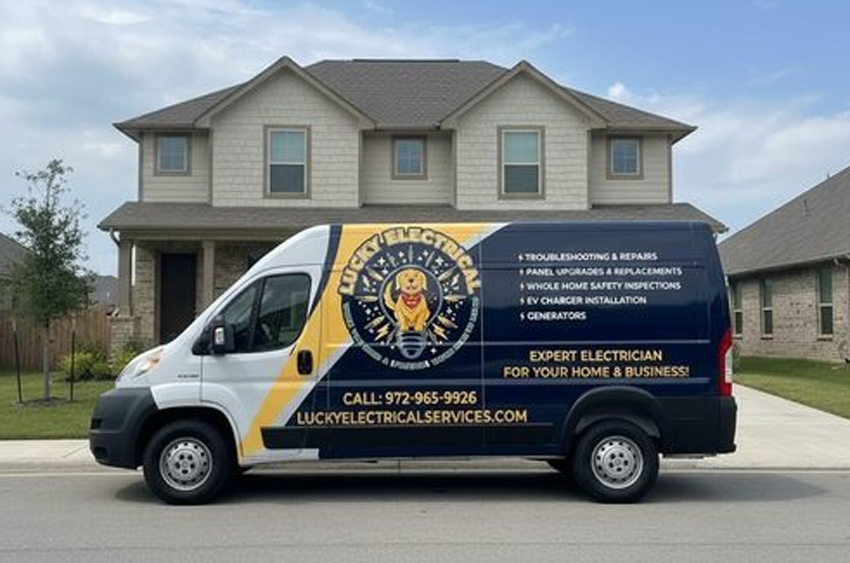
Neither situation is cause for alarm. Both are reasons to know what’s in the panel before the next heat wave or hard freeze. The same questions apply in smaller North Texas communities such as Caddo Mills, where Lucky Electrical is based: can the existing system support what the household plans to add? Checking capacity before buying an EV charger or starting a renovation can help avoid an unexpected electrical upgrade halfway through the job.
The Car in the Driveway
Electric vehicles are a big part of the load question. Texas had about 456,667 registered electric and plug-in hybrid vehicles at the end of 2025, more than triple the count from mid-2022, and around 1,500 more hit the road every week, according to TxDOT. Most EV charging happens at home, usually on a dedicated 240-volt circuit, and that circuit needs room in the panel. Charging overnight rather than in the early evening also keeps the load off the grid’s busiest hours. July’s record, after all, landed at 6 p.m.
Before the Next Freeze
Winter brings its own strain. Winter Storm Fern knocked out power to more than 14,000 Oncor customers when it moved into North Texas in January. When power comes back after an outage, voltage spikes can damage HVAC systems, appliances and electronics, which is why many homeowners add whole-home surge protection at the panel.
Space heaters are the other winter risk. They should plug directly into a wall outlet, not a power strip or extension cord. Electrical distribution and lighting equipment caused an estimated average of 32,620 U.S. home fires a year from 2015 to 2019, with about 430 deaths annually, according to the National Fire Protection Association, and December is one of the peak months for those fires.
Planning Ahead
A useful starting point is to list what has changed in the home: an extra appliance, a new home office or plans for an electric car. Pair that with any recurring problems, such as tripping breakers or unreliable outlets, and an electrician has a clearer basis for deciding what needs attention. Not every house needs a bigger panel; the work should follow the condition and capacity of the existing system.
The data center debate will play out at City Hall and in Austin for months. In the meantime, a panel check, a surge protector and a little planning are things any Fort Worth household can take care of this fall.