



Of 557 fatal occupational injuries in Texas in 2024, construction accounted for 128, according to a Texas Department of Insurance report published in March 2026. Behind each number is a family asking the same two questions. Did the employer carry coverage? And who caused the harm?
Everything that follows depends on those two answers. An eligible Texas worker can collect workers’ compensation while also pursuing a negligent third party, though the carrier may seek reimbursement. No coverage at your employer? Then you may be able to bring a negligence claim against the employer instead. A Houston construction accident attorney can sort out which route fits your facts, including facts you may not have uncovered yet.
How a Houston Construction Accident Attorney Evaluates the Two Claim Paths

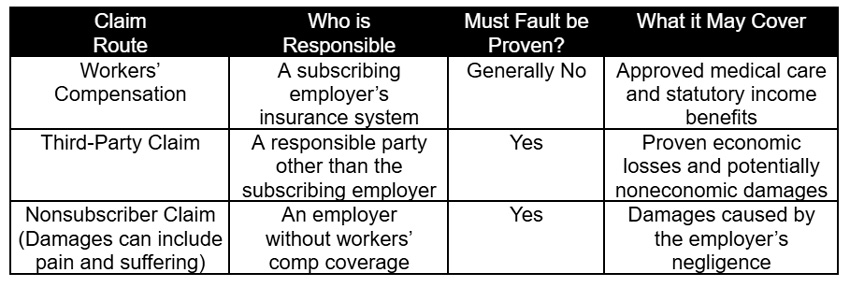
Workers’ compensation pays eligible workers without anyone proving the employer was at fault. A third-party negligence claim flips that burden: you must show another party breached a legal duty and caused compensable harm. And there is a third possibility. An employer that skips Texas workers’ compensation coverage is a nonsubscriber, and suing one works differently than suing an outside party.
Texas Labor Code §406.002 leaves the coverage decision to private employers in most cases. Under §408.001, workers’ compensation usually stands as a covered employee’s exclusive remedy against a subscribing employer. In plain terms, the employee generally cannot sue that employer over a work-related injury. A few narrow statutory exceptions exist. That exclusivity rule is exactly why the coverage question comes first.
So a Houston construction accident attorney starts by sorting out coverage, then identifying every party that controlled the site or supplied the equipment. The evidence decides which of these routes is even open to you.
Statutory Exception — Gross Negligence in Fatal Claims
Under Texas Labor Code § 408.001(b), subscribing employers lose their immunity if a workplace injury results in death caused by the employer’s gross negligence or intentional act. A surviving spouse or children can sue the employer directly for punitive damages. To win, they must prove by clear and convincing evidence that the employer knew of an extreme, life-threatening risk and acted with conscious indifference to worker safety.
Can you collect workers’ compensation while pursuing another party?
Generally, yes. Texas law lets an eligible worker receive workers’ compensation benefits while pursuing a separate claim against a responsible third party. Texas Labor Code Chapter 417, §§417.001 and 417.002, governs how the two interact. Workers’ compensation can pay covered benefits without waiting for a negligence lawsuit to end because the claims address different obligations: statutory insurance benefits on one side and another party’s legal responsibility for causing harm on the other.
The catch is subrogation. The carrier can recover benefits it paid from the responsible third party, so the gross settlement isn’t necessarily what lands in your hands. Before you agree to any settlement terms, ask how litigation costs and the carrier’s statutory interest affect the distribution. A recovery may also change how future benefits are paid.
What if your Texas employer does not carry workers’ compensation?
You can sometimes sue a nonsubscriber directly for negligence, rather than the worker receiving benefits through the Texas workers’ compensation system. Check the employer’s actual coverage before assuming either way.
A private occupational accident plan is not necessarily Texas workers’ compensation, and paperwork bearing an insurance company’s name does not establish subscriber status. Under Texas Labor Code §406.033, a nonsubscriber generally cannot use certain common-law defenses, including contributory negligence and assumption of risk. The statute also bars the fellow-employee negligence defense. Liability is still not automatic, though. You need evidence linking the employer’s negligence to your injury.
Keep your plan documents, benefit notices, and any coverage letters. Request written confirmation of coverage for your accident date.

Who might be liable besides the employer?
A contractor, property owner, equipment manufacturer, or outside driver could be responsible, depending on who controls the site and what caused the accident. Section 417.001 addresses claims against someone other than your employer or its agents or employees.
Job titles alone tell you little. A contractor’s work or control may support liability, but land ownership alone does not establish fault. A manufacturer may face a claim if a legally actionable product defect caused the injury. An outside delivery driver may be responsible for a collision on site.
Picture a scaffold collapse at a Fort Worth job site. You might receive workers’ compensation through your employer even if evidence points to a separate contractor’s improper assembly, and investigators still need to establish responsibility. Your subscribing employer, meanwhile, is not a third party.
What should you do after a Texas construction injury?
Get medical care immediately and report the injury to your employer. Do not delay treatment to gather evidence. This is general Texas information, not an assessment of your case.
1.) Get urgent medical care and describe how the injury happened at work.
2.) Notify your employer promptly and keep a copy of the notice.
3.) Save photographs, witness contacts, equipment identifiers, and employment or insurance documents.
4.) Confirm whether your employer subscribes to Texas workers’ compensation before choosing a claim route.
5.) Get case-specific advice before signing a release or accepting a third-party settlement.
Choose the route that matches the evidence
For a Fort Worth or Tarrant County worker, the next step is to verify coverage and identify each business that controlled the work or supplied relevant equipment. Preserve records before the site changes. If your injuries or lost work are substantial, get individualized advice promptly so your claim follows the evidence and accounts for any reimbursement obligation.