


Olivia Wilde’s The Invite reminds me of Woody Allen. I understand if you or she might not appreciate that comparison, but I can’t come up with a better one. Her four-hand comedy is as tense and funny and insightful about married couples as Woody’s best work. I’ve been missing that at the multiplex. Allen himself hasn’t made anything as good as this in the last 30 years, and not for lack of trying. Neither has anyone else. Would it help if I called this a much funnier version of Scenes From a Marriage? Whatever you’d like to compare it to, this movie that’s mature enough for adults but hilarious enough for the younger ones is the best comedy I’ve seen in the last year.
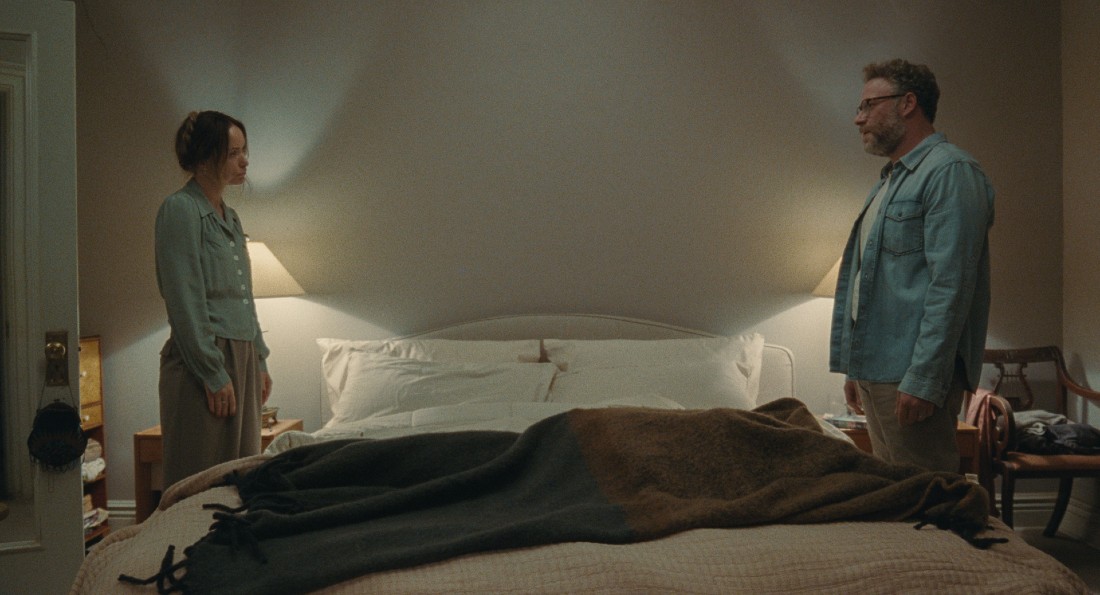
The movie takes place over one evening in the lives of middle-class couple Joe and Angela (Seth Rogen and Olivia Wilde), who live in a tony San Francisco apartment that would be well beyond their means if Joe hadn’t inherited it from his family. With their 12-year-old daughter sleeping over at a friend’s, they’re preparing a dinner party for their new upstairs neighbors Hawk and Piña (Edward Norton and Penélope Cruz). Before the guests even arrive, the first 10 minutes make a compelling case that Joe and Angela should not be married anymore. Angela upbraids Joe for not bringing wine when he’s unaware that a party is even taking place, and Joe keeps threatening to complain to the other couple about the loud sex noises coming from their place.
Wilde is also the director, and after the critical failure of her previous Don’t Worry Darling, she delivers a virtuoso visual performance here. It is truly marvelous to see the crisp and efficient way she moves her camera from living room to kitchen to bathroom, as if to say that she doesn’t need fancy special effects to wring great anxiety from this simple setup. The overall effect is breathless and claustrophobic, which mirrors the way Joe and Angela have trapped themselves in this bad marriage and their own misery over their personal failings. (He was in a mid-2000s one-hit wonder band and has long ago checked out of his job as a school music teacher, while she’s a trained art photographer who now crams her energy into decorating the apartment with stuff she buys on Facebook Marketplace.)

Others might see Wilde working through some personal issues after the very public breakup of her real-life marriage to Jason Sudeikis. I’m struck more heavily by her willingness to play this desperate housewife who is exhaustingly eager to please. Certainly none of her male directors ever thought to cast her in such a role, so her comic talent is a revelation, especially when Joe tries to raise the sex complaint and Angela keeps force-feeding him the homemade flan that Pina has brought for dessert. Speaking of food, Angela puts out a massive Spanish charcuterie spread for her guests, only to learn that Piña does not eat meat, cheese, or bread. With that, Angela’s charming-hostess façade cracks wide open with a despairing “Fuck!”
(Piña later points out to Joe that the ham that Angela thinks is ibérico is, in fact, Italian prosciutto. Joe is not entirely joking when he says, “If you tell her it’s not jamón, she’ll commit suicide.”)
I haven’t even reached the crux of the film, when the neighbors reveal that they are not always the ones making the sex noises coming from their apartment. They are swingers who like welcoming third, fourth, and sometimes fifth and sixth parties to their sexual encounters, and they have come to Joe and Angela’s to invite them to join the action. All manner of amusement results from this, as Joe needs several repetitions of the offer to understand that it includes him, and he and Angela put aside their marital strife to ask questions about how the group sex works. (“What if no one picks you? Do you just have to jerk off in the corner?”) Despite Hawk and Piña seeming to have a much healthier relationship, the movie drops hints that all isn’t well between them, either, in their untranslated Spanish conversations. Piña is right; Hawk’s Spanish is terrible.
Cruz and Norton both enjoy some shining moments — Hawk interrupts a seething moment between Joe and Angela by offering to serve hot tea for some reason. However, the film contains not only the performance of Wilde’s career, but Rogen’s too. Whether Joe is twerking and flailing his arms trying to do a sexy dance for Piña or leaking resentment toward his wife, it’s Rogen’s comic energy that constantly propels this movie forward.
The Invite is a remake of Cesc Gay’s stage play The People Upstairs, which he adapted into a 2020 film called Sentimental. Apparently, the play has already been made into movies in several other countries, though this film significantly changes the original’s ending. (I say “apparently” because the original never got released in America.) Screenwriters Rashida Jones and Will McCormack serve it up with dialogue that’s good enough to eat with a spoon, especially in the climactic scene when Hawk reveals why he changed his name and Piña, a psychotherapist by trade, makes Joe and Angela realize just where their relationship is. Maybe Allen summed it up more succinctly in Annie Hall with his line about the dead shark, but this is a marital comedy for the 2020s that he couldn’t have made for any number of reasons. The wreckage of this marriage is great entertainment.
The Invite
Starring Seth Rogen, Olivia Wilde, Penélope Cruz, and Edward Norton. Directed by Olivia Wilde. Written by Rashida Jones and Will McCormack, based on Cesc Gay’s play and screenplay. Rated R.