


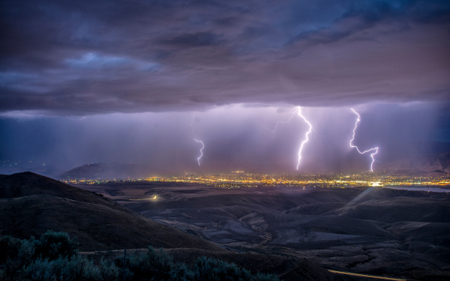
Fort Worth’s outdoor sirens were built for major public threats. Tornado warnings can activate them. So can extreme wind or very large hail. A lightning cell approaching one concert lawn or athletic field may never meet those citywide thresholds.
A lightning alert system gives venue staff a local trigger for action before the first loud clap of thunder reaches the crowd. The equipment gives staff a time-stamped reason to interrupt a game or performance before thunder reaches the crowd.
Fort Worth already has city sirens and public emergency alerts, but those systems answer a broader question. Venue staff needs to know what is happening close enough to threaten one field, stage, or festival site. The equipment can answer that. Moving hundreds or thousands of people before they agree that the storm is real remains the harder part.

The Warning Now Starts at the Venue
Fort Worth’s outdoor warning sirens are designed to alert the public about broad threats. The city may activate them for a tornado warning or confirmed extreme wind event. Large hail can also qualify. Lightning within a few miles of one venue is not listed as a routine activation trigger.
That leaves event operators responsible for conditions at their own property. At a permanent site, weather-monitoring equipment, such as cyclonePORT weather stations, can provide local strike-proximity data to the people overseeing the event. Similar systems may also record wind and rainfall, which helps staff see what is happening at the venue rather than relying on conditions reported elsewhere in North Texas.
This local approach is already visible in Fort Worth’s athletic field policy. An on-site sports field monitor clears city fields when lightning is detected within a 10-mile radius. That is a specific operating threshold, not a judgment based on how dark the clouds look.
Fort Worth’s 10-Mile Rule Shows How the Standard Has Changed
The city’s athletic-field policy is blunt. When the on-site monitor detects lightning within 10 miles, the fields clear. Participants remain off until 20 minutes have passed since the most recent strike inside that radius.
There is no clause for a championship game or a team that has played only half an inning. The rule does not ask if rain has reached the dugout.
That matters because lightning safety once depended heavily on what coaches could see and hear. Dark clouds carried weight. Thunder ended the argument. Detection technology moves the decision earlier, into the less satisfying period when conditions still appear playable.
Parents and players may interpret that as excessive caution. Staff sees a different problem. Once thunder is audible, the storm has already moved close enough to threaten anyone still crossing an exposed parking lot.
The city’s rule covers sports fields, not every private concert site or outdoor gathering. Still, it shows where the local standard is heading. Weather decisions are becoming threshold-based and recorded. A person remains responsible, but the person is no longer expected to guess.
Concerts Have a Crowd-Movement Problem
Clearing a softball complex is one thing. Interrupting a festival beside the Trinity River is another.
Fort Worth hosts large outdoor gatherings where the audience spreads across lawns and temporary event areas. Cars may be several blocks away. Indoor shelter can hold only part of the crowd. Once thousands of people begin moving at the same time, the weather problem becomes a traffic problem too.
That changes when an alert needs to arrive. Ten miles may provide enough time for a small field with nearby parking. It may feel uncomfortably short when guests have to leave a festival site through limited exits.
A pause also carries more friction at a concert. Athletes already expect officials to stop play. Music audiences have paid for a performance and may have waited through opening acts. When the stage remains dry, an early interruption can feel arbitrary.
The operations team has to act before the audience shares its sense of urgency. That is the odd bargain created by better detection. The system works best when many people think the shutdown came too soon.
Weather Data Is Changing Who Controls the Show
At an outdoor event, the most visible person is rarely the one watching the storm. The artist may be onstage. The promoter is thinking about the schedule. Security is dealing with the crowd in front of them.
The weather call increasingly belongs elsewhere.
A designated monitor can follow strike proximity without also managing stage cues or ticket problems. Once the trigger is reached, that information passes to the person with authority to stop the event. The arrangement sounds obvious, yet it changes the internal politics of a live show.
A sponsor may want another song. Production staff may believe the storm will pass north. The artist may have no idea that lightning has entered the operating radius. A written trigger gives the safety lead something firmer than instinct during that conversation.
The record matters afterward as well. Event organizers can show when the alert arrived and when they acted. If the storm misses the venue, the data still explains why the pause occurred. That may not calm every frustrated guest, but it is a stronger position than saying someone saw a dark cloud.
Shelter Is Still the Weakest Part of the Plan
Lightning detection has improved faster than shelter at many outdoor spaces.
Fort Worth has open pavilions and dugouts that offer shade but little protection from a strike. A metal roof over an open structure may feel safe during heavy rain. It is not the same as a substantial enclosed building.
Hard-topped vehicles can provide protection, though that assumes guests have enough time to reach them. At a large gathering, parking may be distant. Some attendees arrive by rideshare and have no vehicle waiting nearby.
Venue capacity makes the mismatch plain. A property may admit several thousand people while its enclosed rooms hold only a fraction of them. Technology can identify the threat early, but it cannot manufacture walls and doors.
That is why some weather pauses turn chaotic despite accurate alerts. Guests hear “seek shelter” and move toward the nearest roof. Staff then have to redirect them while rain begins and the paths grow crowded.
The strongest event sites are not necessarily those with the most advanced sensors. They are the ones where the warning time matches the distance to real shelter.
The Public Is Starting to Expect an Earlier Call
Fort Worth residents are familiar with violent spring weather. They also know that one part of the city can receive hail while another gets little more than wind.
That local experience creates two competing reactions. People take severe storms seriously, but they also become skeptical after repeated warnings that do not affect their neighborhood. Venue operators work inside that contradiction.
A local alert narrows the argument. It does not claim that all of Fort Worth is in immediate danger. It says lightning has crossed a defined boundary around this event.
The next shift is likely to be less visible than new hardware. Guests will become accustomed to pauses that begin while the stage is dry. Promoters will write weather triggers into operating plans before gates open. Staff will know that restarting the show depends on the last recorded strike, not on a patch of lighter sky.
Fort Worth’s city fields already work that way. Outdoor concerts and festivals face a more complicated version of the same decision, with larger crowds and fewer obvious shelters.
The technology does not keep lightning away. What it changes is the moment when someone decides the event can no longer continue as planned. In North Texas, those extra minutes are the whole point.