


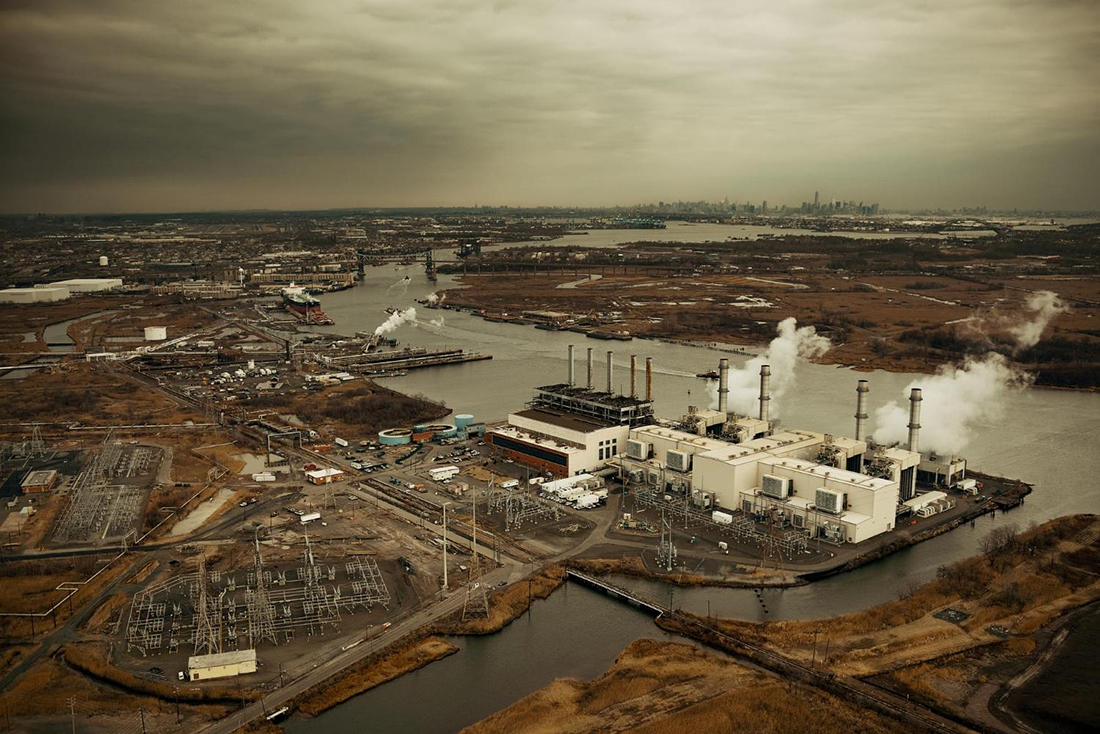
Resource-efficient industrial growth means factories produce more goods and support more jobs while using fewer gallons and kilowatt-hours per unit of output.
The timing matters. ERCOT’s preliminary April 2026 forecast projected about 367,790 megawatts of regional demand by 2032, compared with its standing all-time peak of 85,508 megawatts recorded in August 2023. The scale shows why large users must consider efficiency. Texas water planning also assumes drought-of-record conditions rather than treating severe drought as a remote event.
Growth and conservation can coexist. The Texas Water Development Board says statewide manufacturing water use declined between 2005 and 2014 while economic output increased. The next gains will depend on measurement, water reuse, efficient pumps, smart motion control, maintenance, and investment.

Can North Texas Manufacturing Grow Without Using More Water and Energy?
Yes, North Texas manufacturing can expand without increasing resource use in direct proportion to output. Total consumption may still rise at a fast-growing plant, but consumption per product can fall sharply. A facility that doubles production while increasing electricity use by only 20 percent has not eliminated demand growth, yet it has achieved a meaningful efficiency improvement. Factories can improve this ratio by repairing leaks, reducing idle operation, matching equipment output to demand, recovering heat, and circulating process water more than once.
Water access involves more than a monthly bill. A manufacturer considering private wells, surface-water withdrawals, land purchases, or long-term supply contracts may need to understand what are water rights and which permits apply. Requirements differ by source and location, so project teams should verify them with Texas agencies and local authorities. The practical goal is responsible growth, not zero consumption at any cost.
Where Do Factories Use the Most Water and Energy?
Factories usually consume the most water and energy in heating, cooling, pumping, compressed air, cleaning, material processing, and building services. The balance differs by industry. Food plants may use more water for sanitation, while metal shops often draw more electricity through motors, cutting systems, and compressed air.
Waste often hides inside ordinary operations. An oversized pump may run at full speed while a valve restricts flow. A compressor may maintain unnecessary pressure because leaks have become accepted as normal. Cooling water may be discharged after one use, even when it remains suitable for another purpose. The main consumption points are: process heating and cooling: Furnaces, ovens, chillers, boilers, and cooling towers; pumps and motors: Fixed-speed or oversized equipment operating above actual demand; cleaning and rinsing: Washing, finishing, sanitation, and surface preparation; compressed air leaks, excessive pressure, and unnecessary idle operation; cutting and forming: Machining, waterjet cutting, presses, and related systems; building services: Lighting, ventilation, refrigeration, and air conditioning; leaks and discharge: Unnoticed losses of water, steam, and compressed air. A useful audit follows resources through each process rather than looking only at monthly bills.
Which Technologies Can Reduce Industrial Water and Energy Waste?
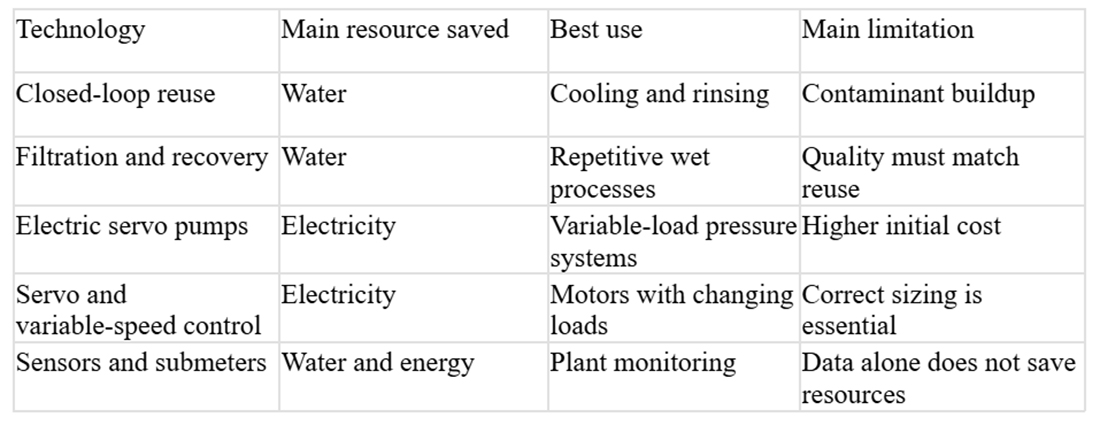
The strongest technologies recover a resource, adjust equipment output to demand, or reveal losses that operators cannot see. Water-reuse systems can reduce freshwater intake and wastewater discharge. Variable-speed pumps and motor controls can stop equipment from working harder than necessary. Sensors can expose leaks, idle loads, pressure changes, and deteriorating performance. Technology must follow diagnosis. Before investing, the factory should define the process requirements, current consumption levels, quality limits, and production risks.
Water Recycling and Reuse Systems
Industrial water recycling systems collect used water, treat it to an appropriate quality, and return it to productive use. Main types include closed-loop circulation, filtration, cooling-water recirculation, rinse-water recovery, condensate capture, and reclaimed municipal water. The next use determines treatment. Cooling water may not need drinking-water quality. EPA guidance says industrial reuse can involve treated municipal wastewater or water generated inside a facility, including boiler and cooling water.
Closed-Loop Water Reuse
Closed-loop water reuse is a process that captures water after use, removes heat or contaminants, checks its condition, and returns it to production. Common applications include cooling, rinsing, washing, finishing, and selected cutting processes. A loop may use filters, settling tanks, separators, chemical adjustment, or heat exchangers. It can reduce freshwater purchases and wastewater volume, but repeated circulation may concentrate salts, oils, particles, or microorganisms. Operators need water-quality limits and scheduled maintenance.
Filtration and Process-Water Recovery
Process water recovery separates contaminants from used water, enabling its reuse. Screens and cartridge filters remove solids. Centrifugal and oil-water separators divide materials by density, while membrane systems remove smaller contaminants. The method depends on the contaminants and the next use. A rough rinse can tolerate more suspended material than precision finishing. Over-treating wastes energy, while under-treating can damage products, pumps, and cooling surfaces.
Energy-Efficient Production Technologies
Energy-efficient production technologies enable industrial operations to run with less electricity, fuel, pressure, or idle time. High-efficiency motors, variable-frequency drives, servo drives, heat recovery, shutdown controls, and monitoring systems use feedback to adjust their outputs rather than running continuously at full demand.
Electric Servo Pump Technology
Electric servo pump technology uses an electronically controlled motor and pump to produce pressure or flow according to operating demand. In waterjet cutting, this can reduce the mismatch caused when a hydraulic intensifier continues to run during partial-load or idle periods. An electric servo pump technology system can vary output and provide diagnostic information for waterjet systems and other pressure-controlled machinery. Quantum SPT claims savings of up to 60 percent compared with standard hydraulic intensifiers, but factories should verify results against duty cycle, pressure, electricity price, and existing equipment.
Smart Motion Control and Variable-Speed Systems
Motion control is the regulation of machine speed, position, torque, and timing. A system may combine a servo motor, a feedback sensor, a controller, and a drive. Servo controllers interpret commands, while servo motor drives deliver controlled power to the motor. These servo controls support robotics, conveyors, packaging lines, machine tools, pumps, and material handling. A servo mechanism corrects movement through feedback. Common servo drive applications include positioning, synchronized motion, variable speed, and controlled torque. Variable-frequency drives match the speed of pumps, fans, or compressors to demand.
How to Reduce Water and Energy Waste in an Existing Factory
Reducing waste requires three main steps: measure current use, prioritize practical savings, and verify results before expanding the project. A factory that buys equipment without establishing a baseline may struggle to prove whether the investment worked. The order matters: 1) Measure water and energy at the process level, 2) Correct low-cost losses and test targeted upgrades, and 3) Compare results with the baseline and scale successful changes.
Step 1: Measure Current Water and Energy Use – Measurement begins with utility bills, production volume, operating hours, peak demand, machine-level electricity use, water flow, wastewater volume, and idle consumption. Useful metrics link resources to output. Gallons per product, kilowatt-hours per batch, or energy per operating hour reveal changes that monthly totals hide. Submeters can isolate pumps, compressors, chillers, and cleaning stations, while walk-through inspections often expose leaks and unnecessary operation.
Step 2: Prioritize the Largest and Fastest Savings – Factories should rank projects by expected savings, production risk, cost, difficulty, and payback. The first actions are often simple: repair leaks, correct pressure settings, shut down idle equipment, clean heat-transfer surfaces, and restore maintenance. After those corrections, the facility can test drive efficient motors, water recovery, heat reuse, or redesigned controls. A pilot limits risk and lets engineers compare quality, maintenance, and resource use. The best project delivers stable savings without causing defects, bottlenecks, or excessive downtime.
Step 3: Measure Results and Expand Successful Changes – Every project needs a starting point and a target. Useful measures include gallons per product, kilowatt-hours per batch, peak demand, water-reuse percentage, equipment idle time, wastewater volume, and maintenance cost. Results should be adjusted for weather, production volume, operating hours, and product mix. Once a pilot produces repeatable savings, the factory can apply the change to similar equipment. Settings, maintenance requirements, and measured results should be recorded to prevent performance from drifting back.
What Are the Benefits of Water- and Energy-Efficient Manufacturing?
Efficient manufacturing lowers operating costs, protects production reliability, improves equipment performance, and reduces pressure on resources. Its value extends beyond utility bills because water, electricity, maintenance, production capacity, and wastewater disposal interact with one another.
North Texas has already shown that conservation can contribute to a meaningful supply. TRWD reported that 27.2 billion gallons of water saved through conservation accounted for about 20 percent of the water it delivered in fiscal 2023. Industrial projects are only part of that picture, but the figure shows how many efficiency decisions can add up.
Six main benefits are: reduce operating costs through lower water, electricity, fuel, and discharge expenses; protect production reliability during drought, grid stress, and price volatility; increase usable capacity by removing waste and bottlenecks; improve equipment performance through better pressure, speed, and temperature control; strengthen community trust by limiting the burden of industrial expansion; and support precision processes that require stable flow, torque, pressure, or temperature.
What Do Industrial Efficiency Improvements Cost?
Industrial efficiency projects range from several hundred dollars for basic leak repairs to millions for plant-wide water treatment and controls. Costs vary with capacity, contaminant load, construction, integration, and downtime.
Small metering and control projects may cost thousands to tens of thousands of dollars. Larger pump, motor, compressor, or line-control upgrades can reach tens or hundreds of thousands. One industry estimate places a complete 150,000-gallon-per-day wastewater treatment system at about $500,000 to $1.5 million. These figures are planning examples, not quotations.
Six main cost factors are: Facility size and flow rate; Equipment age and compatibility; Required treatment or control level; Installation and production downtime; Engineering, construction, and permitting; and Monitoring, maintenance, and training.
The financial review should compare initial cost, annual savings, equipment life, maintenance, production gains, and incentives. Some Texas utility programs provide assessments and incentives for qualifying commercial and industrial measures, depending on service territory and current rules.
What Are the Main Limitations of Resource-Efficient Manufacturing?
Resource-efficient manufacturing can require substantial capital, technical skill, installation time, and continuous measurement. These limits do not make efficiency impractical. They mean projects must be designed around the plant rather than copied from another facility.
Water quality is a common constraint. Reused water may contain salts, particles, oils, or biological material that a sensitive process cannot tolerate. Energy projects can also disappoint when equipment is oversized, controls are poorly programmed, or operators bypass settings.
Six main limitations are: increased upfront spending for equipment, engineering, and construction; interrupting production during installation and testing; complicated maintenance through added controls, filters, and sensors; limiting water reuse when product quality requires strict chemistry; reducing expected savings when sizing or baseline assumptions are wrong; and creating site-specific barriers in older plants with little space or incompatible machinery.
Phased implementation, measurable targets, operator involvement, and post-startup verification reduce these risks.
Conclusion
North Texas manufacturing can grow while slowing the rise in water and energy demand. Texas planning data already show that manufacturing output and water use do not have to move together. The next gains will come from finding losses, maintaining equipment, reusing suitable water, varying machine output with demand, and testing upgrades before expanding them.
Factories do not need to rebuild an entire plant at once. Leak repairs, submetering, pressure corrections, targeted motor controls, and small reuse projects provide a credible starting point. The region’s competitiveness will depend on more than attracting factories. It will depend on whether they can produce reliably during grid pressure, drought, and rapid population growth. Responsible resource use is therefore one of the conditions that can make industrial growth durable.