

And just like that, the gargantuan and long-suffering fanbases of Texas A&M and Texas Tech are eliminated from the expanded College Football Playoff with only three combined points to show for their hopes, efforts, and millions of dollars invested.
As promised last year, I’m not inviting ridicule to the Aggies and Raiders, as we Horned Frogs have endured much after losing the most lopsided national championship in modern history, but the facts remain that the Frogs had to win a semifinal game to be able to play Georgia, something that only the Longhorns have also been able to accomplish within our state. The trash talking between the College Stationers and Lubbockites in the offseason will center on who performed worse, and the Aggies — in true SEC fashion — will be rooting for the Miami Hurricanes to go the distance so the maroon’s shortcomings can be justified to a greater degree.
Poor Texas Tech succumbed to what has become the curse of the bye: a traditional bowl layoff without game speed against a team who might be more banged up but is demonstrably battle-hardened. The Red Raiders are in good company, as only one of the eight teams who enjoyed an extra week off finished the quarterfinal round with anything left to play for. (More on that later.) Tech’s defense performed as advertised, staunchly preventing a plucky Duck offense from finding the endzone until the second half and allowing only two field goals through the first.

It was the offense for TTU that couldn’t and wouldn’t find a rhythm, no matter how badly the situation demanded they do. In addition to missing a field goal in the second quarter, the Raiders committed four total turnovers, three of which quarterback Behren Morton (#2) was directly responsible for (two interceptions and a lost fumble), which spelled irreparable damage in a game against a capable opponent. Oregon wasn’t perfect, but quarterback Dante Moore (#5) was remarkably efficient, completing 79% of his passes and tossing only one interception. The Oregon pass rush proved too much for Morton, and the Ducks advanced to a rematch with Indiana in the semifinal, leaving a historic Tech season in the ashes of an — I’d venture to assert more so than Texas A&M — embarrassing shutout.
Speaking of Indiana, the Hoosiers proved their top ranking by becoming the first team in the expanded era to not only survive the bye but thrive. They absolutely curb-stomped Alabama 38-3 during a game that was even more impactful to IU’s national perception than the Heisman Trophy or their win over Ohio State in the Big 10 Championship.
Heisman winner Fernando Mendoza (#15) was the model of efficiency, missing only two of his 16 passing attempts and accumulating three throwing scores. The Hoosiers completely controlled the game by rushing the ball 33 times between their two feature backs alone and accumulating close to 200 yards between them. The Hoosier defense simply stuffed the Tide. A 38-3 score would suggest many turnovers, but one fumble lost by Bama was the only miscue outside of turnovers on downs. They simply couldn’t find any continuity against the swarming Hoosiers.
IU continues their historic streak on Friday in the Peach Bowl, where their ability to run the ball effectively and Mendoza’s decision-making should neutralize the Duck pass rush and catapult Coach Curt Cignetti’s group to the national championship.
On the other side of the bracket, the Hurricanes did something rare, and that is deliver Ohio State consecutive losses. This U group reminds me of the 2007 New York Giants, who famously ruined Tom Brady and the Patriots’ perfect season: disruptive defensive line, opportunistic secondary, and an offense good enough to take advantage at the perfect moment. The U picked off Buckeye quarterback Julian Sayin (#10) twice, and the offense built a 14-0 first-half lead on their way to holding onto a 24-14 victory.
Miami’s opponent is coming off the most exciting quarterfinal contest. In a 39-34 win over Georgia in the most back-and-forth affair of the weekend, Ole Miss quarterback Trinidad Chambliss (#6) tossed the ball 46 times, connecting on 30 of them while racking up 362 yards — including the game-winning 45-yard drive for a field goal with less than a minute remaining.
Chambliss seems like the most exciting quarterback in the playoffs right now, even if not the most efficient. The Rebels are simply a wildcard and exciting to watch. The Fiesta Bowl on Thursday night will go as he does. Miami will need to account for his elusiveness plus his vision down the field. If Chambliss plays a clean game, one in which he commits one or fewer turnovers, the Rebels should head to the national title game against Indiana, and Lane Kiffin will keep receiving bonuses for games he isn’t coaching.
While their season is over, there might have been more relevant Horned Frog news in the last week than the entire latter half of the regular season. As discussed previously, former OC Kendal Briles is now a Gamecock, signaling a major shift in the coaching staff. Gordon Sammis is heading to the Fort from UConn, and as a former offensive lineman myself, I couldn’t be more excited for a trench-warfare specialist to be calling the plays. Sammis was consistently successful in Connecticut and is a former collegiate lineman for UVA. Known for developing offensive lines and vaunted rushing attacks, he represents a paradigm shift that’s badly needed and will hopefully fix the lack of time of possession, short-yardage foibles, and consistency problems that plagued the Briles era.
Josh Hoover is out. The soon-to-be-senior slinger opted out of the Alamo Bowl, and multiple reports indicate he’ll transfer to Indiana to contend for Mendoza’s soon-to-be vacant position. As much as the timing seems suspect, Hoover committed to IU in high school before flipping to the Frogs. Respect should be paid to one of the most prolific passers to wear purple and white. Hoover set the single-season record for passing yards and is third all-time behind Trevone Boykin and Andy Dalton, edging out Max Duggan by 11 career yards through the air. That said, Hoover had a knack for untimely turnovers and a devil-may-care approach to passes over the middle, and he was not an effective runner or practitioner of the read option. His strengths combined with shortcomings left fans excited about the possibilities of the offense but often disappointed with the results against better opponents.
The most likely replacement for Hoover is Jaden Craig, who is transferring from Harvard for his final season of eligibility. Craig is the Crimson’s all-time passing leader with more than 6,000 yards through the air in the Ivy League and 52 touchdowns. Already considered an NFL prospect, Craig will be part of the process to rebuild the offense with Sammis.
In Hoover’s absence, backup Ken Seals lined up under center for his final collegiate football game in the Alamo Bowl. The Azle native spent three years playing at Vanderbilt and has been the backup in Funkytown for the last two seasons. A star quarterback not starting in a mid-level bowl is becoming more of a common tale across collegiate football, but it’s more specific to TCU, who were dealing with this before it was trendy for transfer-portal reasons. While USC had some of their elite receivers opt out, what resulted in San Antonio was another fantastically fun and tension-filled fight between the Frogs and another financially privileged fanbase from the Left Coast.
TCU’s offense started slow, gaining only 11 yards in the first quarter before warming into back-to-back touchdown drives to begin the second. A first-quarter field goal by the Trojans and a second-quarter score left an almost even 14-13 advantage for the Frogs at the half. Disaster struck to begin the third quarter as Seals was picked off on the second play, awarding the Trojans a short field and what felt like an assured score. The TCU defense — the best unit of the game — bailed out their senior quarterback by picking off USC in the endzone.
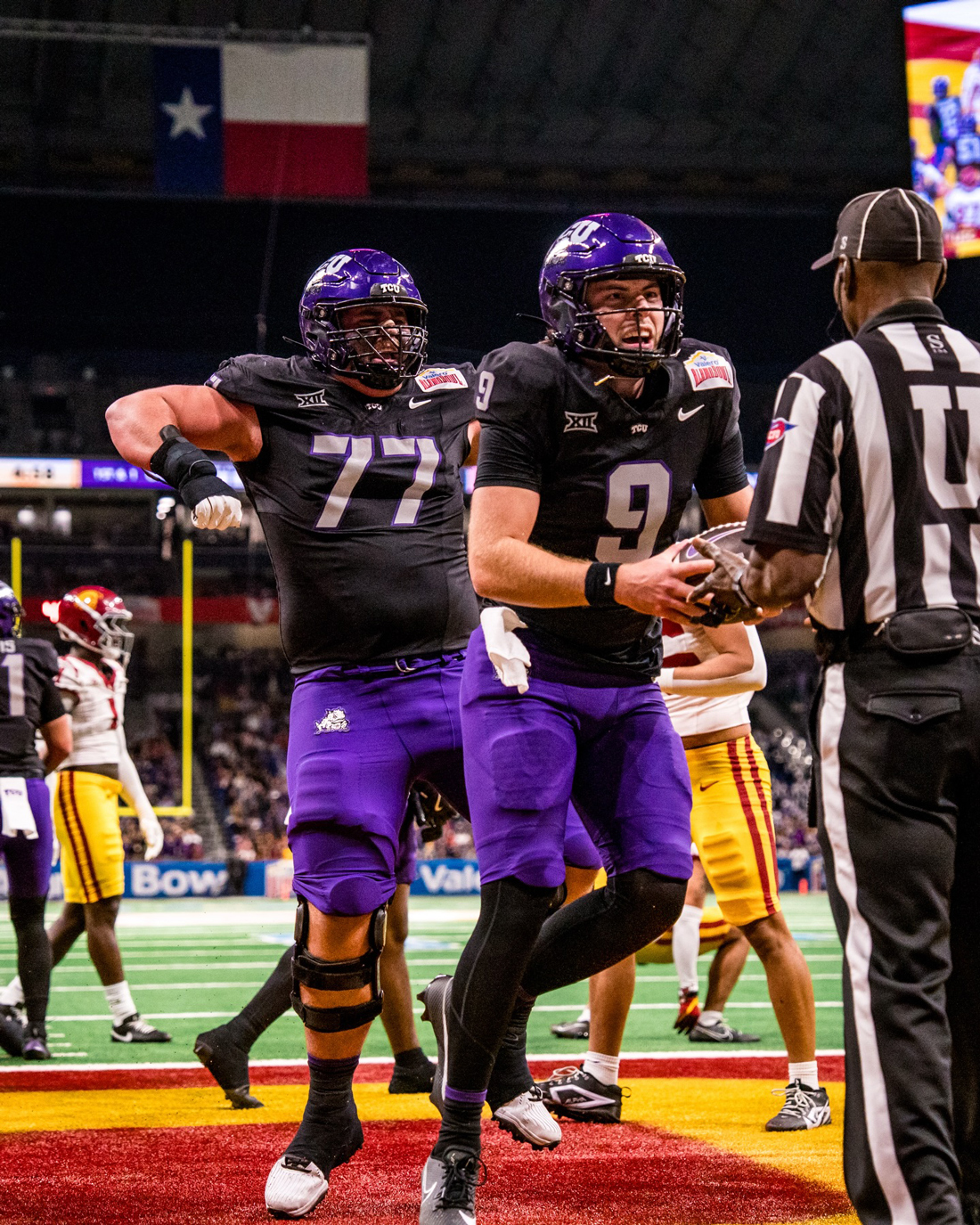
The Los Angelenos found their stride, though, and converted for a touchdown and field goal for a 10-point lead with barely five minutes remaining. The Frogs responded with two long drives for a touchdown and field goal, respectively, to even the score and force overtime. The Frog defense stymied USC one final time for a field goal. After what seemed like an amazing pass and catch by Joseph Manjack was ruled incomplete, Seals took a 10-yard sack to set up a third and 20 and a likely field goal attempt. Seals dropped back, scanned, and hit a dump pass to running back Jeremy Payne (who dazzled with 19 combined touches for 123 yards and two scores), who wriggled, shimmied, and shook three would-be tacklers to take the pass down the left sideline to paydirt and cap a 30-27 overtime victory three days before the 10th anniversary of Bram Kohlhausen (who was in attendance and an honorary captain) leading TCU from a 31-point deficit for an overtime victory against Oregon on the same field.
All “homership” aside, the TCU-USC game might have been one of the best bowls of the entire season. Not only because it was a back-and-forth slugfest that ended on a spectacular play in overtime, but because it’s a staunch reminder that these are still just young men who love football and whose playing careers are culminating. Yes, the transfer portal and big-money contracts are here to stay and the meta of collegiate football has been irreparably altered, but for that shining moment, we saw a small bit of history repeat itself for two quarterbacks where that game in the Alamodome is something they’ll carry with them forever, and we’re all better for it, not because of a bank account or trophy but for the love of competition, memories sweet, and comrades true.