


Should we have been surprised to see a lot of people wearing Stars jerseys at a December hockey game at American Airlines Center?
OK, no. Normally such an observation would indicate nothing remarkable. Just the evening before, in fact, 18,532 fans had watched Dallas’ NHL team play the Chicago Blackhawks, with the preponderance of the spectators garbed, as one would expect, in Victory Green. But that Sunday didn’t represent the second night of a back-to-back for the Stars, who had three days off prior to their traditional New Year’s Eve home game. However, it could represent something important for the future of ice hockey.
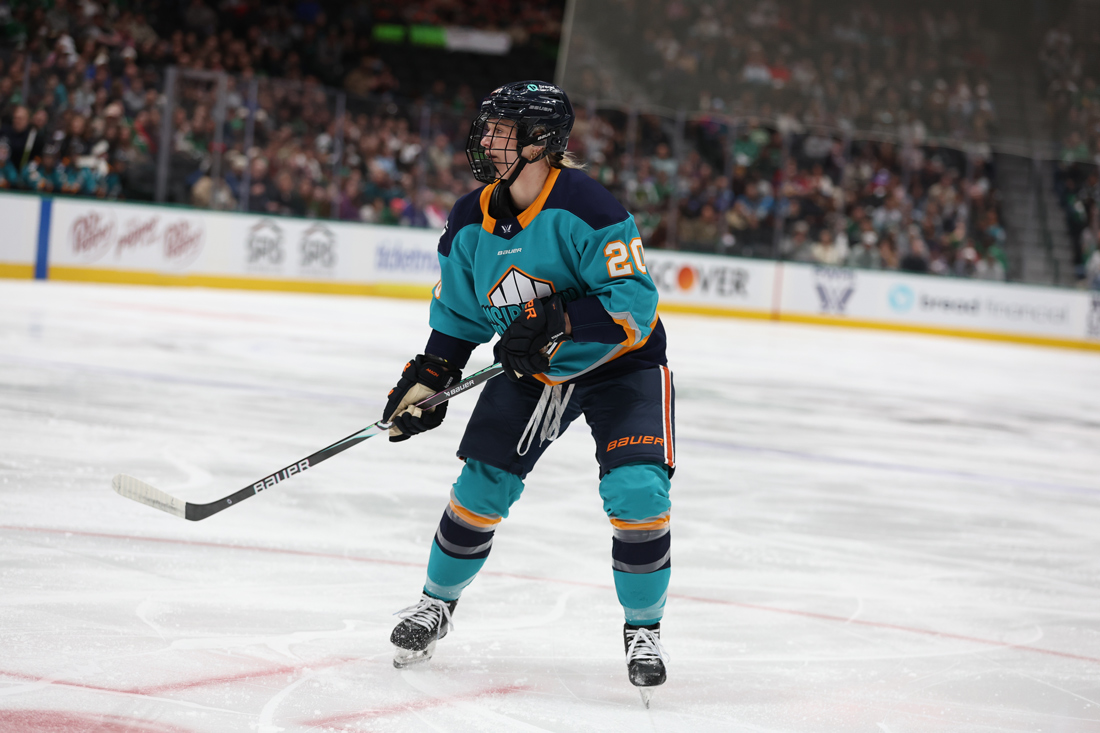
That December 28 game was contested by teams from New York City and Seattle from the Professional Women’s Hockey League (PWHL). The regular-season contest counted in the standings and came to Dallas as part of the circuit’s 11-city Takeover Tour. These neutral-site matchups showcase the product in areas beyond the home markets of their eight teams, which also include Boston, Minneapolis-St. Paul, Montreal, Ottawa, Toronto, and Vancouver.

Certainly, the organizers hope to grow interest in the league and women’s ice hockey generally. Their chances at success start with attendance, announced at 8,514 in Dallas. That stacks up well with the tour’s two previous stops this season, which drew 10,264 at Rogers Place in Edmonton, Alberta (home of the NHL’s Oilers), and 7,238 at Allstate Arena in Rosemont, Illinois (home of the AHL’s Chicago Wolves). The on-ice product showcased a skilled, speedy, physical sport. The game was tightly contested throughout, with the New York Sirens’ Casey O’Brien completing a hat trick on a game-deciding power-play goal late in the third period.

Courtesy PHWL
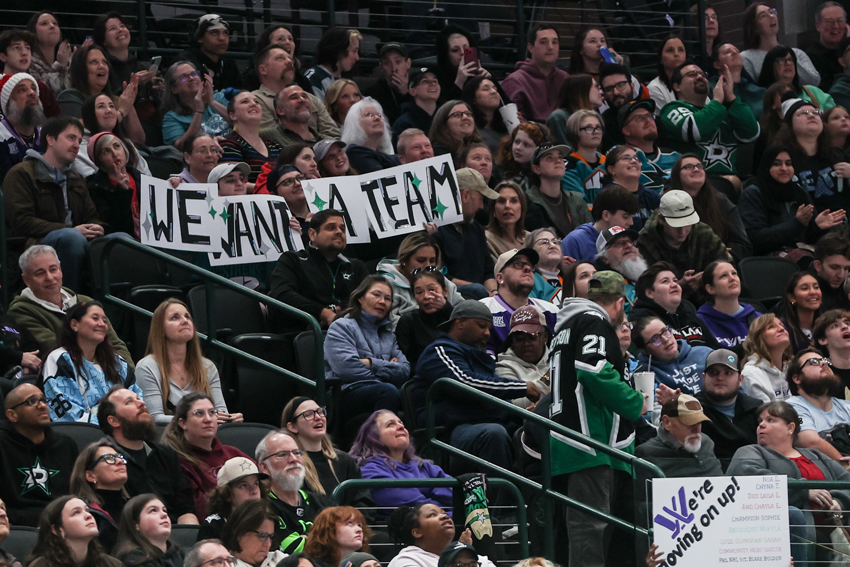
The league operated two merchandise stands on the AAC’s lower concourse. Each had a line of prospective customers that stretched the length of its lobby before the game. Any league would be pleased to see such commercially manifested enthusiasm for its product. And we did see a number of fans already clad in PWHL gear, including for teams beyond the two participants. But we also saw a ton of other pro hockey teams represented. We spotted sweaters for the New York Rangers, Detroit Red Wings, and San Jose Sharks, plus many attendees in Stars jerseys. We considered that an encouraging sign for women’s hockey, because it said to us that those people considered this game a legitimate part of their hockey fandom.
We also saw a number of girls in matching non-professional jerseys, clearly indicating they played on the same youth team. Their attendance spoke in many ways to the effect the Stars have had on their sport. Since moving to the area in 1993, the club has put considerable resources into creating opportunities in youth hockey. In recent years, especially, that has included programs specific to women and girls. Indeed, New York’s Allyson Simpson and Seattle’s Hannah Bilka had dropped the ceremonial first pucks at the previous evening’s Stars game. Both are North Texas natives who got their starts playing hockey in the area.
The North Texas appearance represents the tour’s southernmost appearance by a goodly margin, with the next-closest dates coming in Washington, D.C., and Denver. Though the Stars and the NHL are a big deal, they’re not the biggest deal in this part of the country — there’s a reason half the PWHL teams are located in Canada. So, casting the widest net possible to expand a fanbase seems vital to their brands’ growth. (In an encouraging sign for the league, the D.C. crowd was reported at a U.S. in-arena women’s hockey record of 17,228.) We’ve seen the Stars franchise and its charitable foundation embrace initiatives in South Dallas and with Hispanic sports fans. They’ve hosted Pride initiatives to tap into potential LGBTQ+ supporters. Indeed, the two sports fans I brought with me that Sunday night (my nieces) had never been to a hockey game (totally my fault; terrible uncle), but they had learned about the sport from the Heated Rivalry TV show that centers on gay male hockey stars. Thanks to Sunday’s experience, they’ll now be excited to check out a Stars game. I will definitely make that happen.
The PWHL expanded by two teams for this season, its third. Continued successes in potential growth markets, along with support from men’s hockey entities (the NHL provides in-kind support to the women’s league), will accelerate the process of adding more franchises. The U.S. women’s exciting overtime win against Canada in the February 19 Olympic gold-medal game won’t hurt, either. Team Canada’s roster consisted entirely of PWHL players. Team USA had mostly PWHLers supplemented by a few NCAA college stars.
At the AAC, we saw fan-created signs requesting a PWHL expansion team for North Texas, including one by some fans sitting in front of us that made it onto the scoreboard video screen. Stars players Jason Robertson and Mavrik Bourque also found themselves on the big TV. They came to the AAC on a night off to watch the PWHL game. Maybe someday they’ll share the arena with one of its teams.
Courtesy PHWL