

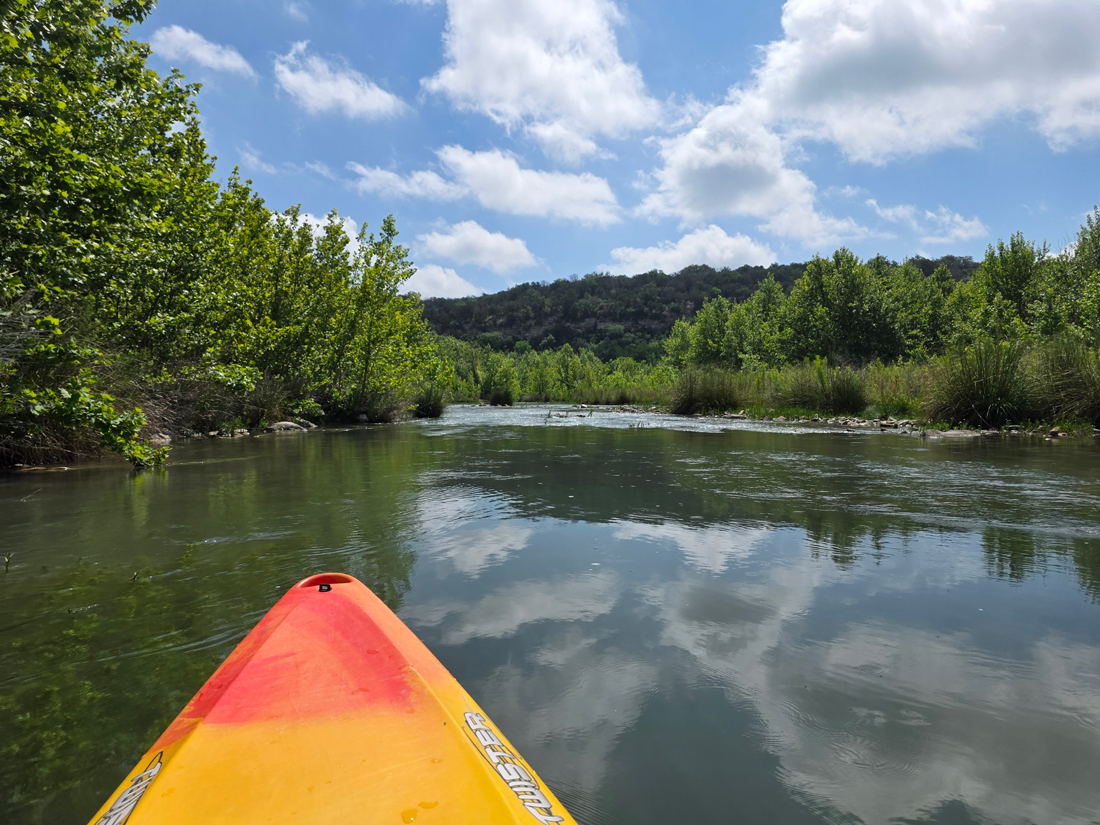
I stopped paddling. I was content just to glide across along the translucent, aquamarine water. It was a sublime daydream.
I caught my breath.
My kayak was skimming along a blue-green ribbon of liquid ether, but my momentum had stopped. Though still heading downstream, a gentle breeze had slowed my progress, and I felt like I was falling back. It was a perfect metaphor for contemporary American life: being pulled backward upstream rather than moving with the natural flow.

I started to dip the right blade of my oar into the water but held off, my kayak now frozen in the river.
Sure, you have to struggle, and, in this case, paddle, move forward. It was bred into me.
But what if I didn’t?
My kayak might turn or list. My kayak might drift into reeds along the verdant bank or beach in the limestone, rocky shallows — but so what.
Loafing has its virtues.
Paddling hard, I’d made several mistakes over the years. I took forks that ended in stagnant pools. I several times toiled down narrowing waterways that left me stuck in intolerable shallows. I got caught in more than one confounding eddy. I was repeatedly capsized by rocks and dangerous rip currents. Some labors led me to dead ends that lasted minutes, hours, and, yes, even years.
I used to have what football secondary coaches called “excellent recovery speed,” which translates to a capacity to accelerate quickly and recover from missteps or lack of optimal position. Now, older, I’ve lost a step, but I see the field better. It’s never too late to right the proverbial ship.
Dead ends are only dead ends if you refuse to turn around, paddle a different direction, or, more formally, chart a new course. It applies to life, love, and politics. And that’s where we are.
I drifted for a moment, in my head as much as along the picturesque South Llano River. It suited me, but so did reaching the next bend in the river, next path across the water to navigate, and the next set of small rapids. I could hear the splashing din already.
Funny, I’d been an infrequent or intermittent river rat for decades but never really recognized or reconciled myself with the pull of the river as clearly as I did in that moment. The cautious turtles, ducks, and riverine storks whom I’d often startled or raced by — now, I knew why they scattered.
The journey is the thing, not the completion of it, time elapsed, or the arrival.
An arrival is just another beginning.
Life is discerning the depth and navigating the flow.
Heraclitus was right over 2,500 years back. “No man ever steps in the same river twice, for it’s not the same river, and he’s not the same man.”
But once you’re on the water or making that journey, you can change the way you see it and how you ply it.
Everything except us seems ready. — E.R. Bills
Fort Worth native E.R. Bills’ eighth nonfiction title, Devil of Devils: Unspeakable Crimes in Southwest Texas, will be released in September by The History Press.
This column reflects the opinions and fact-gathering of the author(s) and only the author(s) and not the Fort Worth Weekly. To submit a column, please email Editor Anthony Mariani at Anthony@FWWeekly.com. He will gently edit it for clarity and concision.