


Ask most people to name a film by Park Chan-wook, and they’ll say Oldboy. That movie came out more than 20 years ago, a sign that Park has yet to gain the same worldwide stature as his film-school buddy Bong Joon-ho. This, even though Park’s filmmaking, if anything, has improved since he made that revenge epic.
His No Other Choice made some other critics’ year-end Top 10 lists, and it landed at No. 1 on mine. This weekend, the film opens at Tarrant County theaters, and you can see how this astonishing craftsman has progressed. Or, if that doesn’t excite you, you can see a gleefully wicked thriller about how the global economy makes killers of us all.
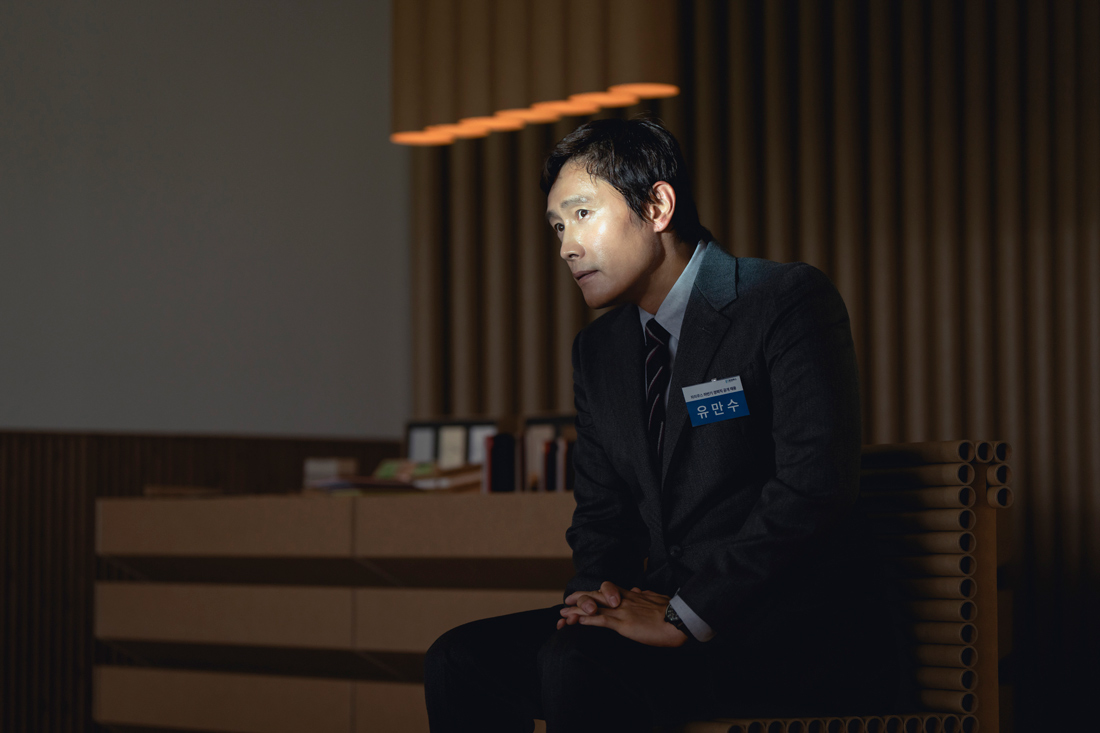
Our antihero is Yoo Man-su (Lee Byung-hun), a line manager who has worked for 25 years at a Seoul paper company. The movie starts on a glorious summer evening, as he hugs his wife Mi-ri (Son Ye-jin), two children, and two golden retrievers in front of his home and declares, “I’ve got it all!” You can sense what’s coming. The eel that he’s barbecuing on his grill isn’t a thank-you from his employer but rather a parting gift from the American corporation that has just acquired it and will shortly fire him.

There follows one of Park’s great, sinuous tracking shots. Man-su tails his counterpart (Park Hee-soon) at the country’s biggest paper company and resolves to take his job by sneaking onto somebody’s terrace and dropping a large potted plant on the man’s head as he walks by.
Man-su backs off, not because he doesn’t have it in him or because he suddenly realizes that murder is wrong, but because he remembers that his entire industry is contracting, so there’s no guarantee that he’ll replace the dead man. Cleverly, Man-su takes out an ad in a trade publication touting a new startup company so that other unemployed papermakers will send him their resumés and he can start stalking and getting rid of everyone who’s more qualified than he is.
The story is based on Donald E. Westlake’s novel The Ax, and the density of detail is just incredible. Bits play into the main plot in all kinds of unexpected ways, such as Man-su’s love of gardening, his dead father’s souvenir from his service in the Vietnam War, and his piggish neighbor (Kim Hyung-mook) offering to buy his ancestral home. Straining his finances further, Man-su’s autistic 10-year-old daughter (Choi So-yeul) is a cello prodigy who needs private lessons at a university to become a financially independent musician. Man-su’s spying on the candidates inevitably bleeds into his personal life — when he finds out that a rival named Gu Beum-mo (Lee Sung-min) has a wife who’s screwing a younger man, Man-su starts casting sideways glances at Mi-ri and the handsome dentist (Yoo Yeon-seok) whom she’s working for as a hygienist.
Meanwhile, she thinks he has another woman because of his unexplained absences from home. This whole movie works as a film about marital infidelity, since almost all the men here are either cheating or being cheated on. It also works as an alcoholism drama, as Man-su discovers that Gu is a fellow recovering alcoholic and witnesses him falling off the wagon after catching his wife in the act. (Before he starts drinking again, the sight of Gu rolling around on his driveway immediately after seeing her infidelity is pathetically funny.) Man-su’s own nine years of sobriety will become a casualty of his quest later on.
Park’s scene transitions are as neat and tidy as ever, with a strobe-lit dance party becoming a thunderstorm that Man-su waits in for one of his victims, and Mi-ri rolling out of bed is juxtaposed with her husband rolling a man’s body into a hole that he’s dug. As always in Park’s movies, the violence and comedy reinforce each other, as in a farcical three-way struggle over a gun among Man-su, Gu, and Gu’s wife (Yeom Hye-rah), who is very conflicted about which man she wants to use the gun on.
Navigating all this expertly is Lee, who plays the ridiculousness of Man-su’s situations but also delivers a rending speech when Man-su resolves to buy a proper pair of shoes for his daughter’s first recital, since he can’t buy her a $50,000 cello. The man listening to this (Cha Seung-won) is another rival papermaker who’s working as a shoe salesman, and he’s moved to pity, which only makes it more horrifying when Man-su later kills him.
Man-su begins No Other Choice by standing up for the solidarity of his workers and the feeling of family fostered by their shared history. It’s the movie’s best joke, then, that it ends with him jumping for joy in a sterile AI-controlled factory where he’s the only human working. Where Bong’s Parasite showed us how capitalism turns poor people against one another, this film demonstrates how the prosperous can just as easily become so desperate. These Korean filmmakers point out our society’s flaws and what they do to us better than just about any other country’s. Like this film’s achievement, that’s stupendous.
No Other Choice
Starring Lee Byung-hun and Son Ye-jin. Directed by Park Chan-wook. Written by Park Chan-wook, Lee Kyoung-mi, Don McKellar, and Lee Ja-hye, based on Donald E. Westlake’s novel. Rated R.