

Do we need another film of Wuthering Heights? The great William Wyler turned it into an imposing movie in 1939. In 2012, Andrea Arnold countered with an absorbing lo-fi version with minimal dialogue and a Black Heathcliff.
Now, Emerald Fennell has made a version that’s different by virtue of paring away all the silly stuff that made Emily Brontë’s novel into a literary classic. This movie is a bodice-ripper about two insanely hot people and their forbidden love. It absolutely does not work on Brontë’s terms. On its own, however, it works pretty well.
The movie starts with abusive, drunk Mr. Earnshaw (Martin Clunes) seeing a boy (Adolescence’s Owen Cooper) being beaten in the street by his dad and taking the kid home as a pet for his headstrong daughter Catherine (Charlotte Mellington), who names the boy “Heathcliff” after a deceased brother. At least Heathcliff now gets beaten behind closed doors, as Earnshaw flogs him with his belt while screaming, “I’m the kindest man in the world!” The boy vows to take more punishment for Cathy, which sets a lifelong pattern for them.

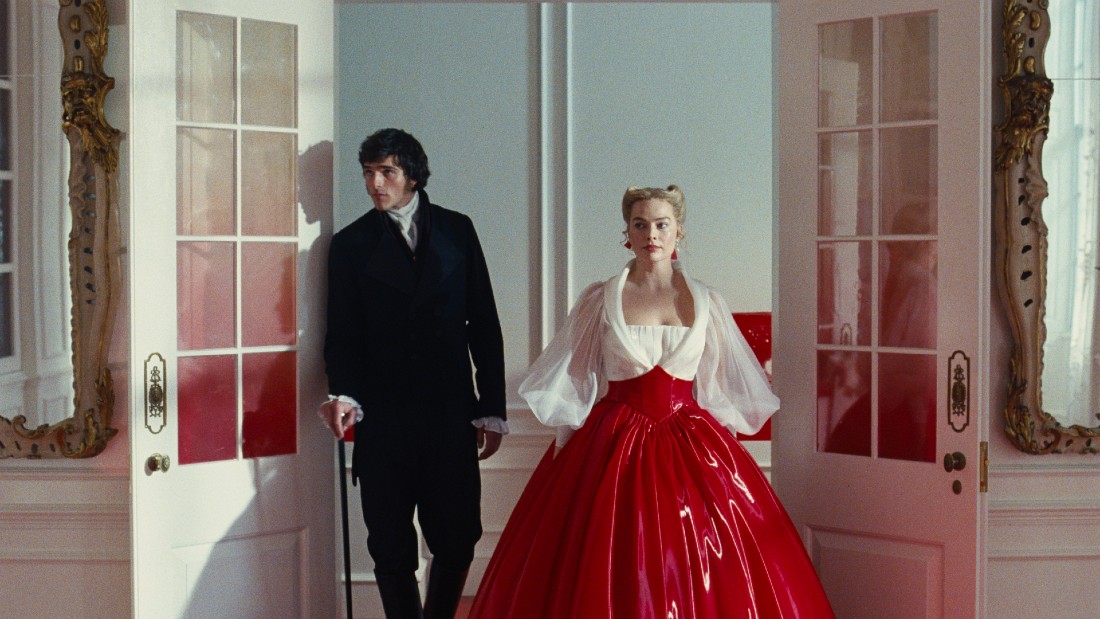
Fennell displayed a sharp visual sense in her previous films Promising Young Woman and Saltburn, and it’s even keener here, which is crucial to preventing this movie from turning into some museum piece. She transforms a room in Edgar Linton’s mansion into a replica of itself in a large dollhouse kept by Isabella (Alison Oliver), as well as Earnshaw dying amid 10-foot piles of empty liquor bottles. Edgar’s mansion is more garish than any Regency-period estate, with bright red floors and a bedroom whose walls replicate the color of Cathy’s skin. The contributions by cinematographer Linus Sandgren, production designer Suzie Davies, and costume designer Jacqueline Durran make this a treat to look at.
The director also infuses this story with more sex than any other film version has ever had, with grown-up Heathcliff (Jacob Elordi) finding Cathy (Margot Robbie) masturbating on the heath. Cathy’s repressed libido means that even seeing a maid knead dough makes her think of sex, and she gets her first glimpse of it when she sees a stable boy and a maid (Ewan Mitchell and Amy Morgan) do it with the help of reins and a riding crop. This is part of a pattern of S&M imagery that recurs throughout the film, though not as much as the movie I’m reviewing next week, so check back here.
The S&M theme finds a parallel in Fennell’s script, which emphasizes the shifts in power as Cathy spurns the impecunious Heathcliff to marry the wealthy Edgar (Shazad Latif), only for Heathcliff to resurface years later with some mysterious wealth of his own. Clunes makes the most of his role as a bastard who finds ways to torture Heathcliff even after the younger man buys his ruined estate, while Oliver lends a welcome note of ridiculous comedy playing Isabella as a creepy nerd who admits to collecting Cathy’s hair. The whole subplot where Heathcliff marries Isabella to spite Cathy is deeply icky, as he keeps her tied up at home on a dog leash but she still manages to taunt him about his past and his secret illiteracy.
Elordi is no slouch here, but Robbie completely owns the show, playing Cathy as someone who’s extremely aware that she’s prettier than any woman around her and is personally insulted when men don’t instantly fall in love with her. We need to give serious consideration to the idea that she’s one of the world’s great actors. Look at her performances in The Wolf of Wall Street, I, Tonya, Birds of Prey, Barbie, and this and ask yourself who else has this kind of range.
Things like her performance and Fennell’s craftsmanship are the redemption of this Wuthering Heights. It’s easy to dismiss this movie as some trashy romance-novel version of Brontë’s story, just as it’s easy to reduce the novel to some hot plot teeming with sex. It’s considerably more difficult to supplement that with an aesthetic of the filmmaker’s own, but that’s what Fennell has managed to do here. In light of that, I’m rather enamored of her trashy mind.
Wuthering Heights
Starring Margot Robbie and Jacob Elordi. Written and directed by Emerald Fennell, based on Emily Brontë’s novel. Rated R.