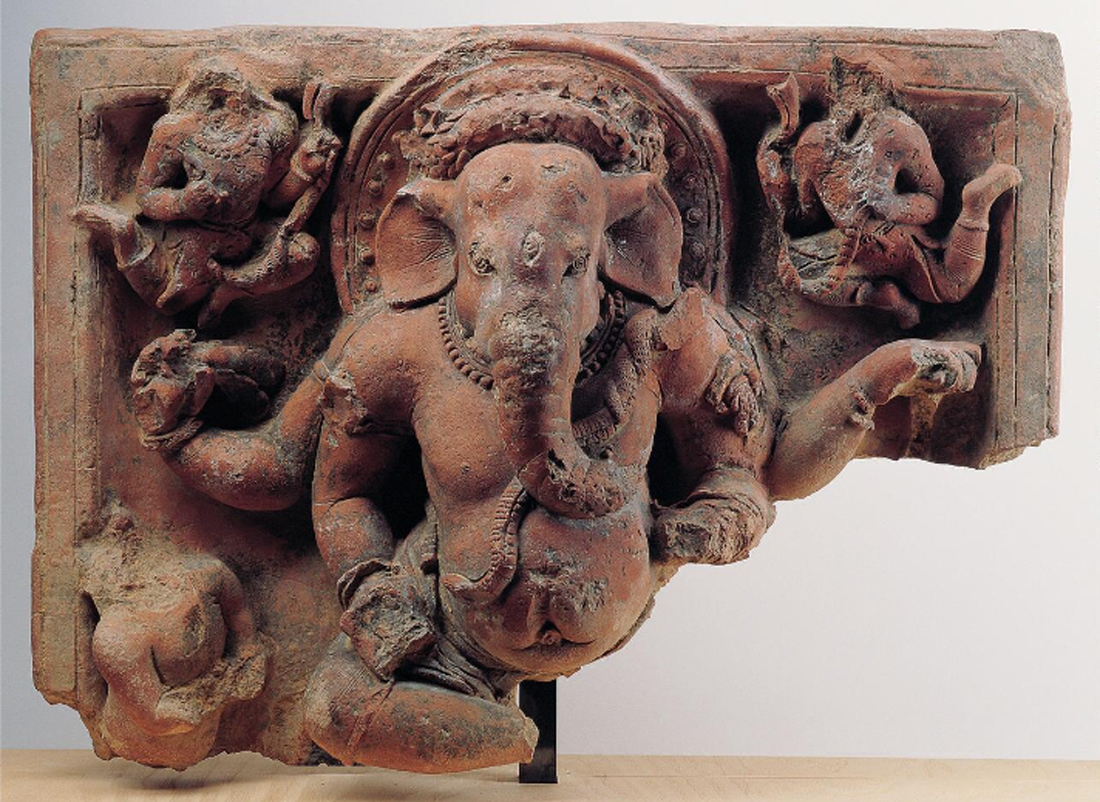
One of the Kimbell’s definitive “jewels” is “Four-Armed Ganesha” from the 5th-6th century A.D. The elephant-headed son of the goddess Parvati and Shiva (one of Hindu’s three most important deities), Ganesha is worshipped for removing obstacles and bestowing upon his followers good fortune, prosperity, and health. The myth is that Parvati employed Ganesha in human form to protect her chambers, but when the baby tried to keep Shiva out, the father cut off the child’s head. To comfort an upset Parvati, Shiva replaced the baby’s lopped noggin with the nearest living thing: the head of an elephant. The Kimbell’s terracotta relief is wonderful but slightly damaged. Traditionally, Ganesha would also bear an axe, rosary, and bowl of sweetmeats. In Hinduism, multiple arms represent deities’ far-ranging, manifold powers, and most brick Hindu temples were decorated with these kinds of plaques. The age and rareness make “Four-Armed Ganesha” an unmistakable gem.
Fort Worth is home to one of the most impressive collections of Asian art in the country. The Kimbell Art Museum’s holdings are not large or comprehensive, just otherworldly and stunning. Many of the pieces are emblematic or typical of a critical time period or style, making them “jewels.”
In the North Gallery of the Piano Pavilion, the Kimbell’s Asian collection encompasses sculptures, paintings, bronzes, ceramics, and decorative art from China, Korea, Japan, India, Nepal, Tibet, Cambodia, and Thailand. Among the dozens of works spanning two millennia are several masterpieces. Chinese, Indian, and Southeast Asian pieces come in the forms of rare sculptures, ceramics, and textiles.
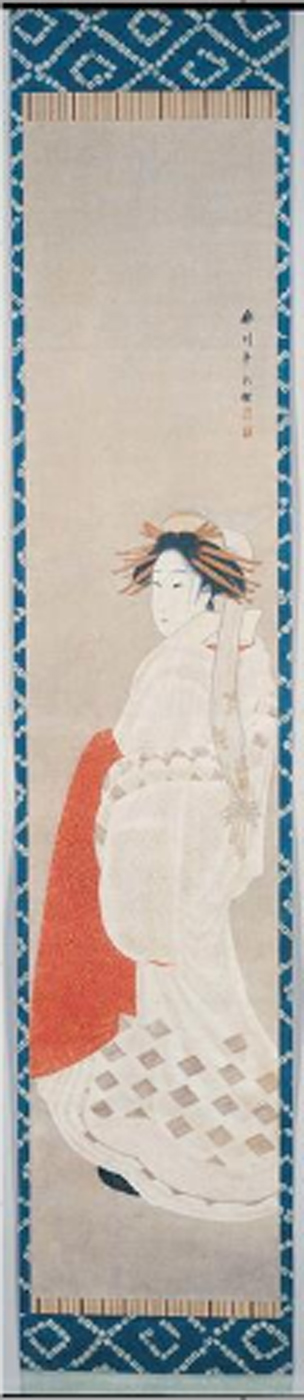
A decorative hanging scroll from circa 1800, Rekisentei Eiri’s “Beauty in a White Kimono” depicts a seductive courtesan — look at how she glances over her shoulder with her hair slightly askew — in the all-white costume worn only in Edo (Tokyo) on hassaku, the first day of the eighth lunar month, a.k.a. the “eighth-month snow.” Her youth and high rank as a courtesan are indicated by the red sash tied in front in a gold diaper pattern, or sayagata. Among the fashion-conscious ladies of the pleasure quarters, paintings of courtesans often focused on the latest styles of dress.
The pieces do not exist without context. Through display and scholarship, the Kimbell does a great job of highlighting the role that trade played between the far reaches of Asia and the rest of the world.
Traveling Asian art also has a home at the Kimbell, whose touring exhibits include 2021’s Buddha, Shiva, Lotus, Dragon from the Mr. and Mrs. John D. Rockefeller 3rd Collection at Asia Society, and 2018’s From the Lands of Asia.
Collecting rare “jewels” instead of going for breadth was established by the museum in 1966 under original director Richard F. “Ric” Brown: “The dominating principle involved in the acquisition process is that the stature of the Museum depends more upon the quality of the definitive objects that it contains than on the historical completeness of its collections. A prospective addition to the collections, therefore, is to be judged from the standpoint of aesthetic quality and typicality and whether it defines a master, period, school, style, or area. The goal shall be definitive excellence, not size of collection.”
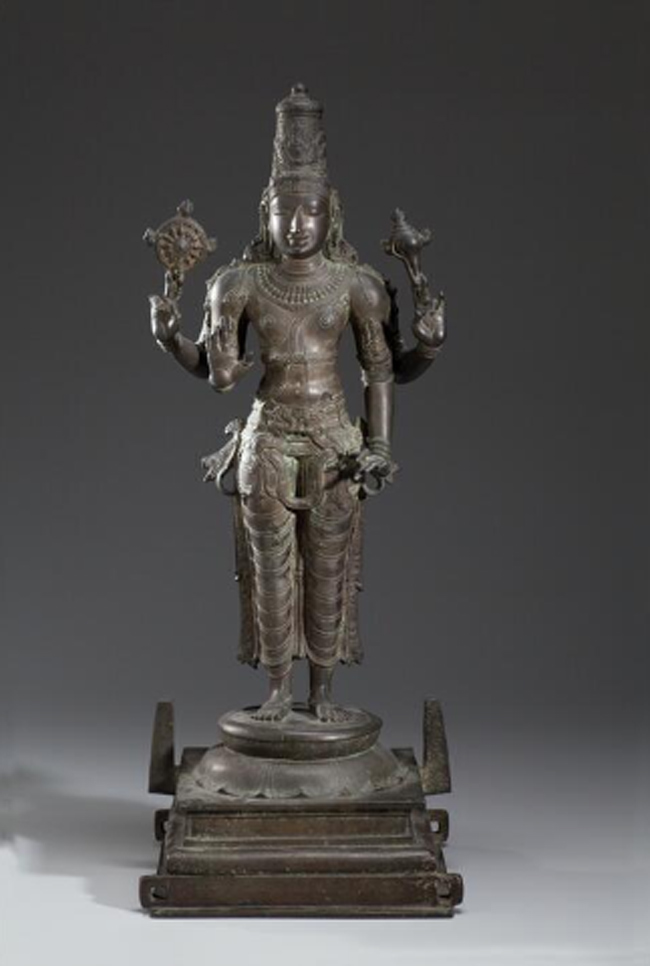
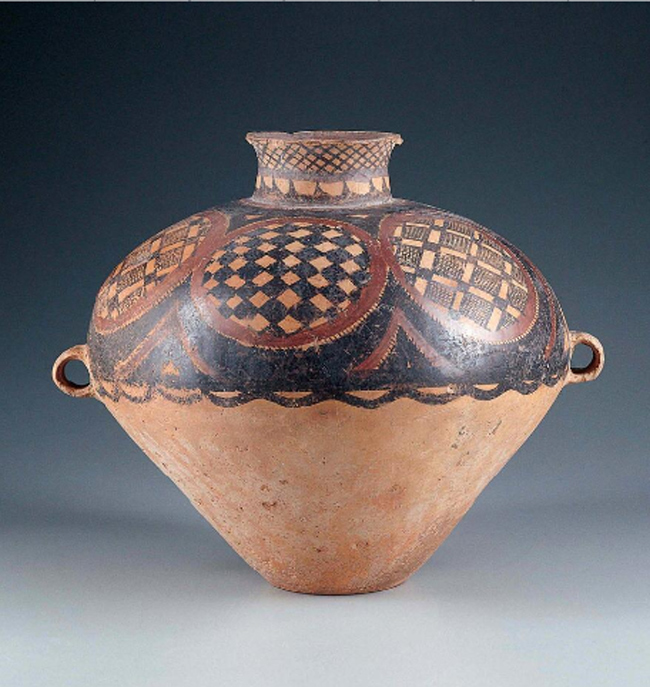
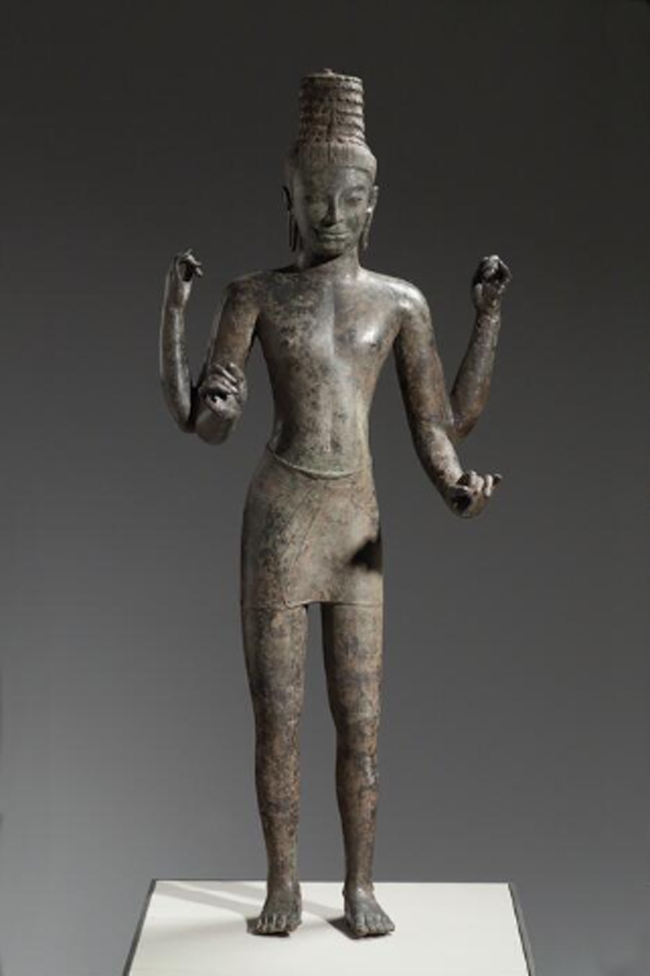
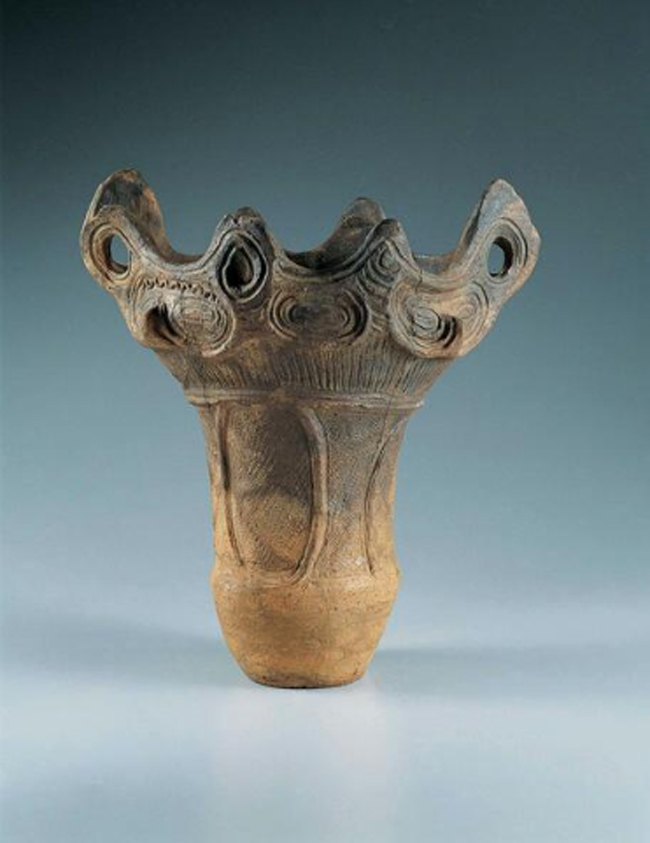
From the 13th century, this sculpture of Vishnu depicts the preserver in traditional relief. This benevolent god who protects from natural disasters and guards the righteous is also a warrior deity who conquers evil all in its various personifications. Standing in the frontal pose of samabhanga, his traditional posture, this Vishnu is spectacularly attired in a fabulous skirt (dhoti), lots of bling, and a tall crown. With his lower right hand, he gestures reassurance (abhayamudra), and with his lower left, he signals gifts (ahuyavaramudra). In his other two arms rest his attributes: a wheel-shaped discus thrown to cut down the enemy and a conch-shell trumpet to strike terror in the opposition’s heart. Sculptures like this were carried in ritual processions through temples and adjoining areas, and it was believed that the deities themselves resided temporarily in their sculptural forms.A simple jar, yes, but this Chinese ceramic from circa 2,500 B.C. has some contemporary appeal. It’s there in the checkerboards, cross-hatching, concentric bands, and an overall abstract vibe that keeps this kind of pottery so intriguing. This hand-painted piece was probably used to hold food or liquids buried with the dead in Neolithic times. To reiterate: It’s really flippin’ old, and simply admiring it in person might inspire you to stay strong and durable in these trying times.Much like Jesus centuries afterward, the divine four-armed bodhisattva delayed his own final nirvana to assist mankind, and the Kimbell’s “The Bodhisattva Maitreya” from the late 8th century A.D. is truly a piece of heaven on Earth. This deity can be identified as Maitreya, the bodhisattva of the future, by the small, venerated Buddhist structure, or stupa, at the base of his coiffure. Measuring around 48 inches tall, this bronze piece from pre-Angkor (A.D. 550-802) Thailand was part of a group of bronzes unearthed in 1964 at an abandoned village temple. The Kimbell’s is one of the largest and most striking of the find. What’s different about this bodhisattva is that he is slender and clothed in only a small loin garment when typical Indian bodhisattvas were depicted in skirts, jewelry, and flowing scarves. The lack of flare means this dude represents a bodhisattva-ascetic, one who denies himself mortal pleasures to achieve spiritual enlightenment. Also kinda like Jesus.Dating from 2500-1000 B.C., this jar with sculptural rim was so fancy it wasn’t used daily but more likely during religious ceremonies. For whatever reason, probably simple pleasure, early Japanese sculptors rolled ropes across the surfaces of moist clay during the Neolithic period to embellish utensils, to fancify them. The technique is called Jomon, or “cord-marked,” and it reveals a hunting/fishing culture in love with beauty in all its forms.