
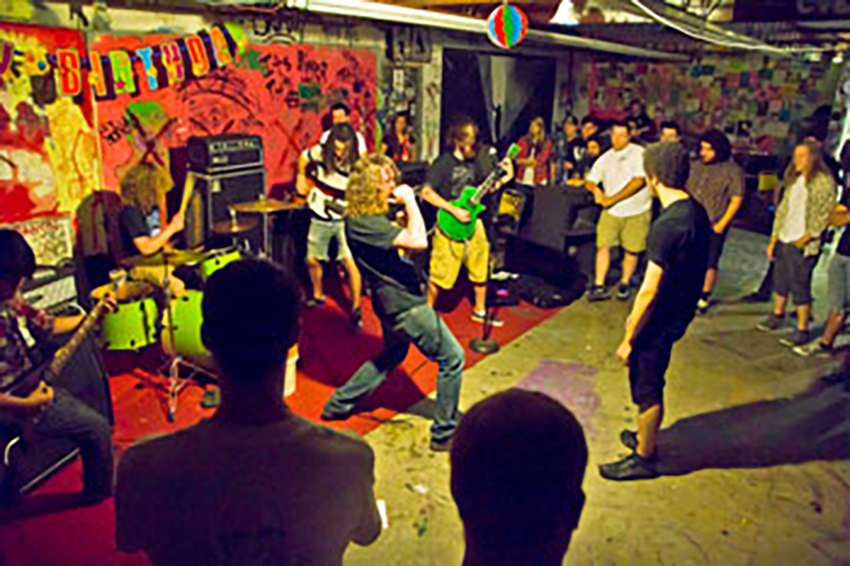
It’s difficult to overstate the impact of 1919 Hemphill. The long-gone, all-ages, DIY community space on the Near Southside lasted from 2002 to 2019, and in those years, the rickety, colorful, faultily wired, graffiti-sprayed maintenance-nightmare of a two-story building provided a space for outsiders and weirdos, hardcore bands and freak-folk artists, activists and anarchists, and hundreds of kids who needed a place where they didn’t feel so alone. It was a center for progressive organizing and philosophical discussions, where people could just be themselves, often amid ear-splitting amp volume and the churn of a circle pit. That place touched hundreds of lives, and the void left by its unceremonious closure is more noticeable now than ever.
Denton-based documentary filmmaker and MFA student McKinley Argyle has completed a short film about 1919 Hemphill. A Place We Can Go To premiered in July at the Oak Cliff Film Festival and is currently making the rounds of the festival circuit (along with her other film, a documentary about the Denton noise scene called Meet the Noisemakers). To be eligible for festival submission, A Place We Can Go To is not yet available online, but Argyle said she is hosting screenings at Rubber Gloves (409 E Sycamore St, Denton, 940-514-0675) on Mon, Aug 31; Fort Worth Zine Fest on Sat, Oct 17, at Southside Preservation Hall (1519 Lipscomb St, Fort Worth, 817-926-2800); and at the Dallas New Media Contemporary “sometime in September.”
In one of the film’s interviews, Fort Worth spoken-word poet Tammy Gomez says, “DIY is about practicing your type of existence, and [at 1919 Hemphill], I loved the interplay of people’s bodies working together, people’s minds with very diverse ideas coming together and sharing.”

The film’s footage, which will elicit a lot of “I was at that show!” moments if you spent a lot of time there, underscores Gomez’s idea of interplay between people and ideas: youth working on projects, youth slamming in mosh pits, youth just making shit happen because it was fun and personally expressive. The end credits are an archive of all the local and touring bands that played 1919, some of which — like Kimya Dawson and Japanther — are still kind of a big deal. But regardless of who came through, showing young people that they could come together and have something of their own was what mattered the most. As organizer/activist Charli Bonham says in another interview, “For me as a young person, seeing people my age, like, running a place like that — I don’t think I realized until I was older how influential that was.”
Argyle is 25 and “was a very sheltered Mormon teenager in Prosper, Texas” during 1919’s heyday, so her connection with the space is really only through her own investigation. She plays bass in a shoegaze band called Gloss and the ambient project Tag-Team Tag-Team, and at a show at a coffeeshop, when she was talking about her idea for a doc about local DIY spaces, a guy there told her about 1919. She said she just “cold DM’d” 1919 Hemphill volunteers Rick V and Al Rios along with Bonham. “They’ve been amazing.”
In addition to the story of 1919 Hemphill, Argyle’s film features Denton DIY spaces Can of Beans and a secret-ish spot generally known as “The House with No Name,” and while 1919’s end was a bummer for Fort Worth, the spirit it exemplified lives on elsewhere. A Place We Can Go To’s message is that these spaces can happen if likeminded people work together.
“I think creating DIY spaces in this day and age is extremely difficult, both because of the cost of living but also the political climate,” Argyle said. “The best resource I have is literally just going to as many shows as you can. I find that that’s where the best connections and community support come from.” — Steve Steward