

The top explanation employers give for layoffs over the last four years is not Chinese competition, government regulation, or even inflation. It’s artificial intelligence, which entered its modern phase when ChatGPT launched Nov 30, 2022.
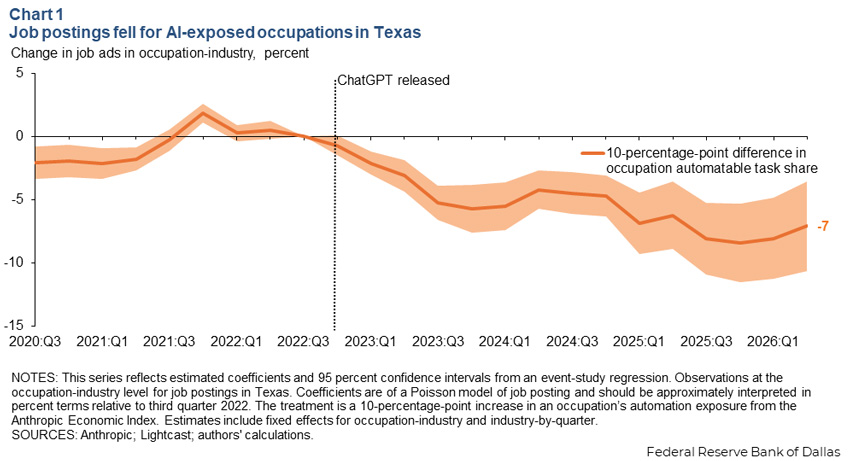
AI was blamed for 193,226 layoffs nationwide or 20% of the total since the start of 2023, according to outplacement firm Challenger Gray & Christmas. But layoffs are just part of the picture. AI may hit hardest on people who never get hired at all. In Texas, for example, the Dallas Federal Reserve said hiring ads for jobs most vulnerable to AI competition fell 8% from the end of 2023 through the first part of 2025.
Nationwide, 2.7 million to 19.5 million jobs could be lost to AI, according to an AI-impact tracker developed by Tufts University. The median estimate is 9.5 million jobs lost. Total annual wages at risk could range from $200 billion to $1.5 trillion, with $750 billion as the midpoint.

While AI job loss could affect nearly all of us in some way, the direct impact hasn’t landed equally on everybody. The Dallas Fed says software developers, web designers, and other computer-heavy occupations are most likely to lose their jobs. White-collar workers in general, including managers, clerical workers, and editors, are also in the AI crosshairs.
If you’re looking for a job likely to escape digital competition, a report from Claude chatbot developer Anthropic offers some suggestions. The most AI-resistant gigs it identified include cook, motorcycle mechanic, lifeguard, bartender, dishwasher, and dressing room attendant.
It could help to be already established in your career. The Dallas Fed said in Texas, recent college grads will be first to feel the effects of generative AI, including ChatGPT, Claude, and other chatbots. Another report, this one from the International Labor Organization, also suggested younger workers have been more affected, as youth unemployment in North America rose from 8.3% in 2023 to 9.9% in 2025.
Anthropic provided a different, more finely grained look at who is in the biggest trouble. It said older, female, more educated, and higher paid would probably be the most heavily impacted.
AI enthusiasts tend to counter statistics about AI-related job loss with promises of future job gains from the technology. And there’s evidence that AI-related job openings are on the upswing. An AI Economic Impact Tracker developed by the comptroller of the state of Maryland counted 273,000 AI job postings nationwide through the first nine months of 2026. That’s 79% more than it found in all of last year. The number is still small, however, totaling less than 2% of all hiring ads in the quarter.
So how bad could it get? Potentially as bad as the Great Recession of 2007-2009. Based on Anthropic’s study, if all the workers in the 10% of occupations most susceptible to AI were laid off, it would increase overall unemployment from the current approximately 4% to around 13%. During the Great Recession, unemployment peaked at about 15%.
But maybe that won’t happen. Things could get better than they are now. While the recent record on AI job impact suggests the technology has generally been a job destroyer, some forecasts are quite optimistic over the longer term. Technology trend-tracking firm Gartner, for instance, recently said only 1.8% of global workers will be hit with AI-related job losses. Further, it expects a net increase of 1.7 million jobs worldwide by 2030.
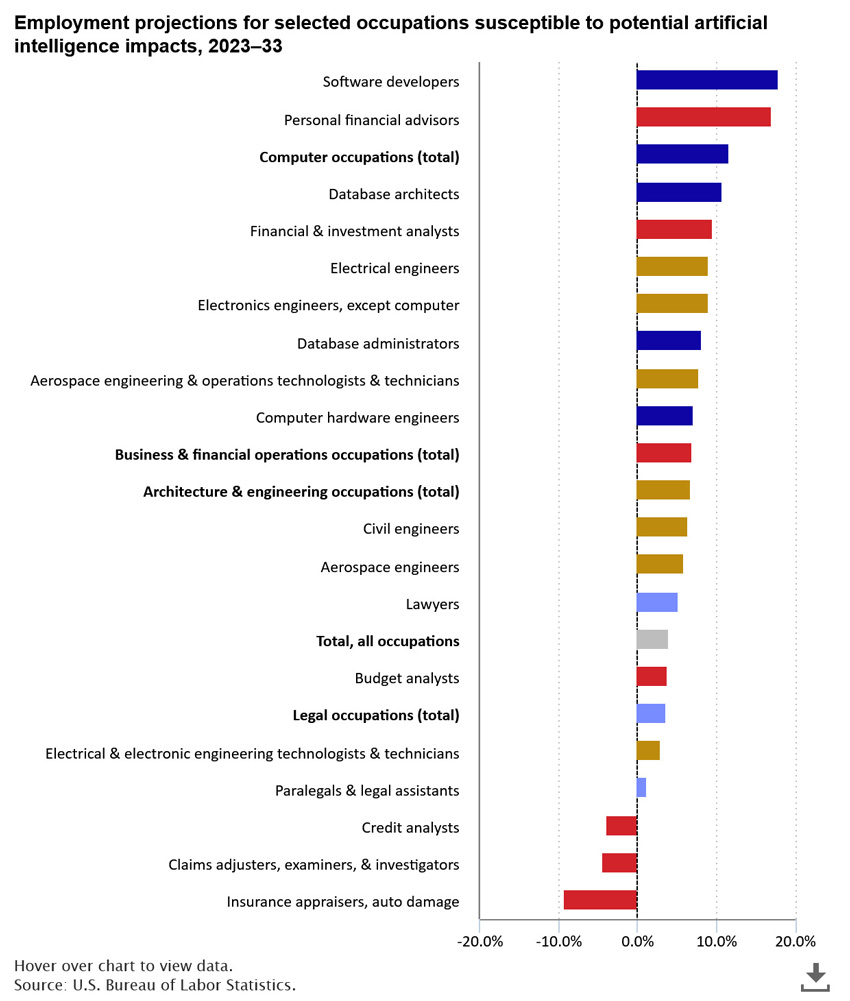
The U.S. Bureau of Labor Statistics had even rosier figures for the decade from 2023 to 2033 in a report it issued last year. By the end of that period, the government number-crunchers predicted, software developer jobs will actually increase by 17.9%. Other AI-affected gigs likely to see sizable jumps in demand include personal financial advisors, database architects, and electrical engineers.
Overall, per BLS, during the first decade of the AI era, employment will grow 4%, from 168 million jobs in 2023 to 175 million in 2033. Some jobs, however, are in for a rough spell. Job losses are forecast for credit analysts and a list of insurance-related jobs, including claims adjuster, appraiser, and investigator.
Of course, none of these forecasters predicted ChatGPT in 2022. And lots of unexpected events could happen to change the outlook. The Blue Wave is an example of one.
Compared to the AI-friendly administration of lame duck Gov. Greg Abbott, newly installed Democratic Texas state officials promise change is coming. Incoming Agriculture Commission Clayton Tucker, for example, has said that upon taking office, he’ll start studying AI data center impacts on jobs as well as the environment. “The more I learn about [AI], the more I’m thinking AI might be the real problem, not just the data centers.”
The Texas Workforce Commission, which is tasked with supporting job seekers and employers in the state, is sticking to a rosier, perhaps longer-term viewpoint of AI’s impact on jobs. In a statement to us, TWC said, “Ultimately, TWC views AI not as a replacement for human labor but as an opportunity for workforce empowerment. AI will allow workers to spend less time on repetitive tasks and more time on activities requiring high-level creativity, relationship-building, and critical problem-solving.”
Meanwhile, TWC does not have a program specifically aimed at helping Texans who’ve lost their jobs to AI. The commission urged anyone concerned about AI impacting their job to contact their local workforce solutions office about programs to learn new skills.