

As I feel that this film is well worth your time and mine, I’m running this review of The Samurai and the Prisoner that opened this past week at the AMC Parks at Arlington even though it is only showing once per day and its prospects for continuing to play in Arlington this coming weekend look dim. Readers who live a little further east or looking for a Dallas adventure can also head down I-30 to the Texas Theatre, the only other place you will be able to see this Japanese murder mystery set during feudal times.
The film is based on Honobu Yonezawa’s novel, which itself is based on real events and people in 16th-century Japanese history. Lord Murashige Araki was a general under the command of Oda Nobunaga, the fabled military genius whose conquests united Japan. However, for reasons that historians still debate, Lord Murashige turned against Oda at some point and retreated to his castle, where Oda laid siege to his forces for more than a year.
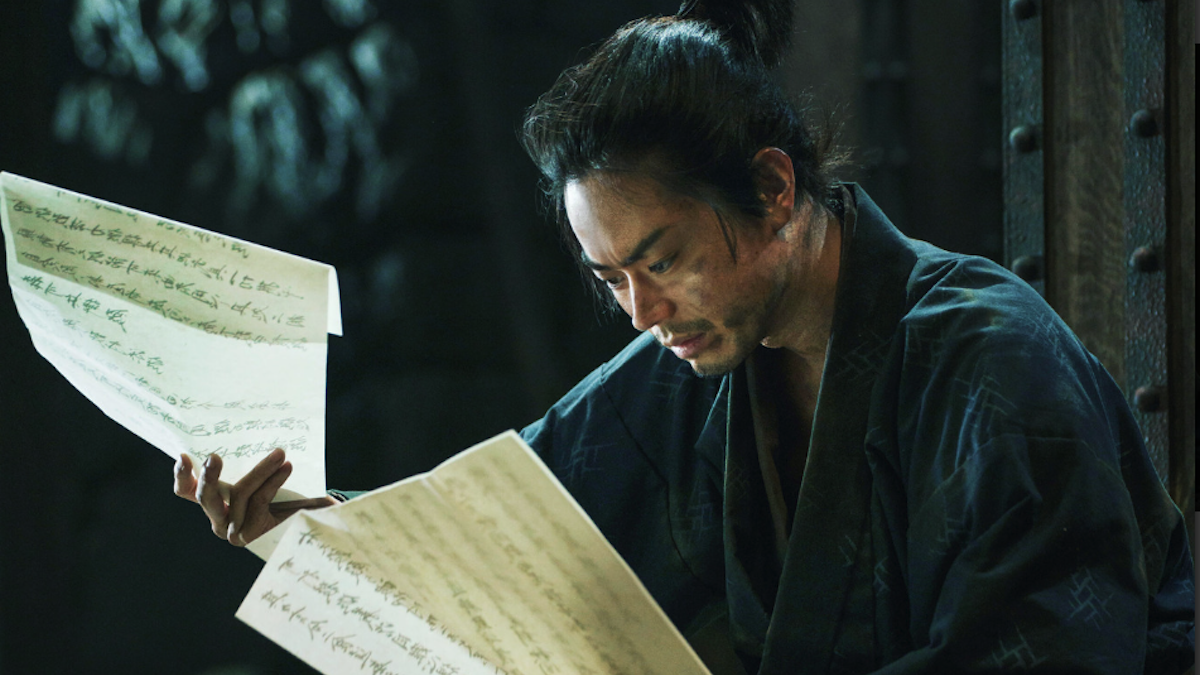
In the film, Lord Murashige (Masahiro Motoki) has more than just the siege on his mind. He violates the bushido code by taking Oda’s envoy Kanbei Kuroda (Masaki Suda) prisoner as well as the 12-year-old son of a former ally who has joined Oda. The boy is subsequently found dead in his cell, seemingly shot by an arrow even though no arrow is present at the scene. To avoid a scandal, the lord has to turn to the brilliant, imprisoned Kanbei to help him figure out how the kid could have been killed, especially with four loyal warriors guarding the room where it happened.

Writer-director Kiyoshi Kurosawa is better known for contemporary films about online culture: His Cure and Pulse are seminal horror movies from the dawn of the internet age, and his recent e-commerce thriller Cloud made my top 10 list last year. (Once again, he’s no relation to Akira Kurosawa.) There’s some unwritten law that every Japanese director has to make a samurai movie at some point, and this one slips into the period milieu with no trouble. You may find the film light on swordplay if that’s what you’re looking for — an entire battle sequence gets skipped over early on, and I suspect budgetary restrictions played a part. The 147-minute film is divided into four chapters labeled by the seasons of the year, as the boy’s killer is soon found before more homicides happen behind the castle walls.
Kurosawa is more interested in the nature of military and political power. While Akira Kurosawa’s samurai films showed warriors playing fast and loose with bushido, this movie dares to suggest that the whole code of honor might be just so much crap. Murashige refuses to execute his prisoners even though they beg for death, because he’s trying to win sympathy among the people. He finds that the move only loses the respect of his own soldiers, who revere the cruel and tyrannical Oda. The whole “victory or death” creed frequently results in the latter.
The men imperiously cite bushido whenever it suits their purposes, and ignore it whenever it doesn’t. When the person who engineered the murders is found out, they point out that the common folk never receive the benefit of bushido, as the samurai are free to kill them off like flies. This epic winds up in the same place as Christopher Nolan’s The Odyssey, with the warlord realizing that the best thing to do with power such as his is to give it up. Indeed, the movie’s epilogue points out that the real-life Oda was betrayed by his own generals and committed seppuku, while Murashige quietly outlived him as a master of tea ceremonies.
If all this is too abstract for you, the movie does drill down into practical matters, as Murashige and his followers conduct field tests to see how the murders were committed. Murashige questions the loyalty of some of his troops who happen to be Christians, which plays fascinatingly with the murderer’s manipulation of the Buddhist soldiers’ need to believe in divine punishment. (The movie does not mention that the real-life Kanbei Kuroda himself converted to Christianity after his ordeal as Murashige’s hostage.)
The movie turns on the relationship between Murashige and Kanbei, as the prisoner’s hostility is the only given that the lord can navigate by. This results in some fine acting by the two leads, with Motoki (who starred in the Oscar-winning Departures) conveys the doubts roiling Murashige’s lordly bearing and Suda as a man whose mind continues working while his body is in chains. Maybe The Samurai and the Prisoner could have done with a bit more blood and thunder, but its strong and complex story more than compensates for it.
The Samurai and the Prisoner
Starring Masahiro Motoki and Masaki Suda. Written and directed by Kiyoshi Kurosawa, based on Honobu Yonezawa’s novel. Not rated.