

There are other epics, but you can argue that Homer’s Odyssey is the epic of epics. Composed centuries before Christ — by a man? a woman? a group of people who gradually added to the poem over decades? — the 12,000-plus-line poem has fantastical creatures, strange lands, huge action set pieces, gods being really petty with one another, and a man trying to get back home to his family. It all begs for cinematic treatment, and other great filmmakers have turned the story into wildly different movies: Hayao Miyazaki’s Nausicaӓ of the Valley of the Wind, Theo Angelopoulos’ Ulysses’ Gaze, the Coen brothers’ O Brother, Where Art Thou?
Now Christopher Nolan has adapted it into a 172-minute behemoth laden with A-list stars. It is a lot of a lot, and it is not free of flaws, but it is a cogent interpretation of the work. Odysseus (Matt Damon) stays away from his home for 20 years not because of eating lotuses or because Poseidon is pissed off at him but because the atrocities he committed during the Trojan War make him ashamed to be seen by his family. If that is a distinctly modern interpretation, it’s no less valid on that account in this film that earns its epic status.
The movie opens with a bard (played by the rapper Travis Scott) declaiming, “A face, a fleet, a war, a man!” He’s preparing to sing about the Trojan War exploits of Odysseus, but Penelope (Anne Hathaway) scotches the performance because she’s heard it too many times since her husband engineered the fall of Troy. Where the epic poem builds up anticipation about Odysseus by keeping the hero out of action at the start, this film indulges in a number of Nolan’s beloved framing devices, as Menelaus (Jon Bernthal) tells part of the story to Telemachus (Tom Holland) while Odysseus himself tells another part of it to Calypso (Charlize Theron) after his memory starts to return.

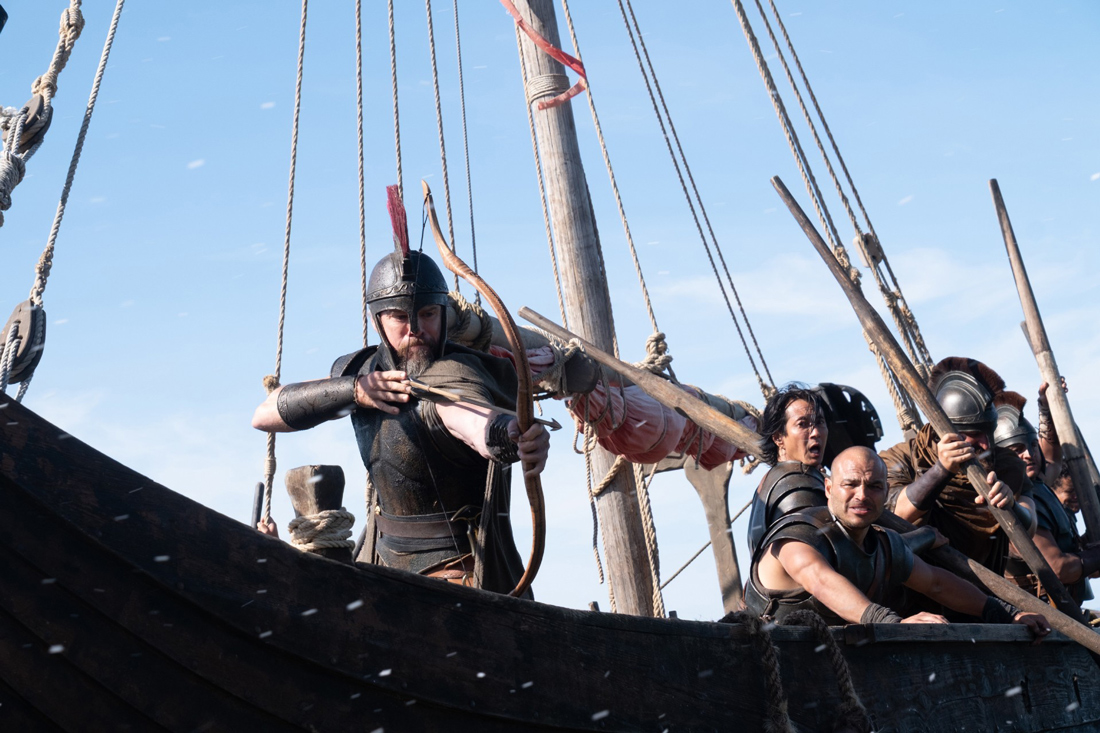
As you’ve probably intuited, you will need a multiplex’s biggest screen to properly appreciate the visuals here: the treacherous topography of the islands where Odysseus’ men set foot, the storms at sea that wash sailors overboard, the boat steering between Scylla and Charybdis, the battle with the Laestrygonians, the black sands of Hades where Odysseus faces the spirits of all the soldiers who died obeying his orders.
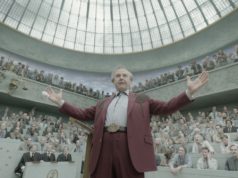
Homer does not spare us the gore in his telling of the tale — surely readers recall the description of the blood jet spurting from Antinous’ nose when he’s shot with an arrow. I wish Nolan had followed suit. True, there’s a nicely gross moment when the cyclops (Bill Irwin) eats the soldiers, but the story would have been so much more powerful if we’d seen more blood during the sack of Troy, which is withheld from us until near the end. In turn, that would have given greater sting to the appearance of the goddess Athena (Zendaya), who follows Odysseus around with an accusatory stare. The film is already rated R, so more violence would not have affected that. Nolan’s overly scrupulous approach does his movie no favors.
Some of the actors do get swallowed up by the scale of this epic, but enough of the film does work on a human level to give many of them rewarding material, like when Odysseus talks to Circe (Samantha Morton), well aware that she’s more than just a lone farmer tending her pigs. Hathaway communicates the anger and loneliness lurking behind Penelope’s regal façade, John Leguizamo is unusually understated as the nearly blind shepherd Eumaeus, and Lupita Nyong’o pulls off an impressive double role as a regretful, facially mutilated Helen of Troy and a vindictive Clytemnestra who murders her husband Agamemnon (Benny Safdie) after he returns from the war.
There is much talk here about Zeus’ law, a golden rule mandating that the rich give alms to the poor and homeowners give hospitality to travelers and people in need. While the cyclops violates that law because he recognizes no gods, it’s nothing compared to Odysseus’ trick with the Trojan horse, a peace offering that carries the soldiers who will massacre Troy’s civilian population and burn down the city. In his disguise as a beggar, a haunted Odysseus tells Penelope that he “saw 10 years of rage pour into the city in one night. … We lived in palaces, trade, and language, and we were blind to its beauty until we broke it.”
Because the Greeks violate the rules of fair play that they claim to believe in, Penelope’s suitors eat her out of house and home. They ambush Telemachus at a holy temple while dressed as priests, and civilization falls to piracy all across the islands. The state of the world mirrors Odysseus’ broken psyche, and the only way to mend it is to kill the fortune-hunting suitors and give up power. The Odyssey could have been a turgid and lifeless homework assignment. Because of Nolan’s angle into this ancient story, it becomes an engaging tale of the sort that Hollywood is uniquely suited to making.
The Odyssey
Starring Matt Damon and Anne Hathaway. Written and directed by Christopher Nolan, based on Homer’s epic poem. Rated R.