


Maybe you’ve heard the whispers that Netflix’s pricey gay epic La bola negra might be the movie that will overhaul The Odyssey for the Best Picture Oscar. That movie now expands to a few Tarrant County theaters this weekend before it hits streaming next month, and I suspect that if I were Spanish, I might be on board with the hype.
That’s because even though the movie isn’t really about Federico García Lorca, it provides a long-overdue reckoning with the idea that Spain’s national poet was a homosexual man and may have been murdered for it in 1936. (The identity and motivation of his killers remains hotly debated inside Spain.) Alas, I am not Spanish, and I have seen better gay movies this year, though this film still has a number of things going for it.
The movie revolves around a real-life stage play that García Lorca left unfinished at his death, a work that dealt openly with homosexuality. In one of the film’s major plotlines, the filmmaking team of Los Javis (namely, Javier Calvo and Javier Ambrossi) imagines how that play would have gone. A young man named Carlos (Milo Quifes) applies for membership in Granada’s big casino in 1932 and is literally blackballed — the members vote with black balls to reject him — because of rampant rumors about his secret gayness.

This plot works reasonably well on its own, especially when Carlos has to answer questions about his sexuality while a mob of revolutionaries is pounding at the casino’s door; the fossilized city fathers insist on going through with the inquisition and refuse to save themselves because it would break with tradition. The imagined end of the play, with Carlos in the afterlife wishing that he could go back and live his life as he wanted to, is a lovely touch.
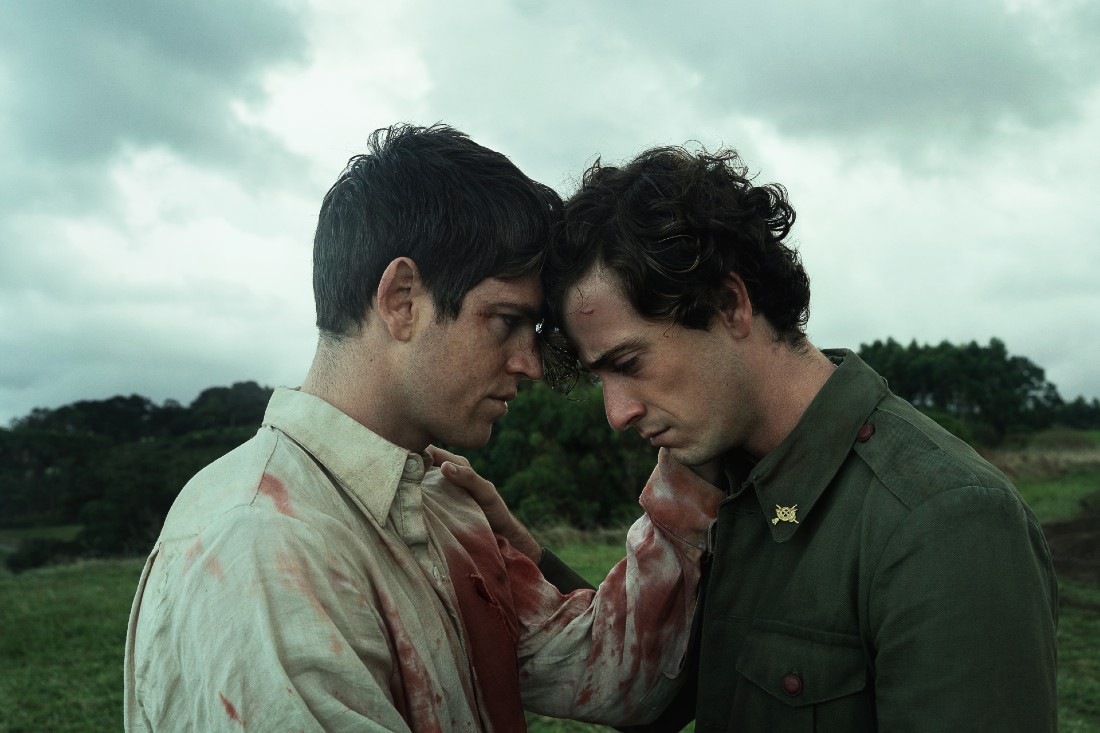
The second major plot takes place in 1937, when a young man named Sebastián (played by the gay folk singer Guitarricadelafuente) joins his country’s fascists and is charged with guarding García Lorca’s boyfriend Rafael Rodríguez Rapún (Miguel Bernardeau), a communist soldier who has been taken prisoner. Tasked with getting military intel out of him, Sebastián instead falls in love with the beautiful Rafa, who’s also a sometime actor and soccer player.
The soccer writer in me feels obliged to point out that the real Rodríguez Rapún played for Atlético Madrid, an important point because Atlético’s roots were as a leftist, working-class team, as opposed to Real Madrid, which was backed by the Spanish crown and later by Franco’s regime. This plotline receives an almighty shot of adrenaline when Penélope Cruz shows up as a nightclub singer who tells Sebastián about the gay underground scene in Madrid. Referring a friend who’s a female impersonator, she says, “[Drag] is a fantasy of possibility. War is the opposite.”
These plots are intertwined with one taking place in 2017, when an openly gay man named Alberto (Carlos González) discovers that the lately deceased Sebastián was his grandfather, whose existence was kept from him because his mother (Lola Dueñas) was too ashamed to admit that her father left the family for a man. Sebastián has left him the missing draft of García Lorca’s play, and Alberto gives it to a professor of gay literature (Glenn Close, speaking Spanish with an appropriately heavy accent) who’s visiting from America.
Los Javis know how to create striking images, and Netflix has clearly spared no expense in re-creating early 20th-century Spain, from the plush casino that Carlos hopes to join to the massacre of Sebastián’s village by Italian fascist soldiers working on bad intel. For all that, the different plots don’t reinforce one another or comment on them in any enlightening ways. Approaching the end of this 159-minute film, Los Javis keep dithering instead of bringing all these stories to some grand unifying end. Also, why no mention of García Lorca’s politics? He was an outspoken socialist, which was just as likely a reason for his murder as his sexuality.
Arguably the only time the film truly takes flight is when the actors recite García Lorca’s poetry. (“Oye mi sangre rota en los violines.” Who else could have come up with a line like that?) La bola negra is essential viewing for anybody who cares about Spanish literature, Spanish history, or gay history. It’s also way less objectionable than Emilia Pérez, the last gay Spanish-language Netflix movie that received this kind of hype. Under other circumstances, I might appreciate it better, but these are the circumstances that prevail.
La bola negra
Starring Guitarricadelafuente, Milo Quifes, and Carlos González. Directed by Javier Calvo and Javier Ambrossi. Written by Javier Calvo, Javier Ambrossi, and Alberto Conejero, based on Federico García Lorca’s play. Rated R.