

I blame AI for doing what I’ve always hated about the drawing/painting/sculpting process: making it performative.
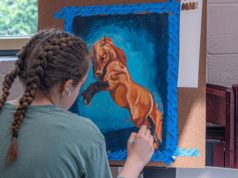
Now, workaday visual artists need to post Reels of themselves plying their medium. The point is to say, “This is not AI. There is a real human being behind this art.” As with most things interwebs-related, the more photogenic artists go viral while the not-nearly-as-photogenic stay stuck in anonymity. When likeability comes before quality, the entirety of the artform sinks. You see it in TV journalism/“journalism,” in writing, definitely in filmmaking — talent can be taught, while viral looks and personality cannot. Color me backward for thinking the visual arts eschewed such nonsense. What a rube I was.
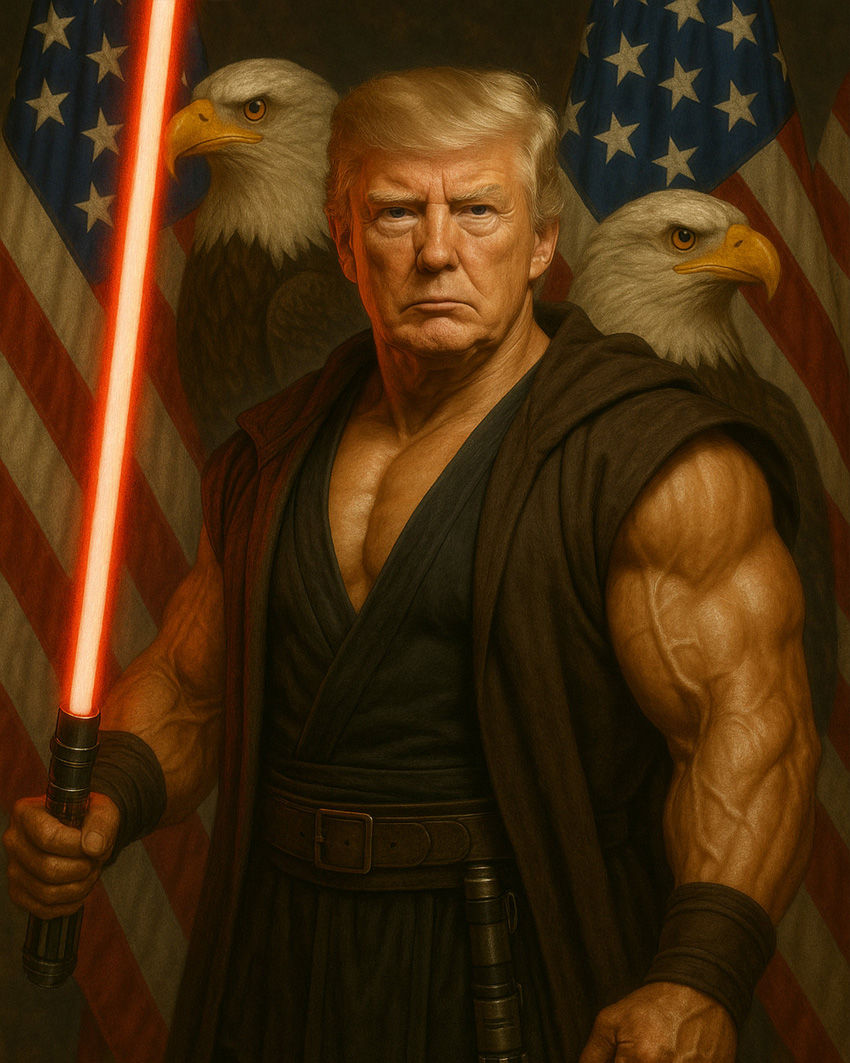
That’s one negative impact of AI in the art world among a whole lot more, including intellectual forgery, plagiarism, and Donald Trump’s stupid Truth Social posts of him with muscles. For any upshot, I guess AI can help authenticate antique art and streamline the logistics behind making, exhibiting, and selling art. All good things. And for the local art scene, AI appears to stand out as a handy logistics tool while owning only a little place in practice.

“As we all navigate this new frontier,” said Andrea Karnes, curator of the Modern Art Museum of Fort Worth, “it feels especially relevant to see what artists will do with it, especially for the level of criticality they can bring to it.”
Lauren Saba and Christopher Blay also offered their perspectives on AI’s impact on the art world. Saba is the founder and owner of the progressive gallery Fort Works Art in the Cultural District and founder and president of Gallery of Dreams, a nonprofit supporting local artists and youth and expanding access to the arts. She said her work focuses on “creating collaborative projects and connecting artists, collectors, and communities through contemporary art and cultural programming.”
Blay is an artist, curator, and writer who has “contributed two decades of exhibitions and criticism to the visual arts landscape in Texas and beyond.” Director of public programs at the National Juneteenth Museum, he is also a contributing writer to Art in America. His artwork was most recently exhibited at Ballroom Marfa, and last year, the 2003 TCU grad was a guest curator at the Modern Art Museum of Fort Worth.
What impact does AI have on your immediate job/practice, if any? How does that make you feel?
Saba: I have been using AI regularly in running both Fort Works Art and Gallery of Dreams for almost two years now. It has been an incredible resource for me personally. It began with developing marketing plans, then shifted to strategies, studying growth, and on and on. In most of these areas, my knowledge comes from personal experience. I studied art history, not business, so learning the art of business has taken decades, and there is still so much to learn.
Having access to so much information so quickly allows me to improve my performance and frees up more time to spend directly with artists and clients, which is still my favorite part of running an art gallery. It’s basically having “someone” to bounce ideas around with whenever you want, even at 2 a.m.
The inner workings of these businesses have historically been pretty opaque, and now the lid has come off. Having access to so much ever-evolving information reminds me of the day we got the full Encyclopedia Britannica set delivered to my house when I was a kid. That was it for me. I was all in. I just wanted to absorb everything I read. I still enjoy that, even though it looks very different in 2026.
Blay: It has very little effect on my studio practice. I tried modeling and visualizing large-scale sculptures and storyboarding for video works, but it falls short of my expectations for my work. Ultimately, artmaking is about each artist’s core connection to the world and how true to that revelation they can be in sharing their version of humanity with each of us. AI in most cases mediates that direct connection and fails on that level.
What are two or three pros and cons of AI’s usage in both artistic practice and museum/gallery administration?
Saba: As far as using AI for artistic or curatorial practices, I don’t find it particularly effective. This is where AI reaches its limits, in my opinion. It can help you do the research to learn and form your own thoughts and opinions, but creating something with your hands, writing something, using your brain, and physically making something, are still very beautiful and pure processes.
Moving paintings around on the floors of my gallery until I like the way they look is still an integral part of my practice. Even when I’ve attempted to use AI for design or creation, I’ve found myself consistently disappointed with the results. I get bogged down and end up spending far more time trying to figure it out that way than if I just rolled up my sleeves, got my hands dirty, and made the work.
I’m a firm believer that AI can never replace that part of being human. Maybe that’s too optimistic, but I’d like to think it’s true.
Blay: AI usage can be helpful in streamlining the drudgery for workflow applications. I suck at spreadsheets, and I can throw data into an LLM, and it will set out a spreadsheet for my tweaking.
It can also be useful in translating data and other analytics into deliverables for grant applications and reporting. Where it fails is in design and good writing. AI is exceptional at generating slop and mediocre text assembled into paragraphs, but it has no “stank” on it. I suspect it never will. And there must be a permanent “warm tone” setting on AI-generated design because it is visible from a mile away.
I’m writing something right now about the Kimbell [Art Museum’s] photography show, where I look back at the precipice of other large shifts in visual arts technology. I am tempted to brush it off to the hysteria and shock of the new, because the same language comes up in the conversations about painting at the emergence of photography, the pictoralists versus Group F64, B&W versus color, then digital versus film, but text-to-image feels different.
Do you see AI as an addition rather than a replacement of sorts?
Saba: I would definitely say it’s an addition. The reality is that consultants and mentors who could help grow my organizations have, in the past, been outside my budget or personal reach. Having access to that level of information and guidance without the expense has been incredibly valuable. It’s not replacing people I would otherwise hire. It’s giving me access to resources I wouldn’t have had in the first place, and I think that’s one of the most important distinctions about AI, particularly for small businesses and nonprofits.