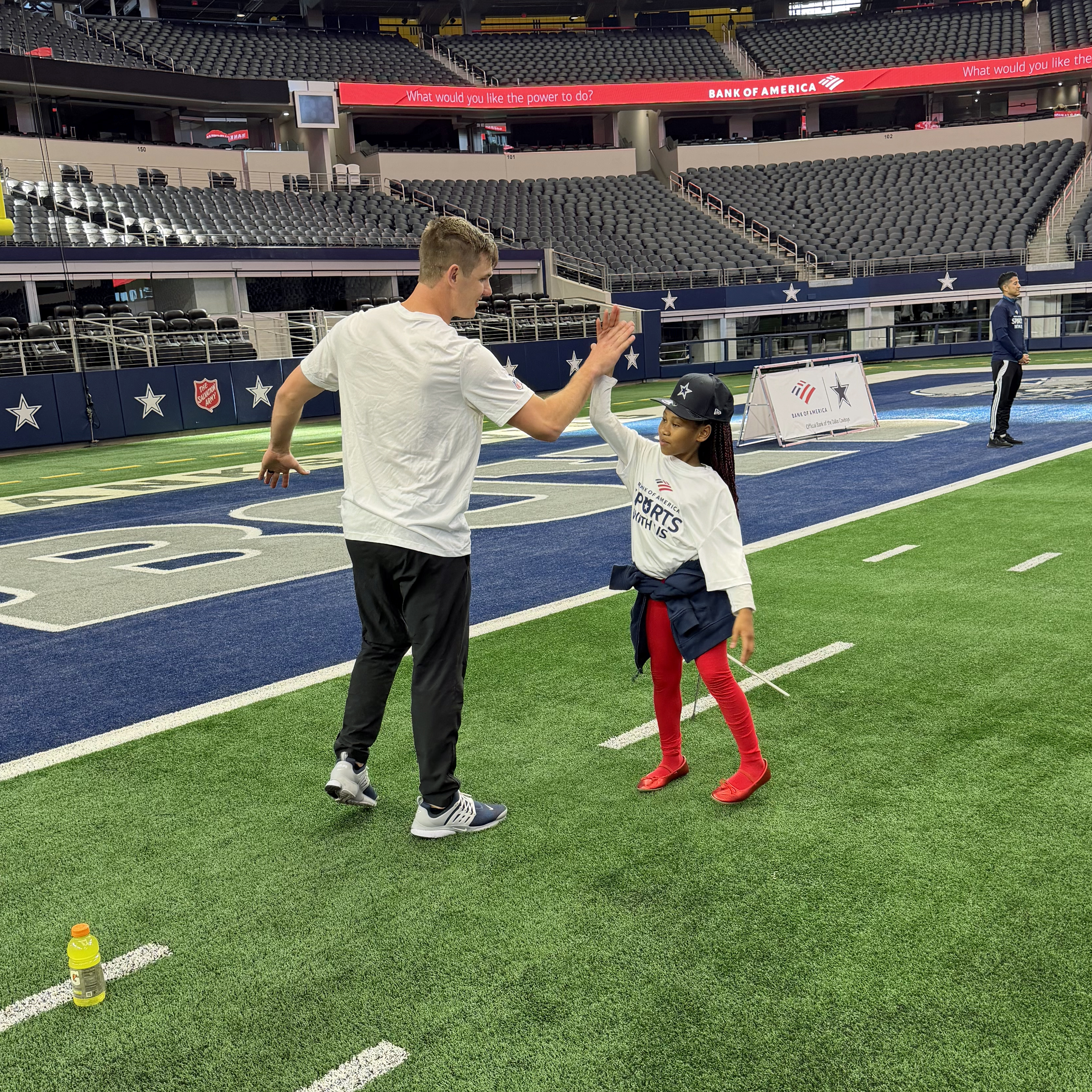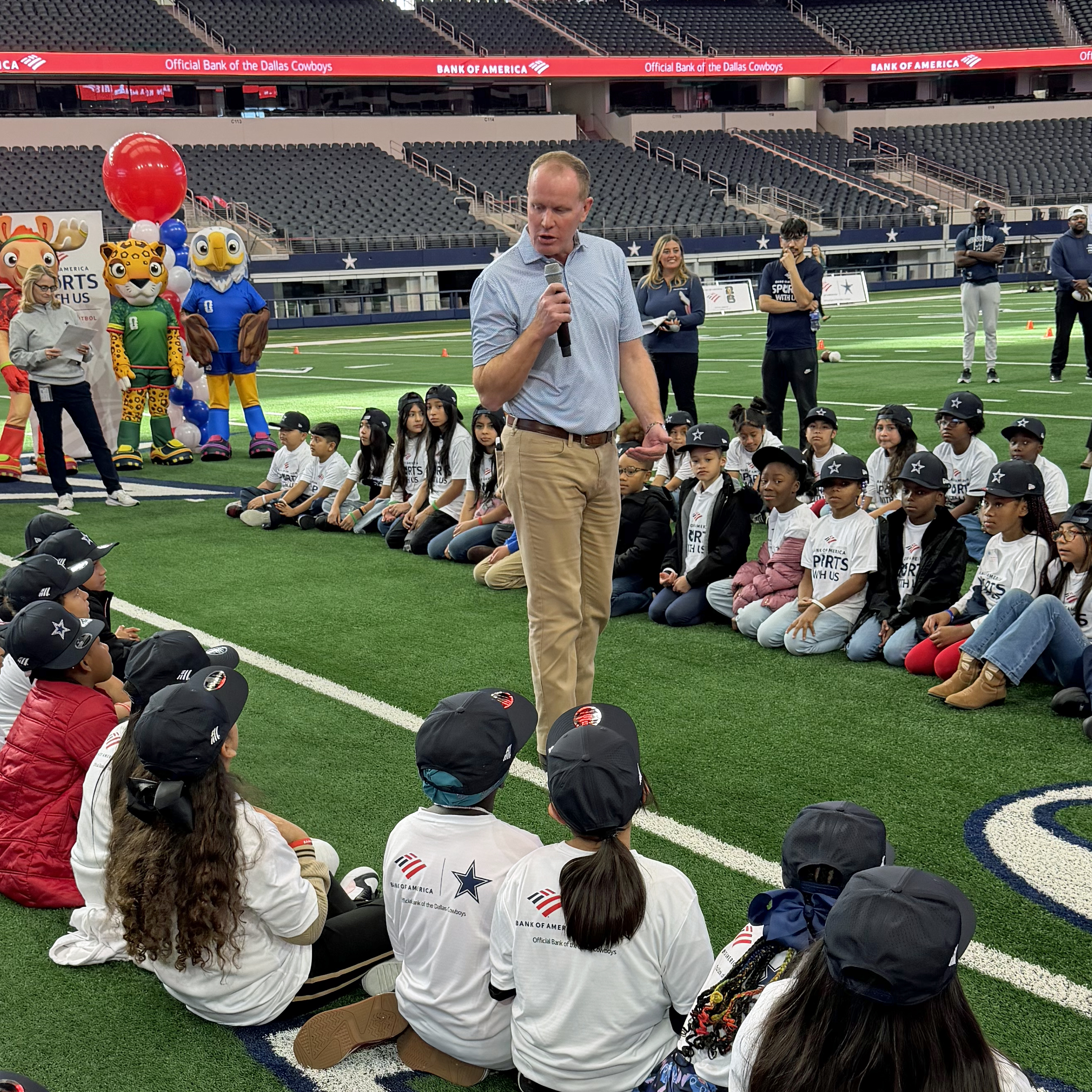


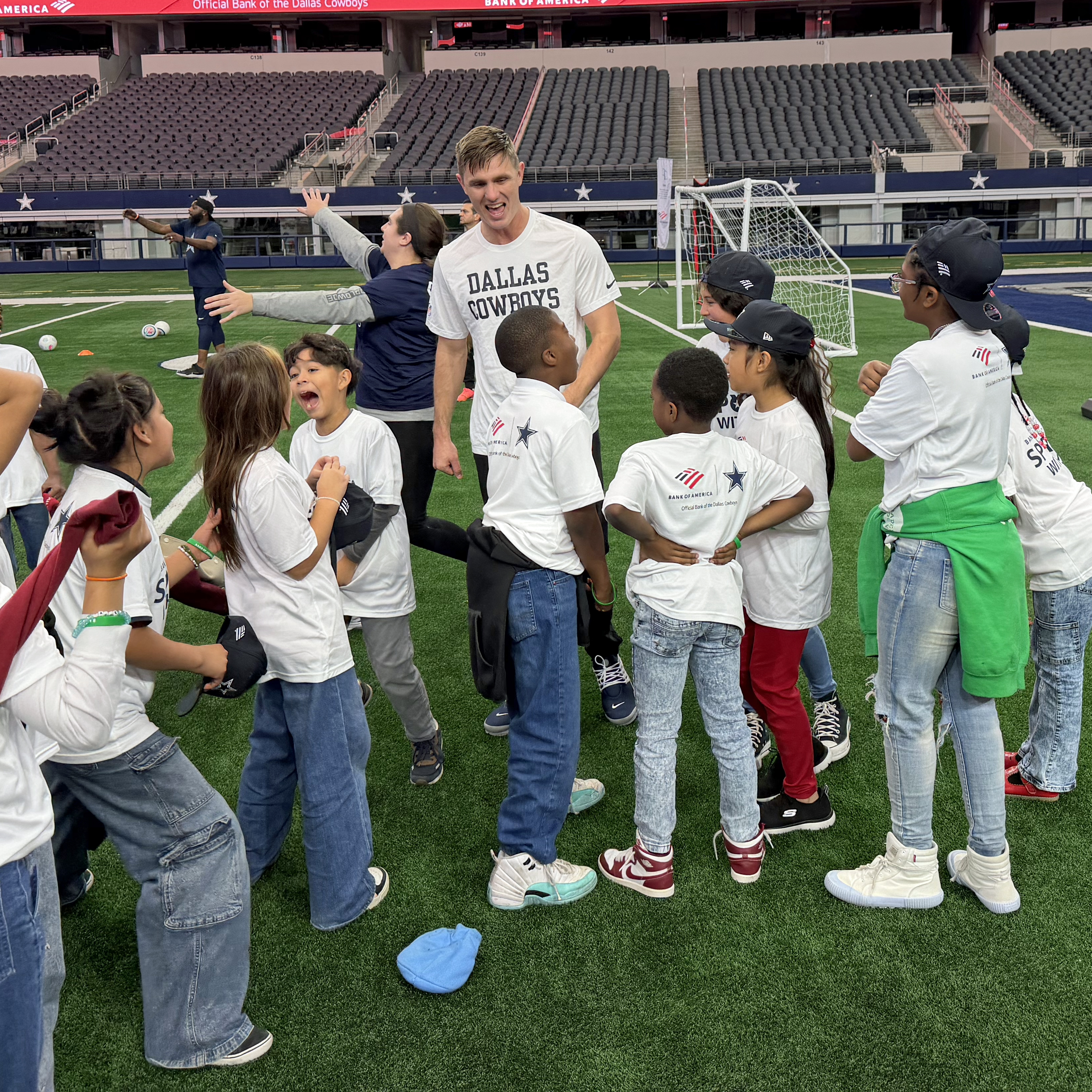
Near the end of a recent Sports with Us clinic, a joint event of the Dallas Cowboys and the FIFA World Cup, MC Kristi Scales asked the assembled children whose favorite sport coming into the event was football and whose was soccer. Adherents of each pastime raised their hands in turn. Scales, the Dallas Cowboys’ radio sideline reporter, then suggested she’d like them “to keep playing both forever and ever.”
The event brought approximately 100 students from a Fort Worth primary school onto the AT&T Stadium field for five stations’ worth of sports activities. The field’s yard lines and end zones reflected the game played by its primary occupant, the Dallas Cowboys, but the point of the day, and the bigger-picture sponsorship that led to it, was to showcase more than one code of football.
“This is a really unique opportunity because we’ve got great partners with the Dallas Cowboys, FIFA World Cup 2026, and U.S. Soccer,” said Mike Pavell, the Fort Worth market president for the event’s sponsor, Bank of America. “To be able to bring all those partners together to support a great organization like Western Hills Elementary School and help them experience the power of those brands and what these athletes can bring to them, it really is a great opportunity for us.”
The athletes Pavell referenced included current and former pros from the two sports he mentioned. USWNT player Croix Bethune and former USMNT standout Clint Dempsey joined former Cowboys defensive star DeMarcus Ware and the team’s current placekicker, Brandon Aubrey, to instruct the kids in their respective disciplines.
“What a cool opportunity it is to be able to do something impactful in the community with FIFA and football,” Ware said.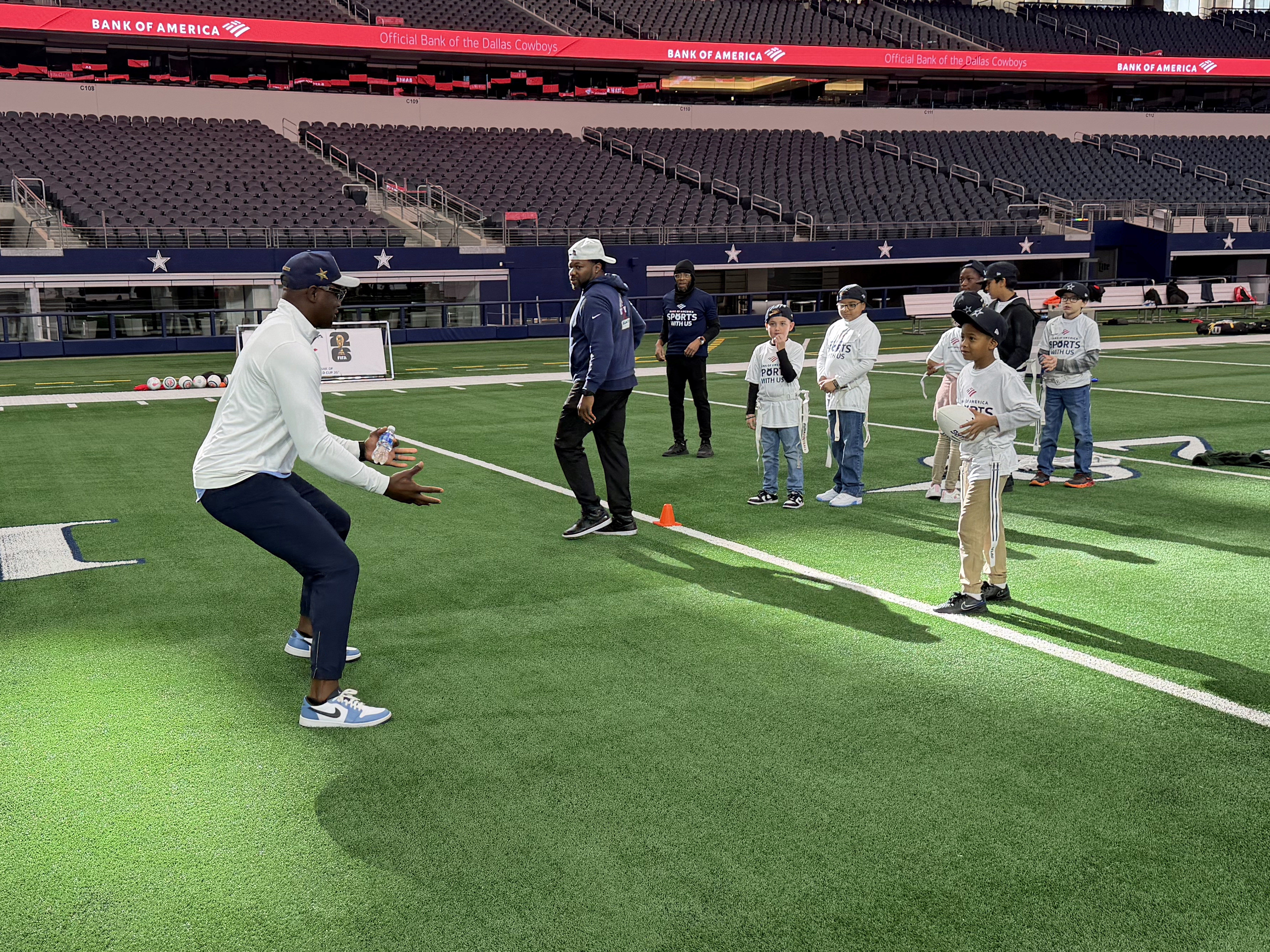
The pro football Hall of Famer added that he had tried soccer as a kid but found himself better suited to American football’s anaerobic nature than the beautiful game’s demanding cardiovascular regimen. But his own athletic experiences also led him to see the benefits of encouraging young people to try different sports.
“In the world today,” he said, “it’s like you’re a football player, you’re a baseball player, you’re a basketball player, but I got an opportunity to play them all. I played baseball. I wasn’t that good at that. I played basketball. I thought I was Michael Jordan. I wasn’t that good at that. And then all of a sudden, I tried football, and lo and behold, now I was one of the best ever to play the game. So, I think that all the kids that are playing soccer and football, try it all, because you don’t know exactly what you’re going to grow into. One of these sports, soccer or football, they’re going to pick them, and they can be pretty successful at it.”
All-Pro kicker Aubrey said, “You never know what doors are available to you to be opened unless you go out and try things.”
Aubrey didn’t discover his own calling until he was an adult, trying football after an abbreviated stint in professional soccer.
“My soccer career didn’t go as well as I wanted it to,” he said, “and I was disappointed and probably a little bit mopey going into my new career. And, luckily, I had a fantastic wife, still have the fantastic wife, and she kind of poked me out the door and said, ‘Hey, I think you could try this.’ And I thought, ‘She’s crazy,’ referring to kicking footballs, because there’s so much effort and energy and hard work throughout a lifetime that goes into being a professional athlete.”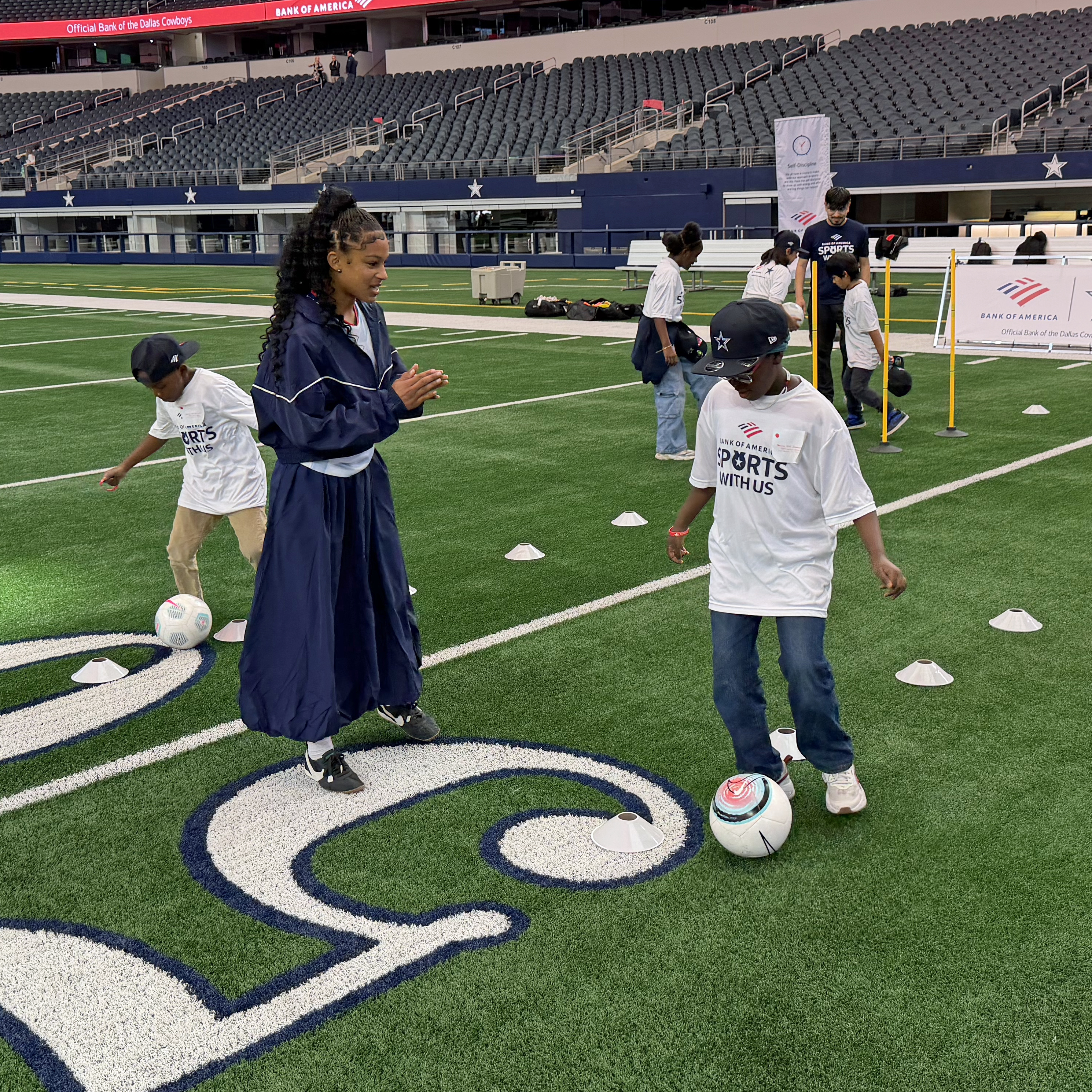
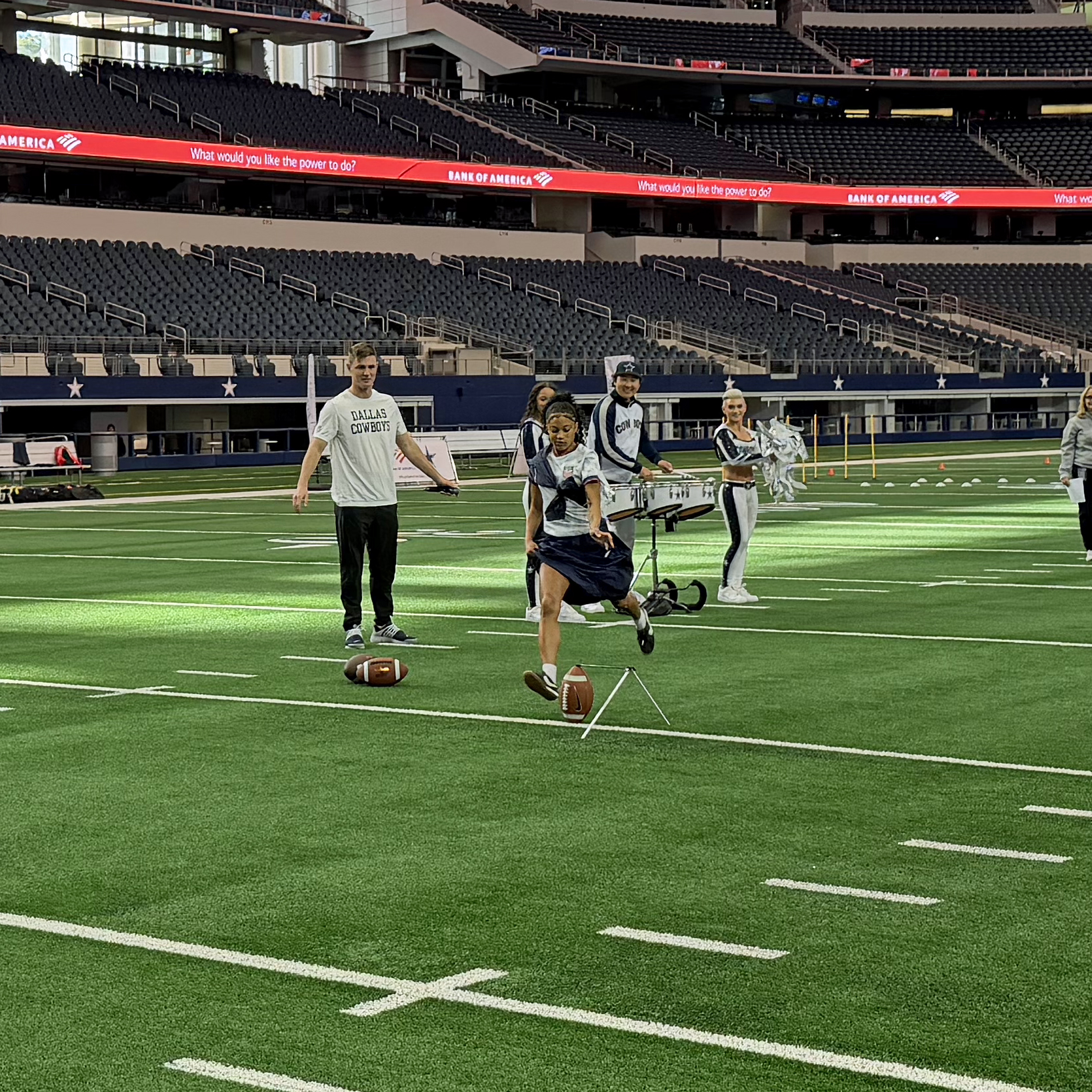
Before the children began their workouts, Aubrey showcased his knowledge of both sports in instructing his fellow pros. Ware may not have had a soccer background, but he ripped a penalty past Cowboys Mascot Rowdy after Aubrey explained some basics. And, in turn, Dempsey and Bethune went 2-3 between them on 25-yard field goal attempts under Aubrey’s guidance. That these decorated athletes had stepped about of their own comfort zones to try the others’ sport might encourage the young participants to do the same.
“It’s very important to have events like this,” Bethune said, “not just for us as athletes on the soccer and football side but to show the kids that we’re inspiration of what they could be, giving them support, teaching them life lessons through sports.”
Certainly, those life lessons could include the perseverance Bethune has shown pushing past injuries to become one of the world’s best players or that are demonstrated by Aubrey in putting in the work to adapt to his new profession.
The on-field activities consisted of five stations, each with the goal of teaching a soccer skill, a football skill, and a life skill. The kids learned from pros and instructors to move, pass, and kick within the parameters of each sport. At one station, Bank of America personnel offered basic counsel on finances and teamwork.
“It’s all about passing it on to the next generation and teaching them skills on the field and off the field,” said Dempsey.
The Nacadoches, Texas, native also talked about how the international scope of his job had nurtured his outlook on experiences beyond the familiar. “The good thing you learn from soccer is an appreciation for other cultures and also being able to come together and learn from each other instead of being divided.”
Inherent in that sentiment is the idea that nobody should be excluded from a game they’d like to play. Scales expressed to the kids, “Girls rule on the soccer field and the football field!”
While participation by women in soccer began to grow in the 1980s and exploded in the ensuing decades, it is only in recent years that opportunities in gridiron football have become open to them.
“I feel like women are getting into playing American football,” said Bethune, who watched the sport with her father growing up in Georgia. “There’s a lot more leagues. I think it’s great that we’re involving women in American football.”
That day, one could watch Ware showing both girls and boys how to position themselves to impede a ball carrier’s progress as Aubrey instructed prospective placekickers of both genders a few feet away. Locally, the Cowboys franchise has been active in creating leagues and teams in which female athletes can enjoy the sport.
The big picture for this sporting crossover goes beyond impacting just one school’s third, fourth, and fifth graders. It involves developing participation in, and audiences for, each different football code. Worldwide, association football is, as Aubrey phrased it, “the predominant sport.” In the United States, the game the Cowboys play is the most prominent. In recent years, the NFL has looked to spread its influence beyond the United States, playing games in other countries and empowering its clubs to market themselves abroad. The Cowboys, thanks to factors that have included on-field success, marketing savvy, and the international popularity of the Dallas TV show have had a head start on other American franchises.
“I travel a lot for my job,” Bethune said, “and I’m always seeing that big blue star. It’s kind of crazy that any state that you’re in, any country that you’re in, you’ll see the Dallas Cowboys brand.”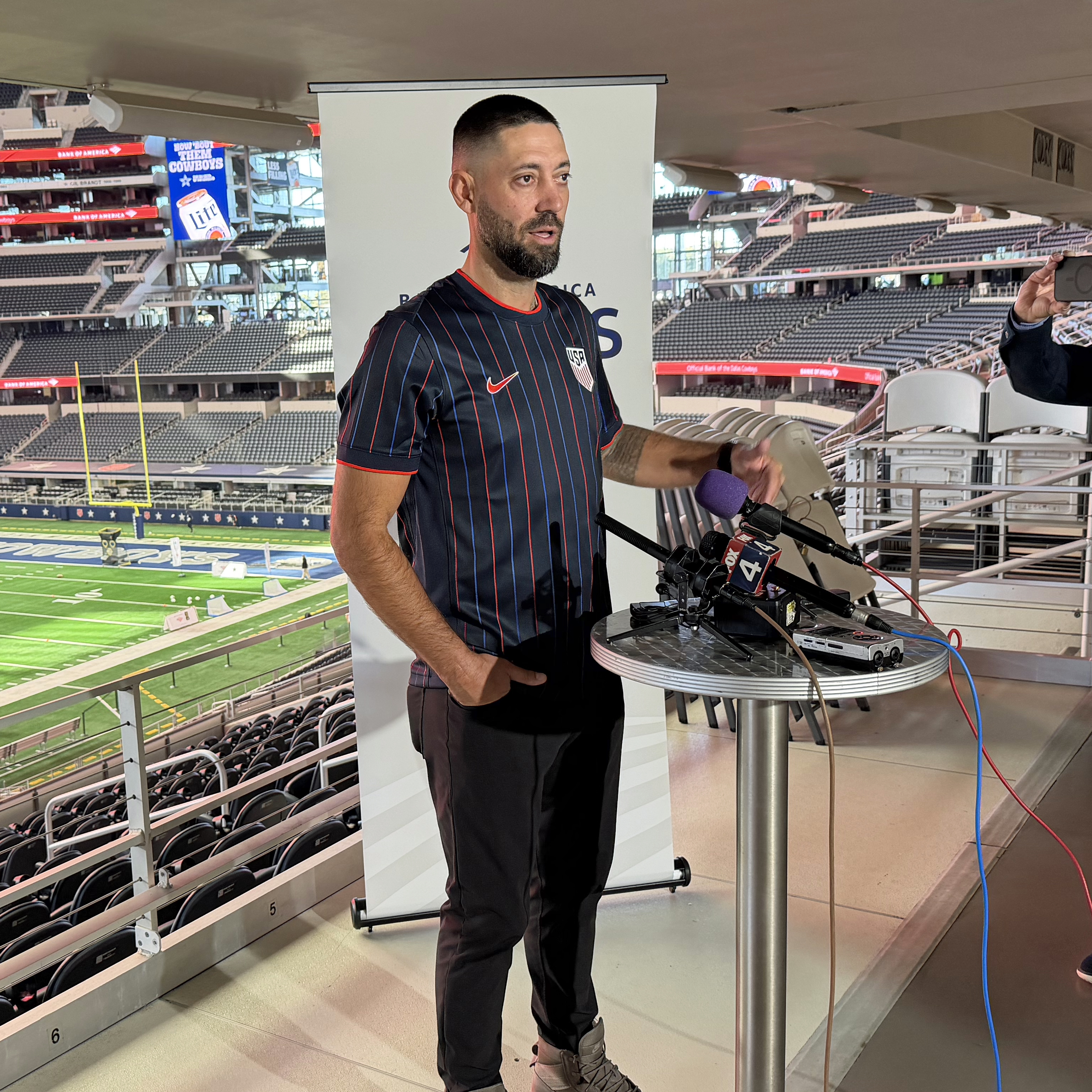
Dempsey said, “I remember going to Mexico and playing the World Cup qualifiers there, and you’re seeing murals of all the different Dallas Cowboy players of old, where they were the dynasty and winning all those championships, and even in Europe, it’s just a popular brand that people know a lot about.”
Even with those brand awareness advantages, the franchise knows it still has work to do to achieve a soccer-like level of prominence outside its core markets.
“We are extremely aware that the NFL brand, while growing internationally, doesn’t have the international appeal that soccer does,” said Cowboys Chief Financial Officer Tom Walker, who also spoke to the students at the event. “So, any time we can connect the NFL brand, and the Cowboys’ brand in particular, to a much broader global scope, it’s something we always want to do.”
A recent collaboration with another globally recognizable entity has supplied the organization with evidence of the impact broad exposure can have.
“Netflix has a broad international appeal,” Walker said in reference to the streamer’s documentary content centered on Jerry Jones and the Dallas Cowboys Cheerleaders. “It puts more of that story, more of Jerry’s story out there, the cheerleader story out there. We’ve seen a great uptick in all of our followings, our social posts, and actually some of our attendance relative to things because of those Netflix series. Can I tie it directly? No. Do I know it’s there? One-hundred percent.”
Coincidentally, on that evening the streaming service had hosted a preopening event for its new Netflix House emplacement in Dallas’ Galleria. Cowboys legend Michael Irvin attended, as did professional women’s soccer players from Dallas Trinity FC. The stage has been set for even bigger growth for the Cowboys, as they’ll show off their stadium and its brand to the Men’s World Cup audience through hosting a tournament-high nine games in the venue.
“Fundamentally, any time you can connect your brand to that, that’s a win,” Walker said. “That’s a win for us. That’s a win for DFW. That’s something we’re really excited about.”
Bank of America can potentially also leverage the two sports to grow its brand, too. Only a handful of companies sponsor both the FWC and the Cowboys, and BOA adds a U.S. Soccer partnership, too. Per their website, they do business in 35 countries, including more than a dozen that have already qualified for the World Cup. As BOA looks to expand its global presence, they could probably do worse than find ways to activate around relationships with the best-known global properties in both sports. Tuesday, they found a way to tie both together at AT&T Stadium.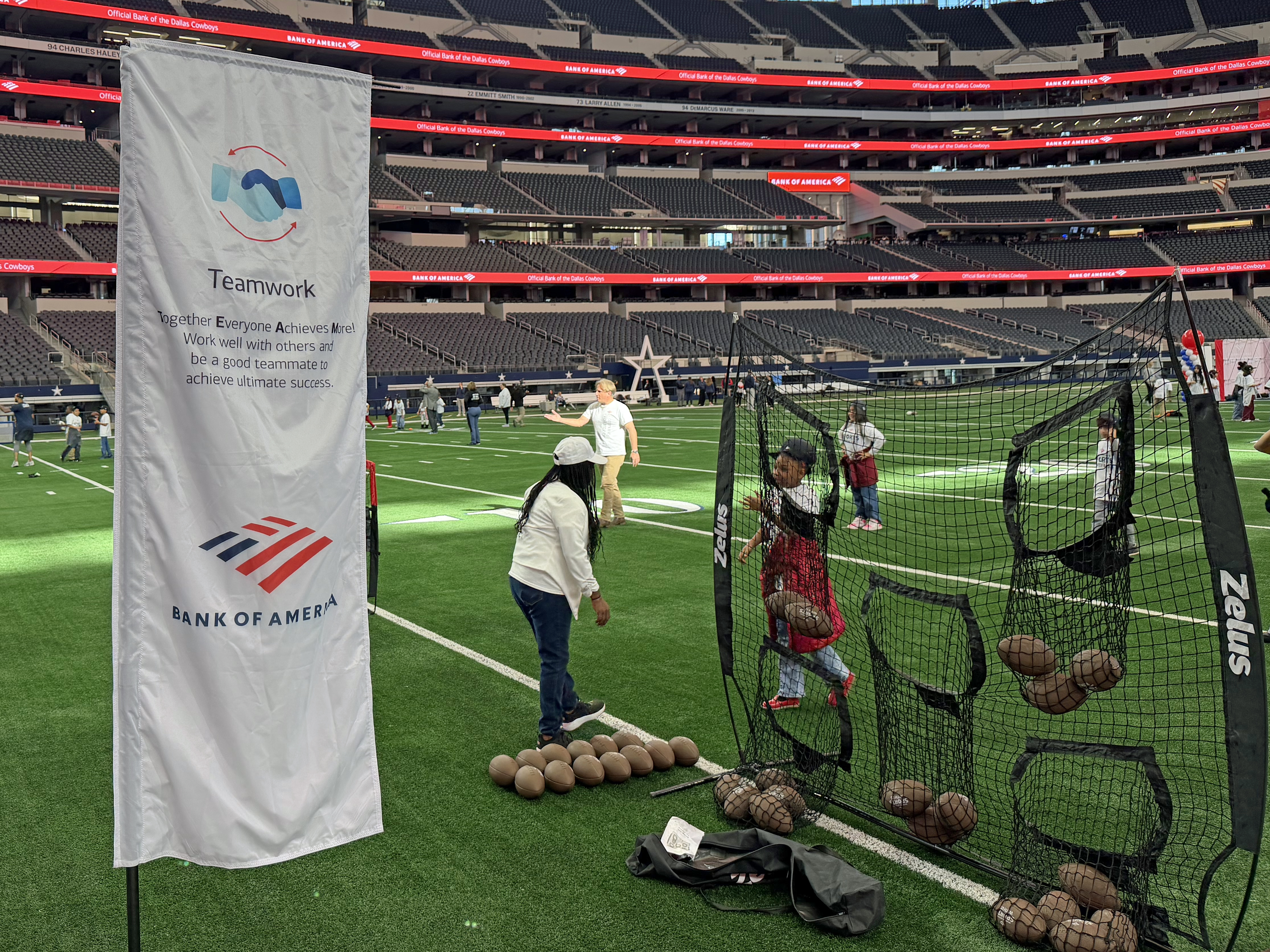
And the sport of soccer must also be excited to join the Cowboys at the team’s iconic facility in 2026. The top attendance-per-game figures in both men’s and women’s World Cup history came in 1994 and 1999, respectively. They played those competitions in the United States, utilizing the huge capacity offered by the nation’s football stadia. The events served as catalysts for the world’s most popular sport in the planet’s largest commercial market.
“I remember being at the Cotton Bowl and watching games in ’94, and that’s when I started believing that maybe one day, that I could maybe play for my national team in a World Cup,” said Dempsey, who did indeed compete for the U.S. squad at three World Cups. “And because of that World Cup, then we had the MLS [Major League Soccer], the professional domestic league, which allowed kids to go professional, which was awesome. And I’m just curious to see what’s going to be the evolution from this World Cup, like, how are we going to take it to the next level?”
FIFA would love to grow the ceiling for its sport in the United States, just as the Cowboys and the NFL would be keen to push their own boundaries beyond North America. One way — perhaps the best way — to address those interests comes through grassroots activations. Watching the children in the drills, it was obvious that some had mad soccer skills while others clearly had played some American football. Getting to work with pro athletes and trained instructors could certainly help them master whichever sport they already liked or perhaps adapt those skills to one they’d never tried before.
“There’s a lot of things that correlate between each sport,” Bethune said. “For example, agility. You do soccer drills with the ball that can also help with your footwork on the [gridiron] field. A lot of kickers were soccer-players-turned-kickers, so you can read off of different things within each sport and then also learning simple life lessons from both.”
The latter might be the biggest reason why an event like this one can have value beyond any skills learned or pro sports dreams (for participants or organizers) kindled.
“Once you learn one sport and how to be successful in that, you kind of know the way in most sports,” Aubrey said. “It comes down to hard work and determination, setting goals for yourself, showing up every day, working towards those goals. And I think that’s a valuable life lesson not just in sports. It’ll treat you well in any job.”