

Who was it who said that a critic’s year-end Top 10 list isn’t really a list of their 10 favorite films? Rather, it deliberately casts a wide net, because if all of my Top 10 are the same type of movie, you’ll think I didn’t see anything else these past 12 months. This approach is more interesting for you, even though it sometimes leads me astray. (It led me to leave Children of Men off my list in 2006, which still haunts me today.) Anyway, I hope this mix of the past year’s blockbusters, low-budget indies, and foreign films leaves you entertained and/or informed.
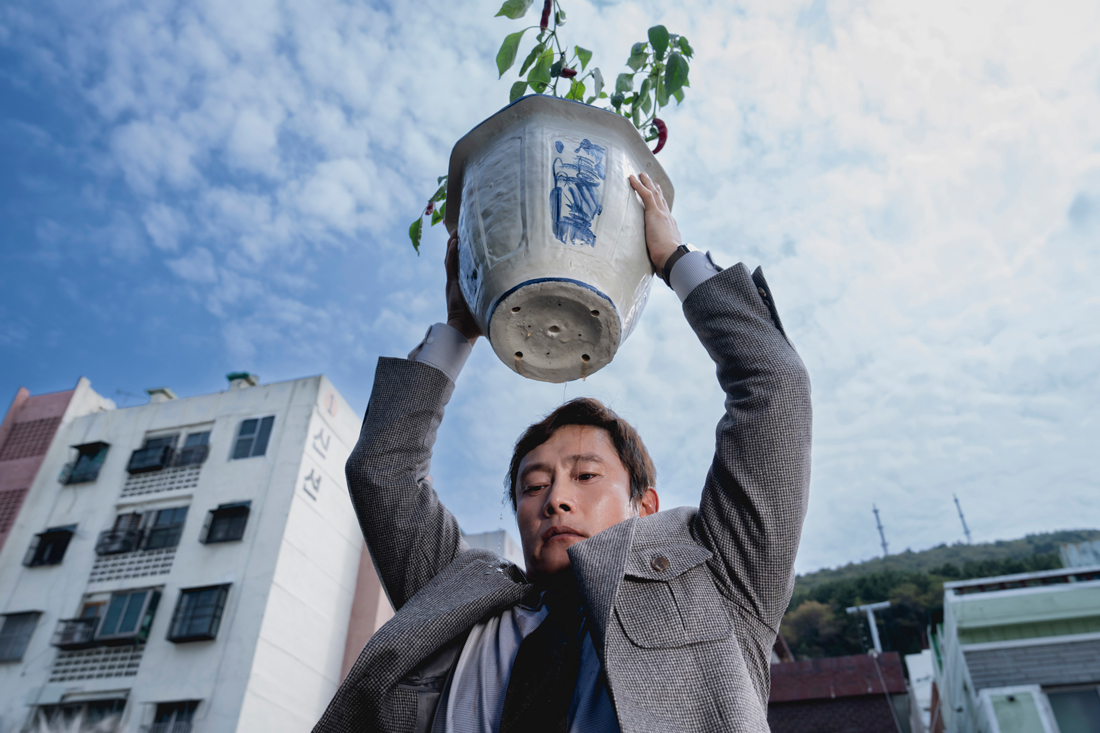
1.) Is it really possible that I’ve never had a Korean-language movie as my No. 1 pick? That streak ends with No Other Choice, Park Chan-wook’s delicious satire about how the ultimate capitalist is whoever’s willing to kill his competition. If Lee Byung-hun weren’t already a global star, he’d become one with his performance as a stationery executive who loses his job and resorts to spying on and murdering all the more qualified workers in his field so that he can be a top candidate for any new openings. (Take that, LinkedIn!) The slapstick and clever jokes add up to a spicy chiller that will resonate with anyone who’s had to go job hunting recently.

2.) Sexual violence is about as unfunny a subject as there is, yet Eva Victor made it into the year’s best comedy in Sorry, Baby. The first-time director’s command of their film’s tone is downright astonishing as the story tracks the psychic fallout from a graduate student’s rape at the hands of her professor and the inertia that takes hold of her in the subsequent years, even as she moves up in academia. Scene after scene hits the mark without any of the slip-ups that you might expect from a debut filmmaker. The nonbinary filmmaker and star announced themselves as a major talent.
3.) Who says Hollywood has no new ideas? Ryan Coogler’s Sinners was not only the highest grossing original horror movie of all time. It’s also an exhilarating mash-up that pays tribute to the originality and power of blues music and looks hard at art’s ability to move the spirit realm while also attracting bloodsuckers who want to use it to augment their power. Coogler packed his heady ideas into an entertaining 1930s period piece with vampires and hoodoo practitioners and showed the industry that his own stories are just as potent as a franchise.
4.) Celine Song’s dialogue in Materialists is as enjoyable and decadent as the finest Dubai chocolate. More than that, her romantic comedy had its finger on the pulse of the contemporary dating scene as it tracked how capitalism and dating apps have inflated the expectations of single people to unreasonable heights (and heightism). Is that why the movie drew such a polarizing reaction when it came out this summer? Or was that just Dakota Johnson hate? Whatever it was, a list like this needs a polarizing pick, so here’s mine.
5.) Kiyoshi Kurosawa’s Cloud is a towering capitalist thriller from a Japanese master (who, once again, is no relation to Akira Kurosawa). It starts out as a character study of a con artist who buys overstocked tchotchkes IRL, then sells them at a markup online. The thing then gives way to a shootout that lasts for pretty much the movie’s second half, as his scammed customers and suppliers trap him in a warehouse and try to kill him. Twenty years ago, Kurosawa made a horror film about internet ghosts called Pulse, but here he suggests that the real online hell is a guy staring at his screen waiting for numbers to move.
6.) Most of my fellow film critics have One Battle After Another higher than this on their year-end lists, but I still rate it as a masterwork and my second-favorite Paul Thomas Anderson movie (behind Punch-Drunk Love). Making Leonardo DiCaprio’s stoned fugitive into the father of a mixed-race kid not only makes him more like Anderson himself. It also raises the story’s already high dramatic tension, with Chase Infiniti’s teenage daughter becoming a target and a heroine because of her heritage. This epic thriller knows that much like cinema itself, the struggle against fascism is ongoing and handed down to future generations.
7.) Why doesn’t Jafar Panahi receive more credit as one of the world’s great filmmakers? Just this month, the Iranian government sentenced him yet again to prison time and forbade him from leaving the country. The reason was It Was Just an Accident, a funny and psychologically deep thriller about a group of Iranians who capture the one-legged man whom they believe tortured them in prison. The ethical dilemmas in this Golden Palm winner at Cannes come with slapstick comedy, bits of unplanned chaos that made it into the film, and tributes to the Iranian people’s ability to resist their religious dictatorship.
8.) Ping-pong ball is life for Marty Supreme, which does better than any movie this year at depicting what it costs to be great at something. Josh Safdie’s sports drama covers so much besides table tennis, including a Broadway play rehearsal, Japanese-American relations after World War II, and Kevin O’Leary paddling Timothée Chalamet’s ass. The unorthodox casting, the unstable air of imminent violence, and Chalamet’s performance add up to a forehand smash of a film.
9.) France has produced a bumper crop of great movies this year, including No. 7 on this list (technically a French film even though it’s in Farsi). My proper French-language entry is Souleymane’s Story, Boris Lojkine’s breathless account of a Guinean immigrant trying to attain legal status while working as a food deliveryman in Paris, being ripped off by both whites and his fellow Africans, making sleeping arrangements at homeless shelters, and prepping for a crucial interview with the authorities. Abou Sangaré’s lead performance brings home the man’s trauma, despair, and hope in his new homeland.
10.) I could have placed just about any of my honorable mention movies in this slot, but I used entertainment value as my tiebreaker. So KPop Demon Hunters takes the last spot on the list. The kimchi seasoning-dusted popcorn hit of the summer first dropped on Netflix and eventually took over the multiplexes and pop culture as a whole. Besides commenting on K-culture in a way Korean filmmakers might not have been able to, Maggie Kang and Chris Appelhans’ animated film gave us a soundtrack with a bunch of bops and a derpy tiger. I’ll raise a cup of ramyeon to that.
Honorable mention: Drew Hancock’s clockwork, highly amusing science-fiction comedy, Companion … Nia DaCosta’s electrifying Black, queer update of Henrik Ibsen, Hedda … James Gunn’s contemporary yet back-to-basics take on Superman … Zach Cregger’s study of a small town collapsing on itself, Weapons … Michael Angelo Covino’s chaotic open-marriage comedy, Splitsville … Francis Lawrence’s heartrending dystopian thriller, The Long Walk … Mona Fastvold’s marvelous, tragic Christian musical, The Testament of Ann Lee … Yorgos Lanthimos’ hilarious conspiracy satire, Bugonia … Joachim Trier’s Bergmanesque show-business drama, Sentimental Value … Chloé Zhao’s Shakespearean study of bereavement, Hamnet … Joseph Kosinski’s you-are-there auto racing movie, F1: The Movie … Michael Shanks’ codependent body-horror film, Together … Reema Kagti’s ode to Indian regional cinema, Superboys of Malegaon … Emilie Blichfeldt’s gruesome patch on the Cinderella story, The Ugly Stepsister … Shih-Ching Tsou’s great Taiwanese domestic drama, Left-Handed Girl … Richard Linklater’s romp through French film history, Nouvelle Vague … Alexis Langlois’ brightly colored lesbian pop-star romance, Queens of Drama … Spike Lee’s kidnapping thriller/reflection on his own legacy, Highest 2 Lowest … Steven Soderbergh’s grown-up British spy drama, Black Bag … and Rian Johnson’s detective story that finds God, Wake Up Dead Man: A Knives Out Mystery.