




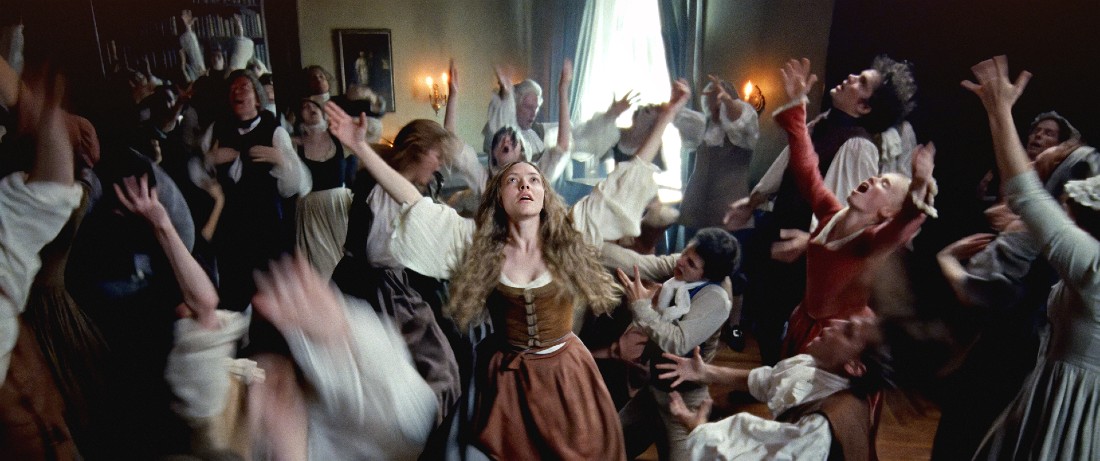
The Testament of Ann Lee is the greatest Christian musical film ever made, even if the competition isn’t exactly God’s plenty: Godspell, Sister Act, The Fighting Temptations. Of course, this one is different because it expressly rejects the Broadway models on which most movie musicals (Christian and secular) are based. It is deeply, deeply weird, and the only film remotely like it is Jeannette, Bruno Dumont’s 2017 French rap-metal musical with a 12-year-old lead actress portraying Joan of Arc. That weirdness is precisely what brings its mystical powers across to ordinary moviegoers.
Based on the founding of the Shaker sect, the movie is narrated by Sister Mary (Thomasin McKenzie), the one-eyed disciple who tells the story of how Ann Lee (Amanda Seyfried) was born poor in Manchester in the 1730s. Seemingly condemned to a life of menial factory jobs, Ann instead starts listening to preachers during a time of great religious ferment in England. The Methodists teach her contempt for the established Anglican church’s rituals, and the Quakers introduce her to worshippers convulsing in ecstasy and the idea that God is both male and female, since we are all made in His — I guess, Their — image. After she dares to preach the word of God herself, British authorities harass her until she takes her “Shaking Quaker” followers across the Atlantic and sets up shop in the soon to be independent American colonies.
The Norwegian filmmaker Mona Fastvold was an Oscar-nominated co-writer on Brady Corbet’s The Brutalist, so Corbet returns the favor by co-writing her film. I’ll admit I wasn’t a fan of her 2021 lesbian Western The World to Come, but the musical numbers give this movie an unhinged energy that was missing from either of those. It would have been easy for the song and dance to break this film’s devotional atmosphere, and that does admittedly almost happen during “John’s Running Song,” when the Shakers’ elderly financial backer (David Cale) runs through the wilderness in upstate New York while singing and pointing at the place where they’ll build their church.

Elsewhere, though, the music expresses emotions too deep for words, as Ann’s performance of “Beautiful Treasures” comes over a montage of her unhappy sex life with her husband (Christopher Abbott) and giving birth to four children only to lose them all in infancy. Choreographer Celia Rowlson-Hall (who previously worked on After Yang and Smile 2) makes the Shakers’ movements look orgasmic and spontaneous even though they’re actually tightly managed. Her work is at the center of “Worship,” a great number when the dancers run complicated rings around a camera that is stationary and panning in a counterclockwise circle.
Besides his own original works, composer Daniel Blumberg sets several traditional Shaker hymns for the soundtrack and smartly doesn’t try to make them sound either ancient or modern. Instead, he creates a unique sonic world by bringing in handbells, electric fuzz guitar, and celesta to underscore the foreignness of the Shakers’ faith and the world that they live in. As for the singers, Lewis Pullman portrays Ann’s secretly gay brother who’s a strong preacher in his own right, and he achieves a tremulous power singing “Bow Down O Zion” with a group of new converts.
However, nobody steals the spotlight from Seyfried, whose flute-like soprano cuts through the orchestra on “All Is Summer” and whose crisp movements help her stand out amid the ensemble despite her small stature. However, she also distinguishes the movie from the herd of Christian films by playing Ann’s religious faith as something hot, angry, and troublesome for herself and others. We see this when she arrives in New York City and cries “Shame!” at a slave auction almost as soon as she steps off the boat.
(The Shakers’ belief in gender and racial equality was one reason for their persecution by other Christians, although the movie is wobbly on this point: Ann Lee did not proclaim herself the second coming of Jesus Christ. That claim was made for her by some of her followers after she died.)
Seyfried is compelling when experiencing visions of angels and Biblical figures. Less expectedly, she’s also a galvanizing presence when leading her congregation. Late in the film, Ann welcomes a new follower who’s a young and exhausted mother of seven, and it’s Ann’s tenderness that makes the woman confess in front of the congregation to occasionally wanting to murder her baby, and her force of personality that brings her into the fold. It takes a peculiar set of traits and skills to portray this singular figure in Christian history, especially as a musical heroine. It truly feels like no actor except Seyfried could have done justice either to her or to The Testament of Ann Lee. That’s the highest praise I can come up with.
The Testament of Ann Lee
Starring Amanda Seyfried and Lewis Pullman. Directed by Mona Fastvold. Written by Mona Fastvold and Brady Corbet. Rated R.






What? Beautiful furniture? Biblical power. Are these bots writing these?