

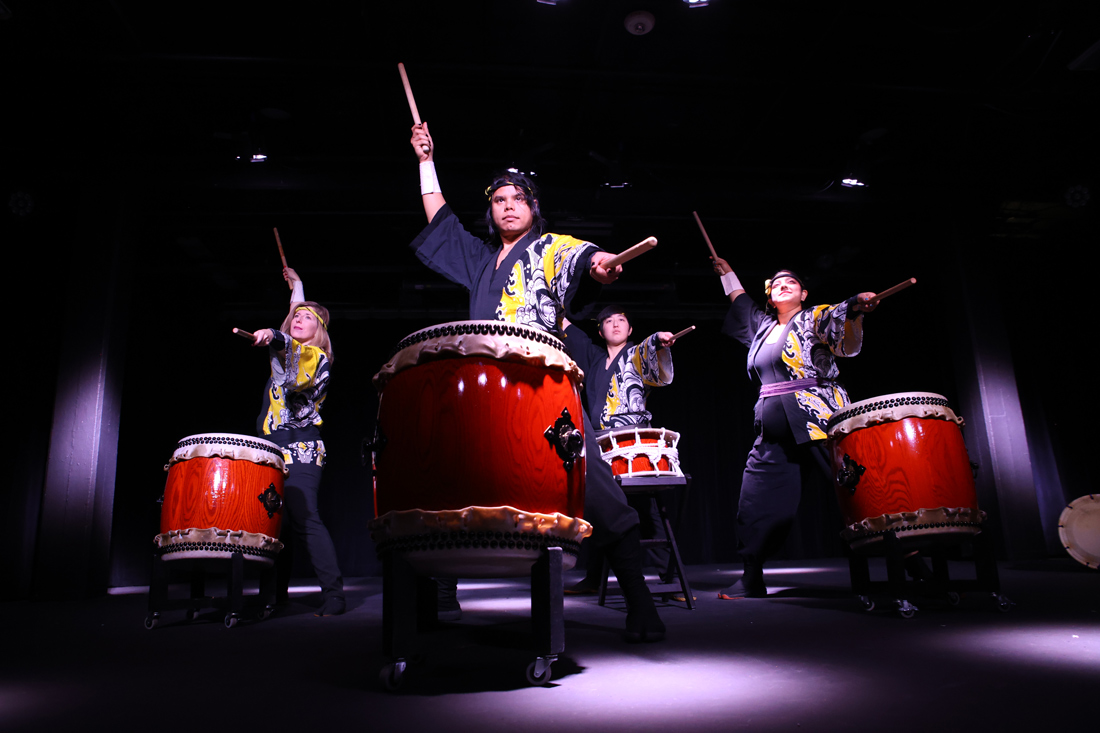
Translated as “fat drum,” taiko is a form of drumming drawing from the music of Japan, China, Korea, and India, and it harks to the many roots of drumming under the World Music umbrella. And while Fort Worth couldn’t be any farther from Asia, there’s at least one taiko ensemble here.
Drummers Jay Cantu, Mayuri Patel, Weekly contributor Kena Sosa, and Kris Wong are known as Goisagi, and they recently released an album. Clocking in at 31 minutes, Inertia was recorded at The Epic in Grand Prairie and has been streaming on all platforms like Spotify since December. The songs are mostly vibrant, soulful, dramatic drumming with added background shouts of encouragement.
“We are really humbled showing others what we can do with our music,” Sosa said. “It’s visual storytelling without lyrics.”

Now a nonprofit, Goisagi performs throughout North Texas while also offering workshops at local libraries.
“We encourage [people] to audition and work with us and outreach to those who are curious, too,” Sosa said. “We want to grow talent.”
The group was founded and taught by Sean Ibanez. The 46-year-old San Antonio native got into taiko starting out as a kit drummer playing mostly metal and industrial plus a little jazz. When he first heard taiko, he said he was excited.
“That was before YouTube,” he said, adding that he saw live taiko in 2001 and wanted to join a group. It wasn’t until he moved to Fort Worth and found Dondoko that he was able to fulfill his passion. He also performed in Dallas with Kiyari Daiko before relocating to Hawaii in 2011 to study taiko with Kenny Endo Sensei.
Ibanez’s first taiko show was by the world-famous Kodo. “I was enraptured by the volume. You could feel it in your body. Combined with sharp, stoic choreography, I was hooked. None of it is digital, and the music is ensemble, so all the parts are divided up, and the performers really have to lock in to one another.”
Ibanez started Goisagi after moving back to Fort Worth in 2015. Now living in upstate New York, he aimed to blend his understanding of choreography and movement of drum beating from both taiko and Kung Fu to create pieces of music that stood out and were their own style.
“My main goal was to start an ensemble where we could do what we wanted, learn the styles we wanted from authentic sources, and write our own music,” Ibanez said. “My focus changed after my studies in Hawaii, and I focused largely on the latter. So, I founded Goisagi as a platform to create our own music based on what I’d been taught in taiko.”
Other groups in the area are Kiyari Daiko and Dondoko.
The first taiko ensembles, in which different drums played different rhythmic and melodic parts together, were established in the 1950s in Japan. This ensemble-style of playing is generally referred to as kumidaiko (harmony drum) in North America or wadaiko (big drum) in Japan.
After Hawaii, Ibanez was committed to starting a group, but the equipment is expensive and hard to make, so there was a lot to do before he could even work with more than one other performer, Sosa.
Sosa spent time living in Japan and studying abroad during college, then moved to Texas. She wanted to still be involved with the cultural exchange between East and West when she met Ibanez.
“We want to make sure we are not boxed in as a style of music,” Sosa said.
The current four pieces carry on the tradition and style of Asian drumming primarily as a percussion ensemble with differently sized custom drums along with other instruments like the fue (Japanese flute).
“There’s a lot to it besides drum banging,” Sosa said. “It’s the style of striking and the feeling behind it that brings the energy. Taiko is best heard live with the actions of the players that spark choregraphed movements that are a part of our songs while we cheer each other on, giving energy and recognizing each other with bursts of yelling adding to the style.”
As a longtime percussionist, Sosa said the taiko drumming experience is joyful. “You’re sharing cultural knowledge and the style of full arm swings on drums and bringing the presence of energy out and blending sounds together emotionally. It’s definitely a growing tradition with the membership being truly what it is. If you want to join the group, we want to give a positive and eye-opening experience to people. We want to grow. We are recording artists that want to continue and give taiko more eyes and ears.”
Goisagi
1pm Sat, May 9, at Watauga Public Library, 7109 Whitley Rd, Watauga. Free. 817-514-5855.