
One of the most confusing decisions Amazon Prime made in its early days was when it canceled the live-action remake of Ben Edlund’s brilliant superhero spoof The Tick. It had nothing to do with ratings, which wouldn’t matter since streaming services have been tightlipped on numbers since the day the medium started. Peter Serafinowicz portrayed the titular blue superhero perfectly, and the show found inventive new ways to build on its previous two incarnations. It’s still on my “My List” queue.
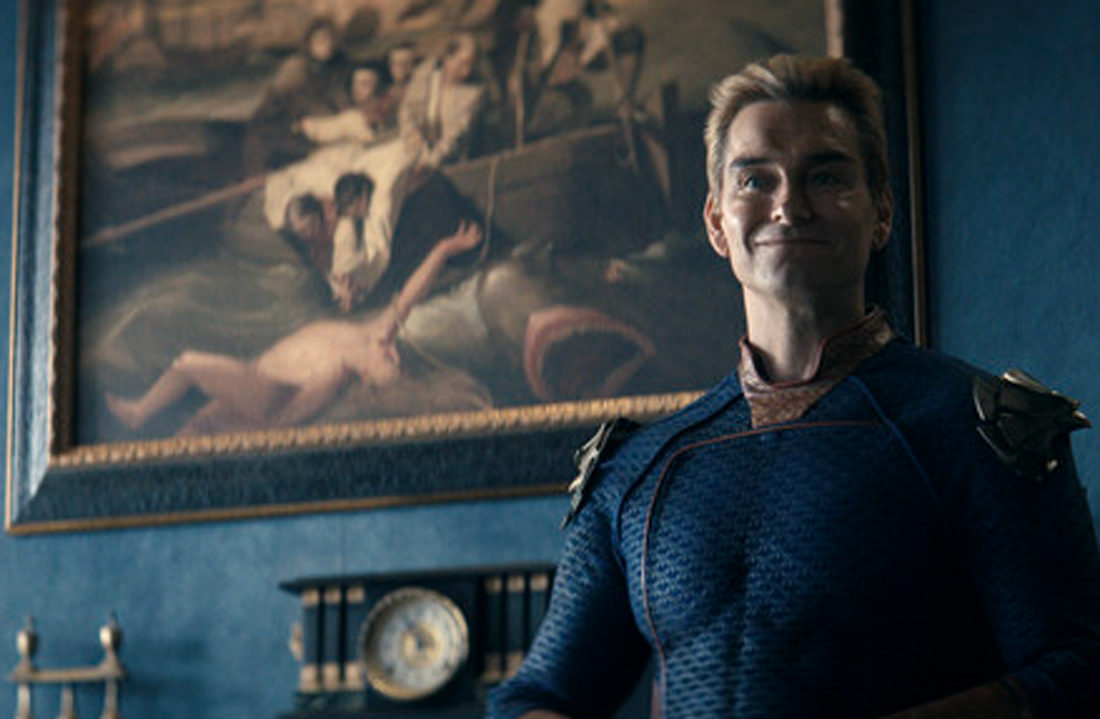
The one bright side of its cancellation in 2019 is we probably wouldn’t have the super-dark, super-funny superhero satire The Boys to enjoy in its place. The dark comedy based on the Dynamite Entertainment comic book series created by Garth Ennis and Darick Robertson does to superhero franchises what Blazing Saddles did to Westerns. The show has just ended its fifth and final season, and it delivered a fitting end to its run and chief antagonist Homelander (Antony Starr), one of TV’s most loathsome villains since J.R. Ewing.
The stakes for The Boys and The Boys, a.k.a., the anti-superhero brigade fighting against Homelander and his evil corporation, Vought Industries, could not have been higher this season. The Superman-esque Homelander has morphed into a public wielder of political opinion and influence and has strayed into the most potent and dangerous influence of them all: religion.

The scariest part of the show is how it so perfectly mirrors reality better than any satire on television. If you find yourself thinking, “Sounds familiar,” it’s intended that way and is one of the show’s greatest strengths. Homelander is basically Donald Trump if Trump could do a pushup instead of just hate-bragging about it to anyone who will listen. It’s even scarier at the start of this final season because (slight spoiler ahead) the secretly insecure Homelander no longer sees himself as a hero of the people. He wants to be their God with a capital “G.”
Meanwhile, the titular Boys are spending their time in separate exile. At the season’s start, three of them are trapped in a star-spangled-themed gulag in the form of Vought internment camps to break the will of the world’s few remaining dissidents. Butcher (Karl Urban) is fully embracing his dark superhero side after injecting himself with the chemical superpower producer known as “V” while giving us the most insight into his psyche we’ve ever seen in a season.
The group knows they are gearing up for one final fight as Vought has wormed its tentacles completely into politics by propping up sock-puppets as president and vice president. The only major plan they have to kill Homelander and all of his super-minions is by manufacturing a virus that can kill people with superpowers upon airborne contact. The virus is propped up as a double-edged sword since killing all the superheroes on Earth also means killing the good ones, most notably Starlight (Erin Moriarity), who has become to The Boys’ universe what George Soros is to the MAGA movement.
The Boys has become something bigger than itself. It’s no longer a satire of superhero franchises, something that cannot be mocked enough as the genre continues to gobble up space on movie marquees across a weary America. It’s become an Orwellian universe with dire warnings for the future of America’s soul.
Even for a smart comedy, it’s not above stooping to juvenile humor at times. Take, for instance, the villain Love Sausage (Vasilii Vorishikin), who returns for the final season as a Vought soldier with an abnormally large and sentient penis. The Boys still has a great sense of playfulness that’s unafraid to go dark or even dumb for the sake of a good joke.
Since it’s the final season and the stakes are high, high-profile deaths are inevitable. Even if you know they are coming, they are still able to retain their emotional depth and empathy. They move the story along nicely, but they stick with you for a while.
Of course, there’s only one death that fans really want to see coming, and it would get into extreme spoiler territory to discuss who that person is and even whether or not it happens. The only way I can describe the ending is how the cleverness of the closure doesn’t end there. It builds on an unresolved conflict that addresses something much deeper than the superhero genre.
The main characters also wrestle with some deep, emotional ties to their mission and one another that help them grow and mature without getting too hammy. Its dark sense of humor prevents The Boys from straying into such territory, but it’s just nice to see a TV comedy whose characters don’t exist in an emotional vacuum.
Even if the show is still a comedy at heart, it’s still fun to see how much The Boys has grown up and matured into a stinging satire and dire warning of unchecked power that’s been set loose in a shaky democracy.
Sound familiar?