




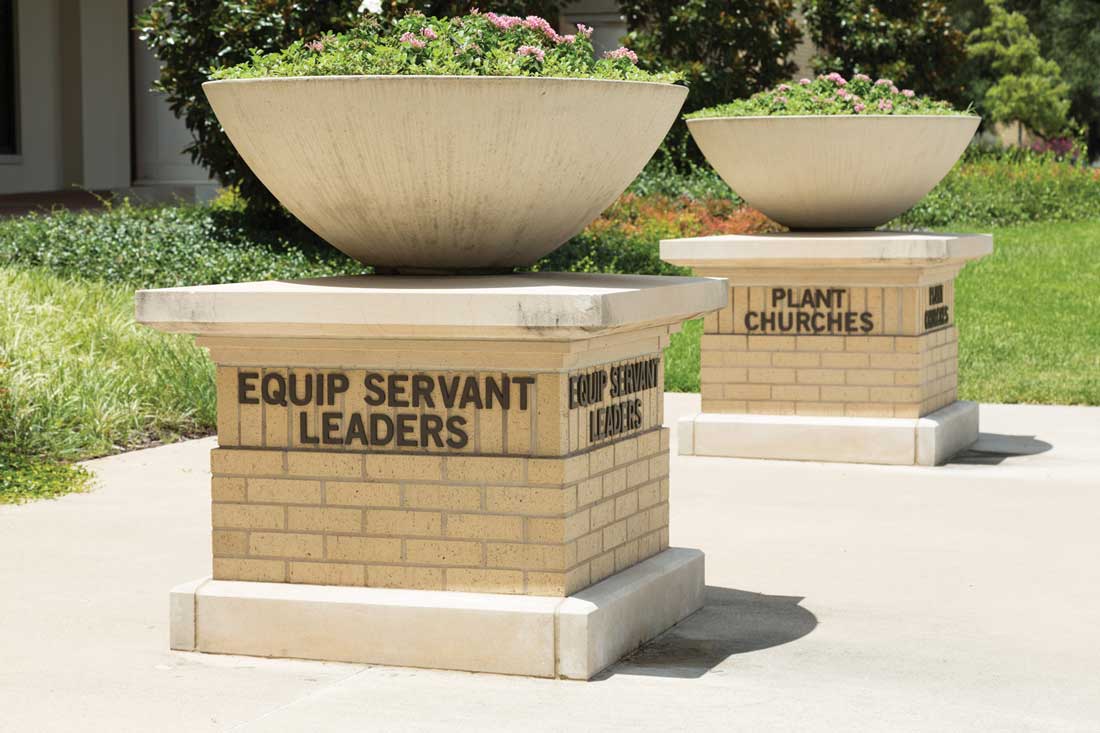
Less than three miles separate the campuses of two leading seminaries that call Fort Worth home, but their philosophies are a world apart. One welcomes those who are LGBTQ. The other prohibits them. One allows differing views on abortion. The other is strictly pro-life. One believes that women should play leadership roles in the church. The other holds a men-only view. Atheists or doubters who want to learn about Christianity are welcomed at one school, but only true believers can attend the other. One believes scripture reflects the perspective of its time. The other believes the Bible is the inerrant word of God.
Both claim that their views are Bible-based.
Confused?

Me too, though I did not feel confused when I was baptized at 6 years old. That was probably because I was too naïve to understand the complexity of what it means to be a Christian. All I knew was that I was afraid of getting on God’s bad side, and I wanted to partake in the Lord’s Supper because I liked grape juice.
“She’s young,” the preacher told the congregation at the now-defunct Eastside Church of Christ in Irving, “but her father says she knows what she’s doing.”
But did I? And do I know what I’m doing even now, all these years later? As part of my decades-long quest to vanquish my befuddlement, I turned to leaders at Brite Divinity School at TCU and Southwestern Baptist Theological Seminary. Surely figuring out what God expects from us isn’t that hard.
Right?
I found answers, but they depended on who I asked. The differences between Brite and Southwestern could be compared to those in the political arena, but the people here behave better than the rest of us. Brite President Newell Williams said that labels such as “liberal” and “conservative” are terms that have been used to describe the schools, but “that’s probably not very helpful. It doesn’t help to understand either school very well. Brite is not a simple, one-note institution. It has a complexity and diversity within itself, and I think that’s the way a theological school ought to be.”
The parallels are still there, and, with Southwestern, I think I can fairly say that diversity is a subjective term. The school has strict theological dictates that must be embraced by both faculty and students, whereas Brite fosters a more freethinking atmosphere. Those hired at Southwestern actually participate in a “signing service” in which they pledge to uphold the school’s deeply held principles.
“We as a Southern Baptist Convention and Southwestern Baptist Theological Seminary would be, on that scale, very conservative,” said Dr. Charles Patrick, Southwestern’s vice president for strategic initiatives and communications. “We believe the Bible is the inerrant and infallible word of God, so everything in it is truth. We can’t just pick and choose portions of scripture, or change things, or say that some things are allegorical and not truth, and so forth, whereas individuals of a more liberal persuasion will say the Bible is not the literal word of God, therefore you can pick and choose or interpret things as you need to.”
But is it picking and choosing? Or is it getting to the root of God’s true message?
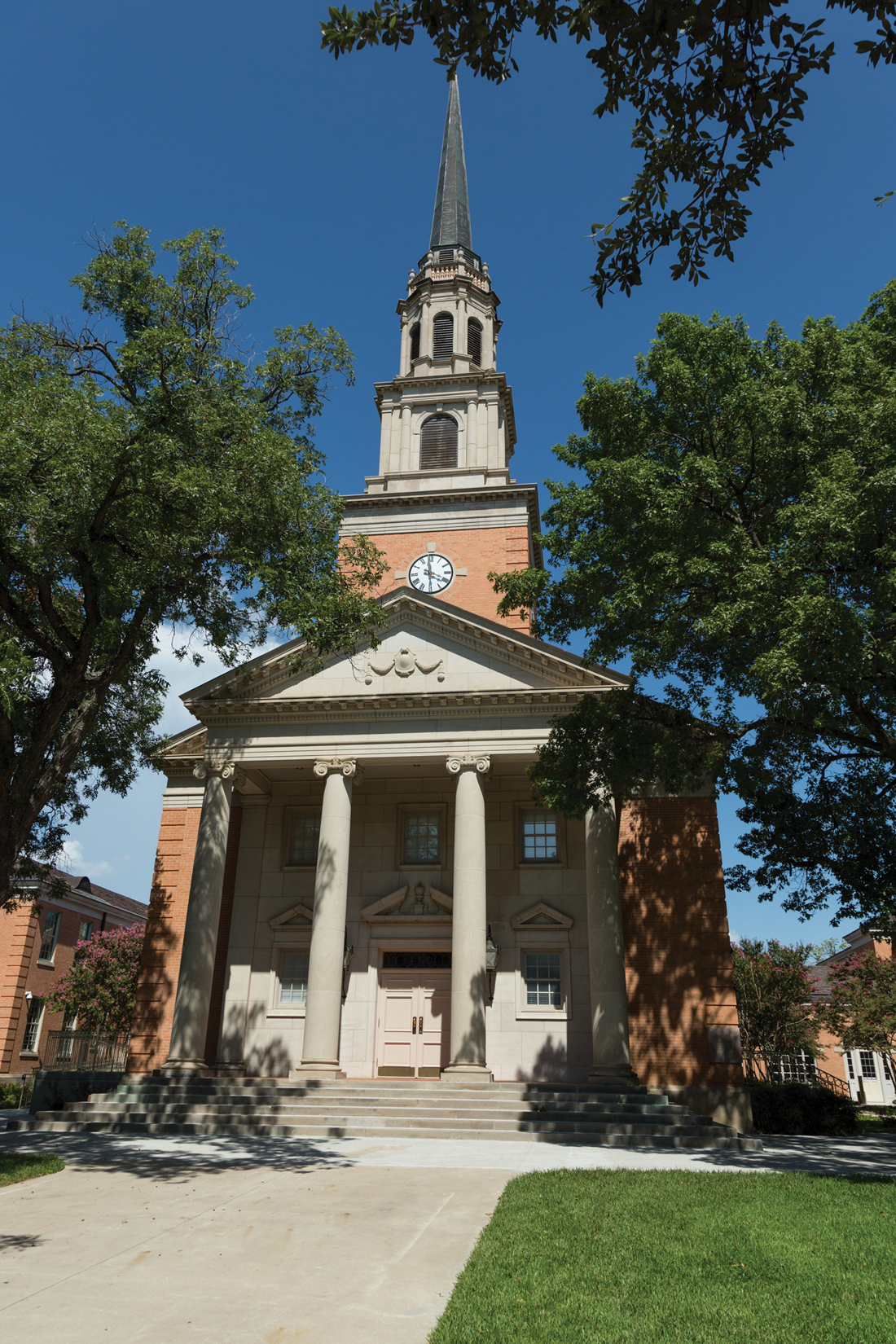
TCU was founded in 1873 by brothers Addison and Randolph Clark, two Disciples of Christ ministers. Brite College of the Bible came along 41 years later, thanks to a donation by West Texas rancher L.C. Brite and his wife, Eddie. The school operates by Disciples of Christ principles and has a partnership with TCU but operates under a different charter. The school’s name was changed to Brite Divinity School in 1963. It is accredited by the Association of Theological Schools and the Southern Association of Colleges and Schools. It is one of four seminaries related to the Disciples of Christ, and it’s the only one related to a university.
Brite, which is approved by the United Methodist Church to teach United Methodist students preparing for ordained ministry, offers several master’s degrees and two doctorates. Its 20 faculty members and administrators represent nine denominations. One faculty member is Jewish and a renowned expert on the Dead Sea Scrolls. A host of academic books have been written by Brite faculty members.
“We’ve always had strength of faculty –– outstanding scholars in the Bible and in the art of caring for people, with a perspective that includes God’s work in the world, God’s grace, and the good news of the gospel,” Williams said. “I think that two fields where Brite has consistently had the most widely recognized reputation for excellence would be the field of the Bible and the field of pastoral care,” services such as counseling and visitation.
The student body represents 28 denominations. “The Divinity School considers this theological and multicultural diversity of students and faculty to be an important context for coming to a clear understanding of individual faith and practice,” reads a message on Brite’s website. Though diverse, the student population is smaller than at Southwestern. Williams said Brite’s average fall enrollment over the past decade has been 228, and the average number of annual graduates over the past several years has been 40.
The school, Williams said, “has a long history of seeking to honor God by recognizing the full humanity of all of our neighbors.”
An example is the decision by Brite’s board in 1952 to begin admitting black students after the National Council of Churches determined that segregation should end in church-related schools.
“That was really quite scandalous in Fort Worth in 1952,” Williams said.
It was especially groundbreaking considering that TCU, despite its deep Christian roots, refused to allow Brite’s black students to eat on the university’s campus. Brite solved that problem by building its own dining room and commercial kitchen, where all students, black or otherwise, were welcome
“Of course, in time TCU came to change its view,” Williams said. “Clearly, Brite made the right decision –– and that’s the way it ought to be. Church-focused institutions should lead the way on issues of morality, and clearly that’s what this was. There is a long tradition here.”
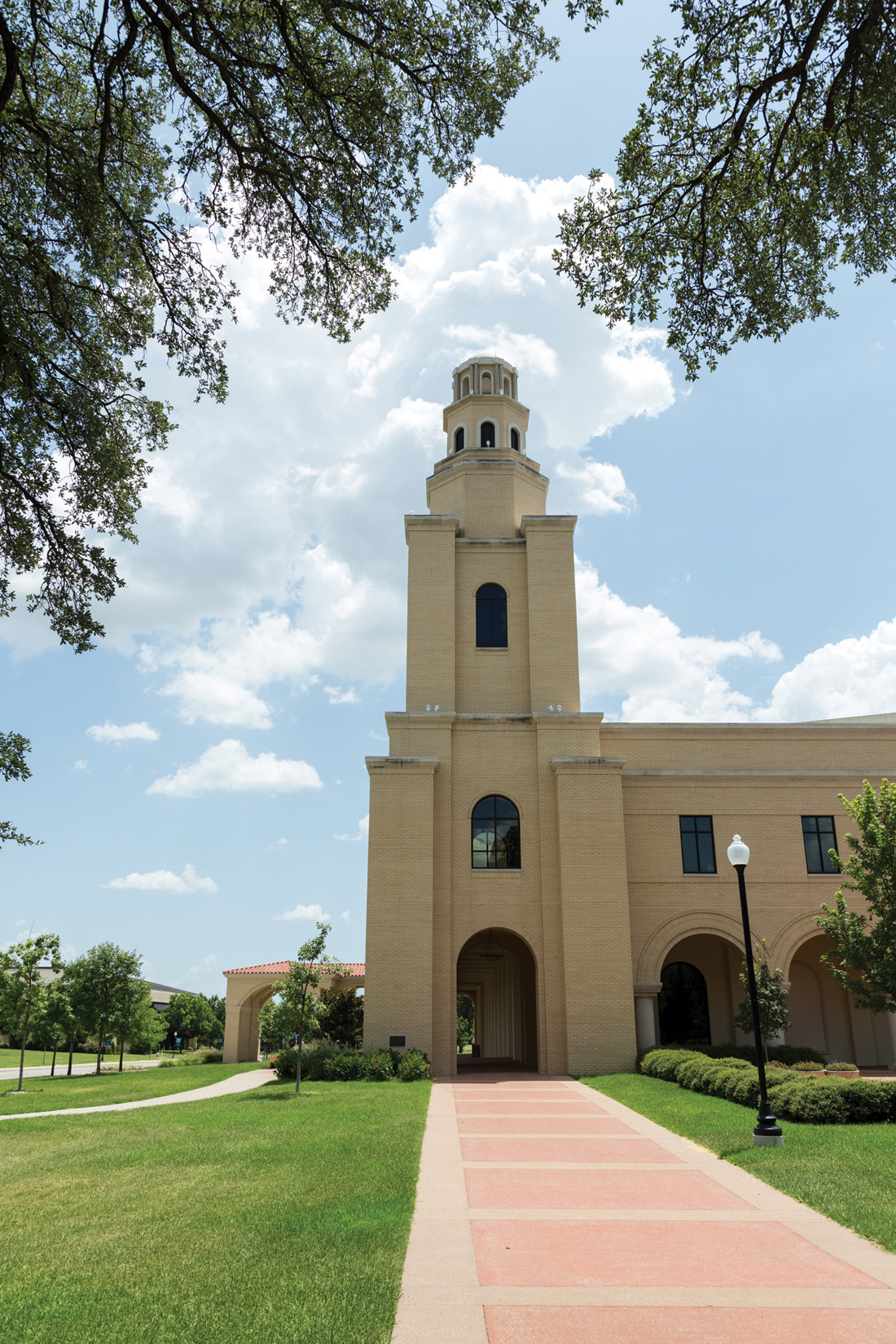
Southwestern Baptist Theological Seminary is one of the largest seminaries in the world and the largest in the Southwest. It has graduated almost 45,000 students since it was founded on the campus of Baylor University in Waco in 1908 by B.H. Carroll. The school moved to its current location on West Seminary Drive in south Fort Worth in 1910.
Southwestern is one of six seminaries that are part of the Southern Baptist Convention, the world’s largest Baptist denomination with more than 16 million members. Each SBC church is autonomous and unique and makes its own decisions about certain things, but all have agreed to a “confession,” according to Patrick. (The word “confession” is used rather than “creed,” Patrick explained, because “creed” is viewed as being an “almost equal authority” to the Bible. A confession is drawn from the Bible, he said.) A main point of agreement in the confession is that the Bible is the inerrant, infallible word of God.
“We may have a difference of opinion in carpet color, but we agree to the confession called the Baptist Faith and Message,” said Patrick, who quit his job as a research scientist at the University of Texas MD Anderson Cancer Center to attend Southwestern. While a student in 2008, he was offered a job as director of operations for the Institutional Advancement office. After graduating, he was asked to stay on.
The Association of Theological Schools lists the Southern Baptist Convention’s half-dozen seminaries among the Top 10 in the United States. Southwestern has more than 20 buildings on its sprawling campus. Its current student body numbers approximately 3,500, and about 600 students graduate each year, Patrick said. Graduates go on to pastor churches, serve as missionaries, hold jobs as church staff, or lead companies that serve as “a platform for missions overseas.”
As a school, he continued, “we are most noted for our focus on evangelism, missions, and our Baptist identity. It’s the core DNA of what we’re known for.”
The seminary offers certificates as well as bachelor’s, master’s, and doctoral degrees –– “the whole gamut,” Patrick said. SWBTS’s scholarship is “on fire,” he said, with faculty members publishing papers and books and attending conferences.
Both Brite and Southwestern have long histories, strong reputations, faculty members who are published authors, and deeply held beliefs. But one of the things that separates them is their views on homosexuality.
At Southwestern, homosexuality is considered a sin. The school will not hire any faculty or accept any student who is openly gay. Not so at Brite. Not only are those from the LGBTQ community welcome as members of the faculty and student body, they also can take advantage of the school’s Carpenter Initiative on Gender, Sexuality, and Justice.
The schools’ opposite opinions on homosexuality are due to differing views of what the Bible says. Southwestern believes that several passages of scripture clearly indicate that homosexuality is a sin. Brite believes that those passages are open to interpretation.
Those who are gay are not necessarily unwelcome on the campus of Southwestern, Patrick said. Officials there are happy to meet with them to discuss God’s calling on their life, but the goal is to dissuade them from the “gay lifestyle,” which they believe is a choice. According to Patrick, there have been success stories.
“We walk them through that,” he said. “Some students will say, ‘I’m not willing to give up the lifestyle.’ Well, they’re not admitted. Some say, ‘I want to overcome that,’ and we walk through that with them. This is a place of reconciliation.”
Humanities professor Robert Lopez, who joined Southwestern about a year ago, is a person on campus who said he turned away from the “gay lifestyle.” He did it on his own through reading the Bible, he said, prior to any association with Southwestern. Lopez said that in 2012 he was relentlessly bullied by the gay community for an essay he wrote about his change of heart. “Growing Up with Two Moms: The Untold Children’s View” was published by Public Discourse, the online portal of the Witherspoon Institute, a conservative think tank that seeks to “enhance public understanding of moral issues.” At the time his essay was published, Lopez was teaching at California State University-Northridge.
Lopez claims that within hours of the essay’s publication, university officials were contacted and encouraged to take disciplinary action against him. He said that he was also attacked on websites, his emails were made public, and his father and sister were contacted. “They went all out.” No one from the gay community spoke out against the treatment, he said.
Lopez was 28 when he turned from the “gay lifestyle” and 41 when he wrote that essay. He’s now 46 and has been married since 2001. He and his wife have two children, ages 11 and 3. He said that Southwestern’s president, Paige Patterson, sought him out to offer him a job. Looking back at the vilification he endured for speaking out about a lifestyle that he believes is harmful to society, Lopez feels sure it served a purpose.
“It was purification by fire,” he said. “I don’t have any doubts in my mind.”
Though he would prefer to leave the past behind him, Lopez speaks out when he feels it’s necessary. “I feel like God keeps calling me into the fray,” he said.
Despite excluding those who are LGBTQ from its faculty and staff, Southwestern has not been accused of being non-inclusive, Patrick said, because “people know where we stand and where our set boundaries are.”
In Genesis, he said, God defines the institution of marriage as being “a permanent union of one man and one woman.” Specific passages that serve as proof that homosexuality is a sin, Patrick said, are: Genesis 1:27-28, Genesis 2:24, Genesis 19:1-27, Matthew 19:4-6, Leviticus 18:22, Leviticus 20:13, Romans 1:18-27, and 1 Corinthians 6:9-11.
“Jesus,” he continued, “also reaffirms marriage as a sacred, monogamous, and life-long institution joining one man and one woman in Matthew 19:4-6. Marriage is a covenant relationship and an institution established by God and is not simply a human social construct. Any sexual behavior outside the husband/wife marriage relationship is sinful, including premarital sex, adultery, bestiality, pornography, and homosexuality.”
By contrast, Brite not only welcomes those who are LGBTQ but has been as much ahead of the curve on gay rights as it was with desegregation. In 1994 –– more than two decades before the U.S. Supreme Court struck down bans on gay marriage –– Brite began offering housing to same-sex couples in committed relationships who said they would have been married had the law allowed it.
“This is nothing new at Brite,” Williams said of the school’s inclusiveness. “We have a very sophisticated, highly regarded faculty in pastoral care, pastoral theology, and sexuality. For that reason we have attracted students who wanted to better understand different types of partnering. Two people can do more for the world than one, so there has been a welcoming of couples at Brite, including same-sex couples.”
Dr. Joretta Marshall, who heads up Brite’s Carpenter Initiative on Gender, Sexuality, and Justice, compared differing views of homosexuality to the complex healthcare debate. An ordained minister in the United Methodist church, Marshall said that Methodists have long been split on homosexuality.
“Religion and churches don’t carry the same understandings about what it means to be a human being and particularly part of the sexualized minority of LGBTQ,” Marshall said. “Brite’s stance is that we are open and affirming, meaning we think that people are called by God and some of them are LGBTQ and some are straight and some of them are African-American and some of them are Korean and some of them are from the United States and white. We think that LGBTQ folks are just as embodied with God’s grace as anyone else.”
Marshall, author of the 1997 book Counseling Lesbian Partners, was not surprised when I ticked off Patrick’s list of anti-gay Scriptures.
“Those would be the passages used to suggest that God does not value persons who have same-gender loving relationships,” she said. “There are lots of other Biblical interpreters who do not understand it that way.”
Williams acknowledges that some verses in the Bible “clearly seem to be condemning homosexual behavior.” However, “careful Biblical study” such as that which takes place at Brite “questions that on a couple of grounds, and one is that, for example, ‘homosexual’ is a modern English term that does not even appear in scripture.”
Homosexuality, then, is a translation, he said.
“If you really dig into it, it’s really not as clear as one might think,” Williams added.
Marshall believes that all denominations decipher God’s word in one form or another, even those who claim they don’t.
“There are ways in which we have changed our mind over the years about lots of pieces of scriptures –– everything from how we understand slavery to how we understand the role of God in creation,” she said. “We’re always trying to understand more, and we’re always trying to seek a way of wisdom. And that means sometimes we have to change our minds about something.”
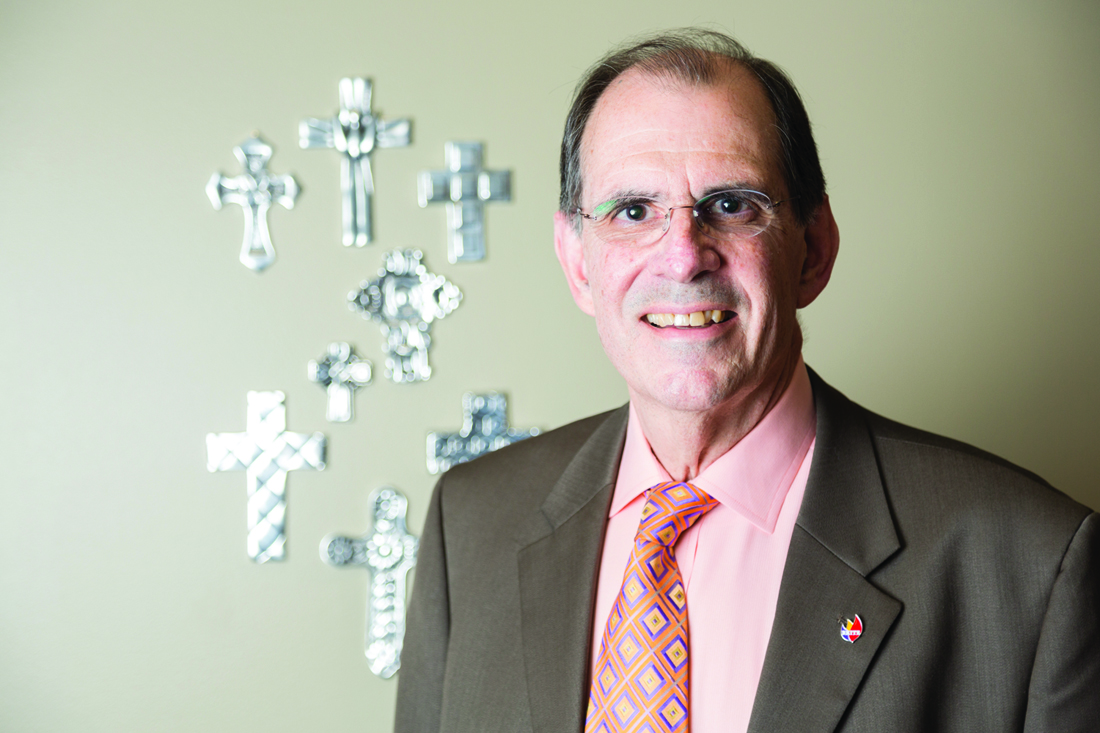
Another key difference between Southwestern and Brite is their views toward women. Southwestern believes that women have an important role in the church but that only men should hold pastoral leadership positions. Patrick said that God’s dictates about women go back to “the fall” in Genesis, chapter three. “Although it is a large topic, it is really straightforward,” he said. Both men and women are created in the image of God, and both have equal value, but different “God-defined” roles, Patrick said, adding that this is called the “complementarian view.”
Southwestern and the Southern Baptist Convention feel that the more men and women have veered from their God-intended roles, the more society has suffered.
“Women should not feel excluded at all, not any more than I should feel excluded for not being able to birth a baby,” Patrick said. “God has merely defined certain roles for man and woman. God created an order of authority at creation. Because of this order of authority, women are not permitted to serve as pastor, teach men, or assume a role of authority over men at church. That is not to say that women do not have a role in the church. On the contrary, they have an immense role, and there are numerous instances of women serving actively in the New Testament.”
He continued, “1 Corinthians 14:33-36 teaches that women are not to assume a role of authority over men, or it will lead to confusion in the local church. I would submit that every evangelical denomination that has permitted women to have authority over men has ended up being a very confused denomination, resulting in denominational splits and decreased membership. If you believe that the Bible is the inerrant, infallible word of God, then you will ascribe to the entire truth of the Bible, including the gender roles God defined. If one does not believe God’s word is truth, then gender roles are completely subjective.”
Considering its conservative views, I am not surprised to learn that Southwestern is against abortion except if the pregnancy is a threat to the life of the mother. This means the seminary opposes abortion even in cases of rape or incest.
“We would still uphold not doing an abortion,” Patrick said. “If she is, for whatever reason, not able to raise the child, then we would help her with adoption. The child is innocent of that circumstance. They have equal value. We’re not going to help abort that life. If she can’t forgive the offender, then there’s a way to take care of that baby. It can be put up for adoption within the church. The sanctity of life is preserved.”
Patrick said he understands that pregnancy and childbirth under such circumstances would not be “an easy process.”
“I’m not trying to make light of it, whatsoever,” he said. “She was violated, absolutely. It’s been going on since the beginning of time and will continue to, unfortunately. But we would still uphold the sanctity of life.”
It’s different at Brite, on both fronts –– abortion and women as church leaders. Some of the school’s female students and graduates are members of churches that do not recognize women as being eligible for some leadership roles, but other women are part of denominations in which gender does not determine leadership ability. Williams said those denominations include United Methodists, Disciples of Christ, the Presbyterian Church USA, and the Cooperative Baptist Fellowship. He noted that, in July, the Disciples of Christ elected its second female general minister and president and the first African-American woman to be selected as head of a mainstream Christian denomination.
Williams said that the school’s mission statement makes its views about women and leadership clear: “Brite Divinity School educates women and men to lead in the ministry of Christ’s church, the academy, and public life as witnesses to God’s reconciling and transforming love and justice.”
Williams said that at Brite, conversations on “hot button” issues such as abortion are encouraged and conducted “in a context of respect.”
One faculty member, he said, “writes books that are pro-life. Others are clearly in the pro-choice camp. So on our faculty, we have both of those views represented, and our students are exposed to both. I think that’s the way it’s supposed to be.”
Back in the late 1970s and early ’80s, Brite and Southwestern intermingled. Williams said the schools “cross-listed” their courses. Southwestern students came to Brite to take classes in pastoral care and counseling, and Brite students went to Southwestern for courses in music.
“That’s the way things were when I left Fort Worth in 1984,” said Williams, who spent 19 years at another seminary before coming back to Brite. “Southwestern and Brite were colleague schools in the same city, and each school allowed and encouraged their students to consider taking a course or two at the other school. When I came back, that had changed, and Southwestern no longer encouraged students to take courses at Brite.”
It had to do, he said, with a “major transformation” within the Southern Baptist Convention. I’ll let Patrick pick up the story from there.
“There was a period of time in the seminary’s history, in the 1980s, where it went a little liberal because there was an effort in the Southern Baptist Convention to not believe the Bible was the inerrant and infallible word of God,” Patrick said. “Liberal folks got in there that were not truthful and started moving people away.”
But then came the great Conservative Resurgence, Patrick said, in which Patterson, Southwestern’s current president, played a critical role. A group quietly began orchestrating a plan to put “leaders in place” to steer the convention back on the conservative course. It took 10 years, Patrick said, but they pulled it off. At a “critical convention” in Dallas, 40,000 messengers from churches showed up to vote.
“And that was the key,” Patrick said. “It flipped back. No [other] denomination has ever come back from that, except this one.”
The Bible was once again considered the inerrant and infallible word of God within the SBC, with no “interpretations” that might lead followers down the wrong path.
“It’s a hill to die on,” Patrick said. “We’re going to stake our claim that God’s word is truth.”
I asked both Patrick and Williams what their schools’ founders would likely think if they were to visit the seminaries today. Both said they believe they would be pleased.
If Southwestern’s founders visited in the 1980s, Patrick said, “I think they would have been a little concerned. But I think they would be amazed at the global impact we’re having presently. We are involved with 137 seminaries around the world. I think they would be pleased at how we have stayed with God’s word and focused on evangelism and missions. And they would be amazed just to see the campus. There are probably 21 or so major buildings, and it’s a 200-acre campus. At first there was just one [building] here on top of a barren hill.”
And Brite?
“The world has changed a lot” since the Brites gave their money, Williams said. As to whether the school has stayed true to its mission, he referred not to the Brites but to Colby Hall, a dean at the school for four decades. Williams said that Hall was probably the most influential person in the institution’s early development.
“I think that Colby Hall might be surprised by some things,” Williams acknowledged. “But he was a loving, gentle, scholarly man. One of the things he was proudest of was that Brite was the first seminary in the country to have married housing.”
He explained that, years ago, other seminaries held the view that if students couldn’t wait to finish their seminary work before getting married, then perhaps their priorities were misplaced. But Hall’s progressive view perhaps paved the way for other changes that would occur at Brite over the years, such as the welcoming of black students and same-sex couples.
“I think that Colby Hall would understand the Brite of today,” Williams said.
So where does all this leave me –– and you –– when it comes to getting Christianity right? Getting it wrong doesn’t necessarily mean we aren’t “saved” –– not if we have professed Jesus as our lord and savior. At least, that’s the way I understand it, but, hey, what do I know? Honestly, I’m still confused, though I do feel clear on the reasons behind each seminary’s religious philosophy.
Who was it who said, “In the end, we all sleep alone”? Maybe that, in essence, is what it all boils down to. Maybe we have to find our own way, read the Bible for ourselves, come to our own understanding of God, and hope that when the day comes that we really do sleep alone, we won’t have the proverbial rude awakening.l








Thanks for the spotlights of both schools. I learned a lot!
Excellent article but your placement of Dr. Williams picture sandwiched between text about SWTS was as misleading as Patterson’s picture among Brite text. Too late for a print fix but easily done now for e-media.
Thoughtful and well-written piece with respect accorded to both schools. While the topic concerns two schools it does a nice job of illustrating the divide in Christianity as well.