

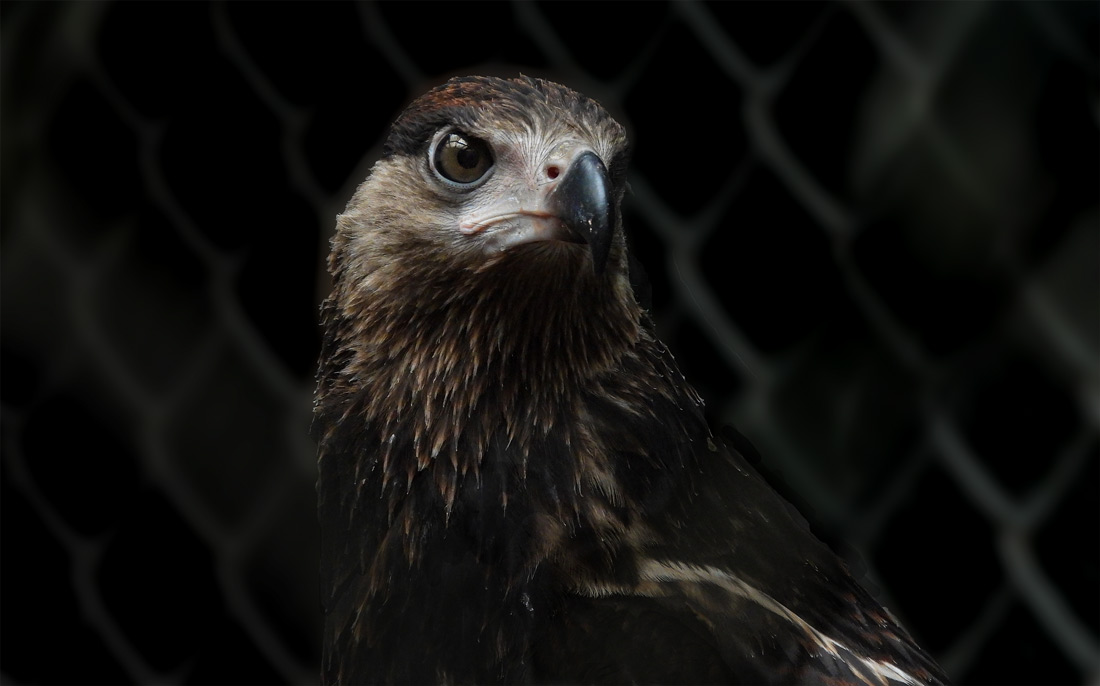
Something both regal and wild echoes within the haunting cry of African fish eagles. With their heads arched back in a bold salute, the birds’ piercing call — weee-ah … hyo-hyo-hyo — heralds a raptor that commands the skies and waters of sub-Saharan Africa.
Striking in appearance, African fish eagles have a milk-white head, shoulders, and chest set in sharp contrast against a body of deep chocolate-brown feathers. Their wings span up to 8 feet in flight.
In the wild, they are precision hunters. Their dark brown eyes can see the shimmer of scales beneath ripples of water. Once a fish is in view, the apex predator skims inches above the surface in a stealth attack. With one decisive strike, barbed talons and rough footpads grab the prey, and the eagle rises, carrying its meal away.

Deeply embedded in culture and folklore, the fish eagles’ piercing cry is widely known as the Voice of Africa.
Although plentiful in parts of the continent, these birds are rare in North American zoos. Only a handful of institutions accredited by the Association of Zoos and Aquariums (AZA) exhibit the species.
One of them is the Fort Worth Zoo.
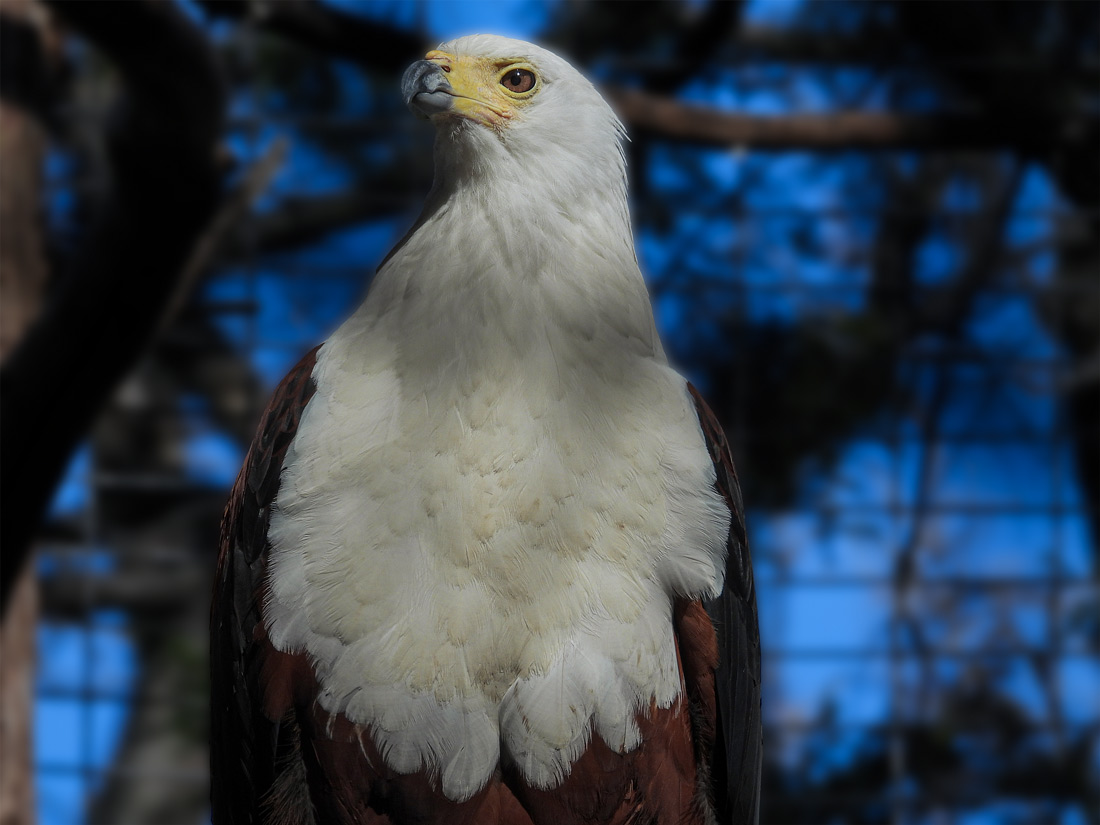
Photo by Teri Webster
The recent arrival of an African fish eagle hatchling is raising a new song by becoming the first one in the zoo’s 117-year history. Fort Worth is also the only AZA-accredited institution with a successful fish eagle hatching in recent years.
The rare hatchling was made possible by careful planning by zoo staff and an assist — strangely enough — by an ordinary chicken.
“Before Fort Worth, only two North American zoos that I know of bred African fish eagles in the last 25 or 30 years,” said Beau Parks of the Tulsa Zoo and chair of the AZA’s Raptor Taxon Advisory Group.
“I would call it unique,” Parks said. “There are not a lot of places that have them. That speaks to the level of care their birds get. [Fort Worth Zoo’s] bird staff was able to be successful with a species that not many places keep or have bred.”
Available space and a slow reproductive arc are two key challenges for breeding large raptors in zoos, Parks said.
At Fort Worth, bird supervisor Amanda Zalewski has lived those challenges firsthand. Take, for example, having enough space for large raptors. One reason is their elaborate aerial courting displays, Zalewski said. “In captivity, it’s harder for them to fully go through those motions. That leads to a harder time nesting and breeding. You need enough space in an exhibit to give them a platform.”
Getting the nesting materials right was another puzzle. Keepers experimented with different sticks, leaves, and nest platforms until the pair finally approved.
“They ended up liking pencil-thickness sticks, but they like it with greens on it,” Zalewski said. “They want something leafy. They didn’t like just plain sticks. We tried kind of cedar and pine needles, and those weren’t as big, so we ended up using a lot of the Elaeagnus [plants]. [The fish eagles] really liked that.”
The larger challenge was finding the right mate for the zoo’s female, who arrived in 2019.
“This is actually her second mate,” Zalewski said. “We brought one male in first. They got along but didn’t go through all the breeding displays. She just wasn’t that interested in him, and he wasn’t that interested in her, so we swapped him out” to another facility.
The second male arrived in 2023 and triggered proper breeding behaviors: calling together, feeding each other, nest-building, and more.
“We were very hopeful,” Zalewski said. “When she started laying eggs, the first few were fertile. We got very excited, but she did not sit very well.”
The strong-willed female fluttered around and left the nest too much to properly incubate the eggs. The zoo, however, had a secret weapon waiting in the wings. More accurately, there was a hidden helper sitting with folded wings.
Enter: the unsung heroes in the world of raptor-hatching. Tucked away behind the scenes at the zoo is a group of broody hens. A broody hen is a chicken whose hormones have decided that her life’s mission is hatching eggs.
A broody hen will also stay on the nest incessantly and can aggressively guard the eggs, as well.
“We encourage them to lay eggs, then give them other birds’ eggs to sit on,” Zalewski said. “They incubate them for us.”
One chicken performed a marathon sitting for the fish eagle egg.
“A chicken usually sits 21 days for her own eggs,” Zalewski said. “This was 37 days. She sat the whole time, never any problems. She was a great chicken.”
The hatchling arrived as a pale-gray puff not much larger than a tennis ball, the zoo said, but the challenges didn’t end with the announcement of the hatchling in March. Keepers had to prevent the chick from imprinting on humans.
When a bird hatches, the first thing it sees becomes its parent.
“Just about every bird that hatches will rely on a parent,” Zalewski said. “The first thing they see coming out of the egg, they expect that as their parent. They expect that for food. With us bringing him food every day, he would form that attachment: ‘This is where my food comes from. This is my parent. I need to rely on this figure for my safety, my nourishment.’ ”
Keepers and veterinary staff used mirrored gear and even a fish-eagle puppet for feedings — a delicate dance to ensure the bird knew it belonged to its kind, not to humans.
Since then, he has continued growing, already hinting at the impressive wingspan that defines a species.
The young fish eagle remains behind the scenes for now and will likely be transferred to another accredited zoo once he matures. His parents, Zalewski said, would likely see him as an intruder, not their offspring.
The fish eagle may have made history in Fort Worth, but the species has deep and longstanding roots in Africa. Birding South Africa notes that the fish eagle is the national bird of Zimbabwe, Namibia, and South Sudan. Zambia displays it on its flag and coat of arms. In folklore, some cultures believe the bird possesses protective spiritual powers or serves as a messenger of the gods.
Though listed as Least Concern by the International Union for Conservation of Nature (IUCN), African fish eagles still face habitat loss, overfishing, and environmental poisons. In that regard, they are important ambassadors for a much larger picture, experts said.
“This applies to all the raptors, all the birds, all the animals at the zoo,” Parks said. “A lot of kids, and people in general, will never see these animals otherwise. It’s our mission to make that possible, to make a connection, to make people care about things they normally don’t have access to.”
That includes access to African fish eagles. Majestic. Loud. Iconic. And in Fort Worth, access is growing — at least in part — to a chicken that perhaps has always wanted to fly high.
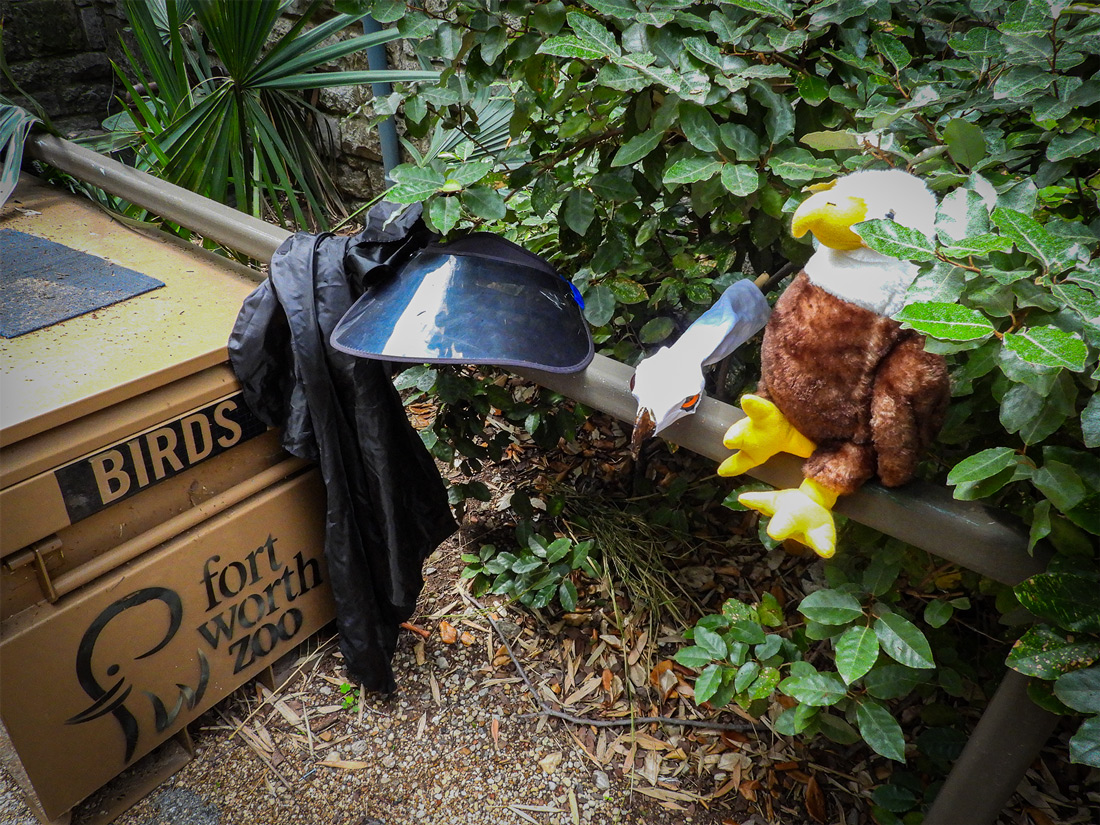
Photo by Teri Webster