

Well, well. If you’d come up to me during the run of Harry Potter movies and asked me which of the kid actors outside of the leads would have a burgeoning career as an adult, I wouldn’t have picked the fat kid who played Dudley Dursley. Here we are, though, and it is going good for Harry Melling (in many roles for Netflix, interestingly enough), who boasts a fascinating face with eyes set so close together that he resembles a figurine from a Nick Park stop-motion movie. The Coen brothers cast him as an amputee Shakespearean actor in The Ballad of Buster Scruggs, and then he played a grandiloquent Edgar Allan Poe in The Pale Blue Eye. In between those, he was the state chess champion who loses to Anya Taylor-Joy on The Queen’s Gambit.
He’s now the best thing about Pillion, a British gay S&M romance that I alluded to in my review of Wuthering Heights</em>. Adapted from Adam Mars-Jones’ novel Box Hill, the movie popped up on some other critics’ top 10 lists for 2025, though I’m considering it a 2026 film. It opens in three Tarrant County theaters one week later than originally scheduled, but it is worth the wait, and not just for viewers who are gay or into BDSM.
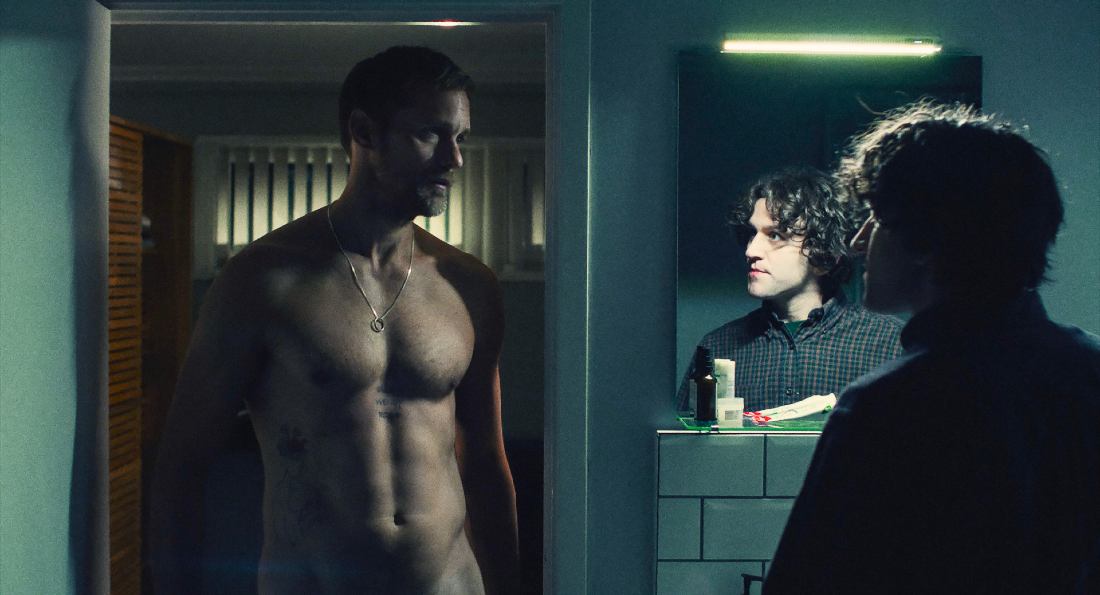
Unlike the novel, the movie is set in the present day. Melling portrays Colin Smith, an officer with London’s Metropolitan Police who takes a lot of abuse because he’s basically a meter maid, patrolling busy city parking garages and writing out tickets. His only social life is singing in a barbershop quartet founded by his dad (Douglas Hodge), which is how he meets Ray (Alexander Skarsgård), a member of a gay biker gang who wears immaculate white outfits while riding when all the other gay bikers are wearing black. Motorcycle enthusiasts know that a pillion is the cycle’s back seat, and Colin is so happy sitting there with his arms around Ray that he no longer cares about motorists cursing at him.

The way he takes the abuse from Ray is somewhat understandable, since Colin’s amazed that such a good-looking and confident man would be interested in him. Thus he agrees to a wrestling match in Ray’s living room while wearing an assless singlet, which leads to rough sex that’s the best of his life. Problem is, Ray spends the rest of the time acting like a less likable version of Christian Grey, ordering Colin to cut off all his long hair and wear a heavy chain with a padlock around his neck to signify that Colin is his. He marks Colin’s birthday by making him cook dinner for him even though he tells people that he hates Colin’s cooking. No wonder Colin’s terminally ill mother (Lesley Sharp) pronounces Ray a creep upon meeting him, which is the last time Colin speaks to her before she dies.
Watching this one-sided relationship meant that I spent much of the movie feeling like Colin when he’s taken to a biker orgy and everyone studiously ignores him. First-time filmmaker Harry Lighton directs all this with a reasonable degree of proficiency, but what really saves the movie is the climax, when Colin finally starts chafing against Ray’s strictures and Ray proposes a “day off” where they do what Colin wants. It’s a blissful day of the sort that other couples (gay and straight) have, and it reveals that Ray is actually the weak link in the relationship. The prospect of a carefree day without him giving orders freaks him out so much that he breaks things off.
So Pillion is a gay male version of Babygirl and The Chronology of Water, where the sub’s experience with S&M teaches them to ask for the things they want in the bedroom and in the relationship. Except, Lighton’s movie is better than those because its observations about BDSM come paired with psychological insight, as well as genuine chemistry between the two leads. It’s all good enough that when I start compiling my list of the best movies of 2026 some 10 months hence, I’ll give serious consideration to this.
Pillion
Starring Harry Melling and Alexander Skarsgård. Written and directed by Harry Lighton, based on Adam Mars-Jones’ novel. Rated R.