


Like a lot of former college students, Brandon Aubrey didn’t end up working in the field for which he went to school.
“Went off to play D-I soccer at Notre Dame, won a national championship there as a freshman, and then was skilled enough to get drafted in the first round (of the MLS SuperDraft). That’s where it all went downhill,” he told me in the video interview for this column.
Aubrey did not make it onto a Major League Soccer roster, competing at a minor league level before ending his soccer career. Luckily, he then discovered he could kick an American football really well and has become an All-Pro placekicker for the Dallas Cowboys.

In his current job, Aubrey is an exception. Almost every player in the NFL, the world’s elite tackle football league, came through a college football program. Gridiron football, that is.
The same is true of Eddie Lewis’s current profession. As the founder and proprietor of an entrepreneurial venture, he shares college attendance with many of his peers. In fact, he told me in his video interview, he got the original idea for his business concept while matriculating at UCLA and playing on the school’s soccer team.
 “We’d kind of sit and watch the basketball team train before we’d go out for practice, and they rolled out these smaller than regulation size hoops one time, and the idea was these guys are going to work on their three-point shots on the smaller hoop, which obviously in the game would make it a lot easier. So I thought, ‘All right, that’s a good concept.’”
Lewis turned to tennis balls to mimic the basketball drills in a soccer context. After his own playing career finished, he decided he could adapt the concept, which had helped him hone his own skills, for a broader audience.
“The day I retired, really began focusing on ‘How do I make this this training concept more soccer-specific?’” he said. “I looked around. You know, golf had a driving range, baseball had batting cages. Like, this concept already existed, but for soccer there wasn’t anything.”
Lewis’s insights manifested themselves as a company called TOCA Football, which opened indoor, tech-centric soccer training centers in the United States, Canada, and Mexico. They have also expanded to add TOCA Social soccer bars/restaurants in North Texas and overseas.
Lewis’s training techniques helped him became a successful player. He made two U.S. World Cup squads and had a lengthy club career in Europe and Major League Soccer. The path he took (and that Aubrey had hoped to take) to professional and (especially) international soccer has become less common.
When Lewis played in the 2002 and 2006 Men’s World Cups, the great majority of his teammates had also played in college. The 2026 group includes only eight players on the 23-man roster who came through the university system. Aubrey grew up dreaming of playing in a Men’s World Cup wearing the red, white, and blue and for big professional clubs. But the nature of the sport makes the path he chose less straightforward than the one in his current sport.
“Soccer’s an international game, so that’s not the only pathway through. It’s kind of a young man’s game, so starting out at 23 is a little bit late versus making it to the pros at 16, 17, 18, which is the model for a lot of European and South American clubs. So the U.S. is also trying to implement that model here and kind of raise their kids all the way through an academy system,” Aubrey said of the academy structures MLS franchises have developed over the decades since Lewis played. “You have three different pathways to the professional system here, which is that youth academy system, college soccer, and then just signing players from abroad, where you don’t have those same pathways in most other sports in America, especially football. So there’s a lot more competition than just your fellow college athletes.”
Male players now often make the leap straight from an academy into a professional team in the U.S. or abroad, bypassing college. On the women’s side, the newer National Women’s Soccer League and Gainbridge Super League have not implemented such an infrastructure, at least not yet. Consequently, NCAA programs remain a vital pipeline for American women who aspire to pro soccer careers. Though a few U.S. women have elected to bypass the student-athlete route for immediate pro opportunities, the 2023 Women’s World Cup roster still included 20 members who had played college soccer.
Debate rages in U.S. soccer circles about the worth of the college system in developing elite athletes for both the men’s and women’s national teams. Many prefer a system more like the ones in place for European club academies. But dribbling skills and set piece execution aren’t the only things one learns through immersion in a university environment.
“The main reason I wanted to go to college was the education,” Aubrey said. “You have to have some sort of backup plan in case it doesn’t go well, which it didn’t for me.”
“I played in Europe for 10 years, and I saw a ton of 16-year-olds and 17-year-olds that turned pro, and the one thing college offers is it also teaches you how to grow up and be an adult and be more responsible,” said Lewis. “A lot of these kids, 16, 17, were starting to make a bunch of money, but didn’t really have a lot to offer outside of soccer practice, and they would end up struggling and falling out of the game because they hadn’t really matured the same way that college helps you do as a young man or as a young woman.”
I wrote, researched, and directed a docuseries called “Raising Her Game,” now streaming on Tubi. It charts the growth of U.S. soccer and women’s sports through the eyes of the 2023 University of Texas women’s soccer team. We talked to a lot of players who had come through the U.S. college system. A number of them pointed out the quality of the facilities and medical care they get, some of it subsidized by American football revenue at a school the size of Texas. They noted the classes they could take and the networking inherent in a university alumni base. But one person we interviewed had a special perspective. When Paolo Bonifazio, a languages professor, came to teach at UT from Italy, she found an unfamiliar (and enormous) athletic infrastructure.
“Coming from Europe, at first, it’s something that you cannot comprehend. You cannot comprehend why a sport would be so relevant at a university, right? And I have to say, that in time, I came to appreciate that,” explained Dr. Bonifazio. She liked the way an athlete didn’t necessarily have to make a decision about their entire future as a teenager.
“The way in which sport, it’s not either/or, but rather, can be a gateway, because maybe eventually, college athletes may go on and do a completely different profession than being athletes. But they have learned something by being athletes, and they’ve also had the opportunity to actually go to college. So, I mean, it’s great,” she said.
College soccer could perhaps use some refinement in terms of its schedule and rules to make it more effective as a developmental pathway (or perhaps not – it’s still a debate). Legal wranglings, realignment, and player payment issues have thrown university athletics into flux. But at many levels, the collegiate experience retains many of the characteristics that add value for 18-22-year-olds.
Though he probably wasn’t expecting a basketball gym to be the classroom that inspired a business career, Lewis sees a lot of value in the path he took.
“I’m a huge fan of using college as a real development pathway for players. Not all players, but certainly there’s many more players, in my opinion, that should play college before they turn pro, even if it’s for a few years, just because of the education, the social environment, the maturity that comes along with it,” he said.
The team we profiled in “Raising Her Game” has so far produced 11 professional players and a med student. None of the pros have yet earned generational wealth from soccer and though progress has been made, there are still fewer opportunities to do so in the women’s game than the men’s. No matter how many years they play, they may be happy they got to take classes at a top university in their youth.
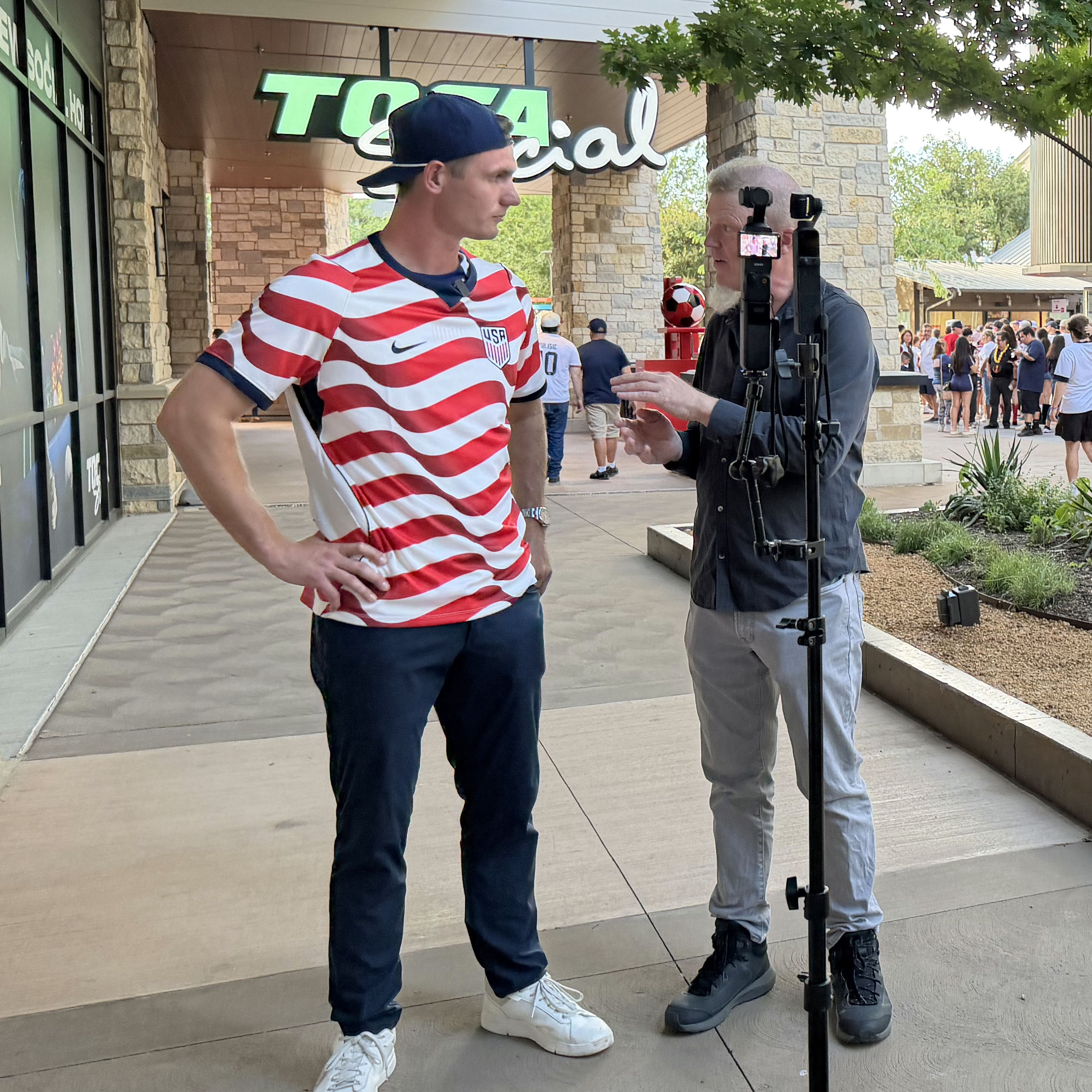 “I think it’s really important to go get that degree and be ready for life after soccer,” said Aubrey.
With the FIFA Men’s World Cup ongoing in the U.S., supporters and media members from around the world have observed how this country approaches soccer (which most of them would prefer we called “football,” even as we generally reserve that term for Aubrey’s new sport). And the debate continues about what the U.S. system should learn from those of the visitors, many of whose teams were favored to defeat ours. But it might make sense for the out-of-towners to also consider what they could learn from the system that produced Aubrey and Lewis. It has had its successes, in a number of areas of life.