

FedEx promises to deliver on time — unless it involves sticking to agreements.
The global carrier has a long history of acting as a bad neighbor in the Southeast Fort Worth neighborhood of Echo Heights. For five years, the global carrier operated its 9.4-acre trucking facility under a permit lapse that went unnoticed by the City of Fort Worth, despite the lot sitting adjacent to a city code-compliance building. Now, halfway through a two-year Conditional Use Permit (CUP), the carrier has failed to fulfill its commitments made to the Echo Heights community.
When residents and environmental advocates exposed the lapse, Fort Worth City Council, in June of 2025, moved to approve the CUP following the recommendation of District 11 Councilmember Jeanette Martinez, who said at the time that she “hoped FedEx was able to live up to their words and commitment to being a better neighbor to the Echo Heights community.”

To secure the permit, FedEx spokesperson and legal counsel Sean Tate vowed to “demonstrate” the carrier’s “commitment to being a better partner moving forward, not with promises but with actions.”
Under the approved terms, FedEx committed to updating truck routing maps, erecting a new screening fence, planting a landscape buffer of more than 300 trees and shrubs, and installing a $30,000 air quality monitor at W.M. Green Elementary to be commissioned by Dr. David Lary’s UT-Dallas lab. Martinez conceded that the five-year lapse should have been caught sooner by both FedEx and the city. Municipal officials blamed the oversight on shifting processes, when permit approvals moved from the Board of Adjustment to the Zoning Commission and City Council.
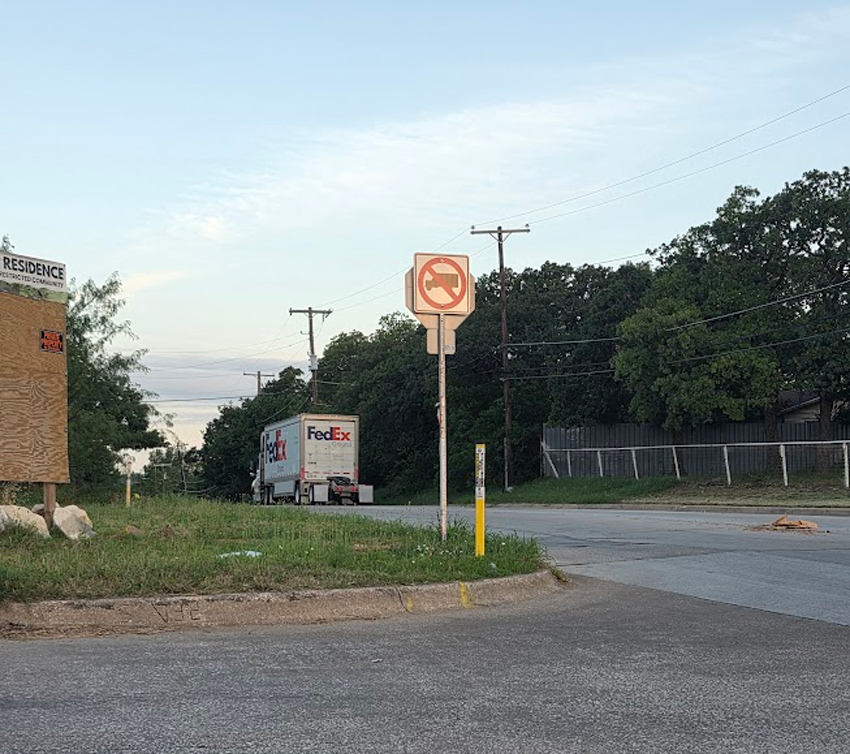
Photo by Chris Jones
One year later, FedEx hasn’t fulfilled any of its promises to the Echo Heights community. The facility was supposed to replace its chain-link fences and provide landscaping. Semi-trucks also continue to speed through residential streets, ignoring no-truck signs and destroying roads. Most importantly, W.M. Green Elementary is still without an air monitor.
When pressed by the community, Martinez acknowledged that some of FedEx’s pledges weren’t legally binding. She clarified that FedEx committed to donating the air monitor as a “good-faith effort outside of the CUP approval process” and that “while it was not a condition of the permit, I believe businesses should honor the commitments they make to the community.”
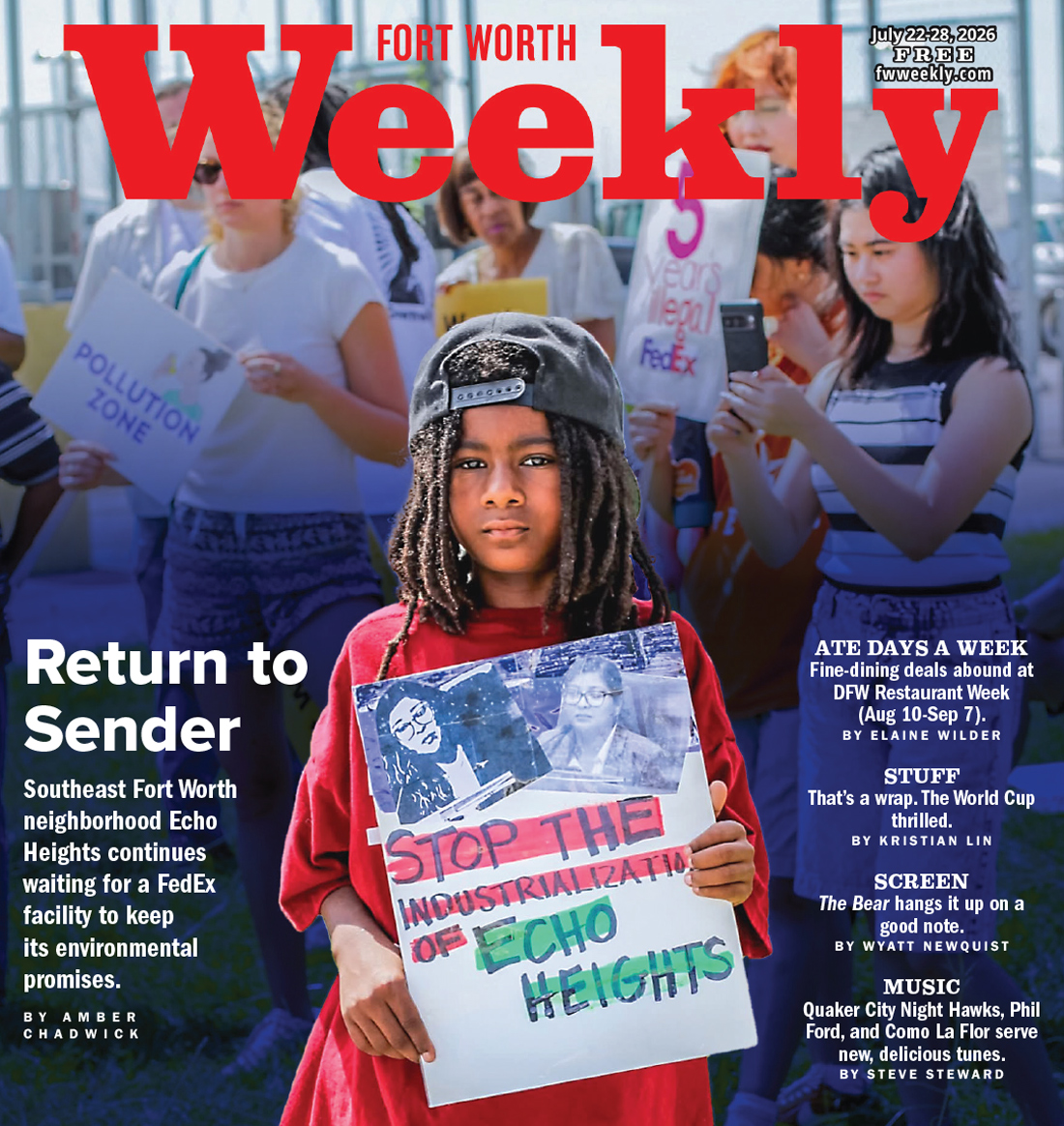
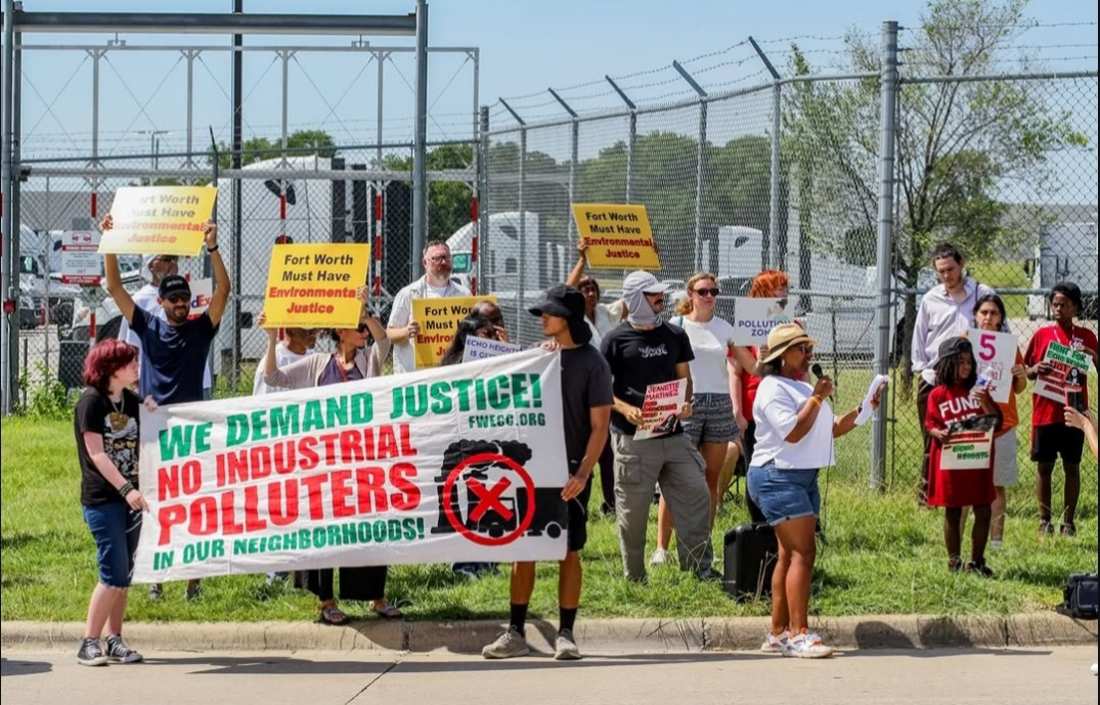
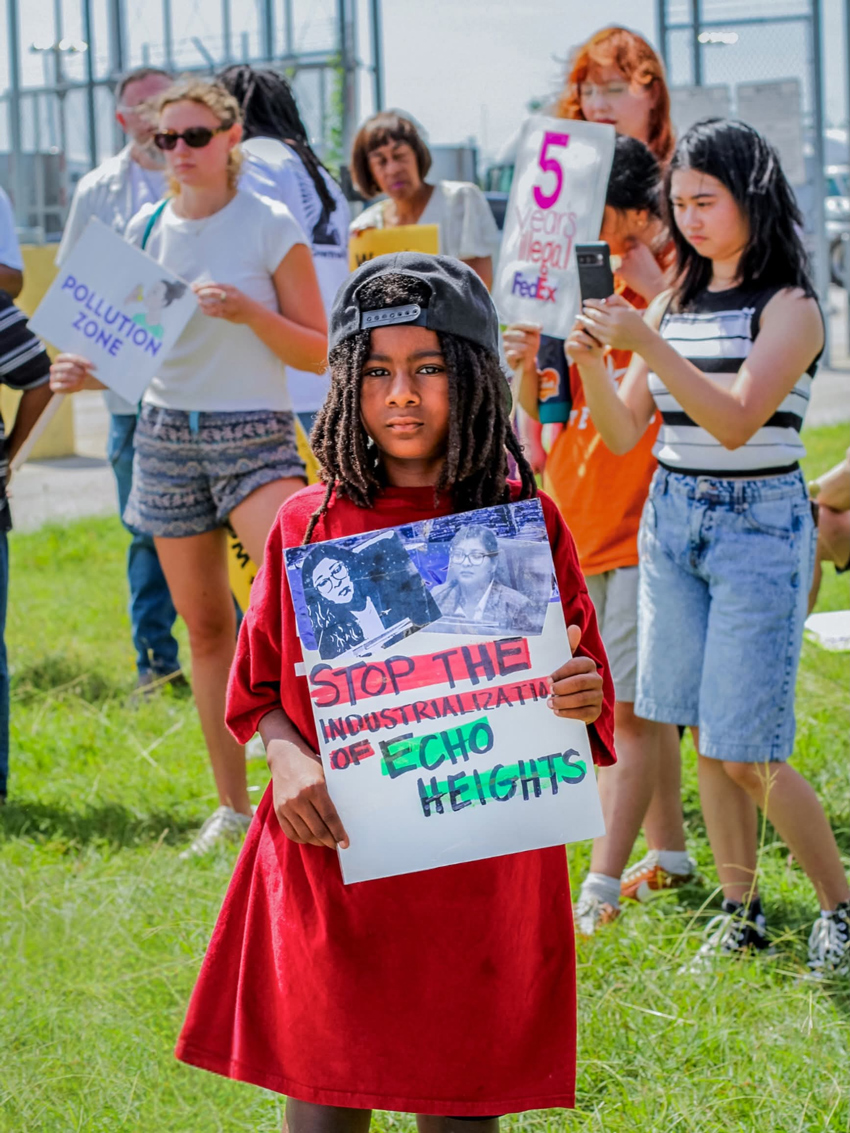
Last month, demonstrators showed up outside FedEx’s Echo Heights facility at 4700 Martin St., demanding accountability for the carrier’s negligence. The rally was led by the Fort Worth Environmental Coalition of Communities (FWECC), with support from the Sierra Club and the Echo Heights Stop 6 Environmental Coalition. Protesters stood in tall weeds, holding picket signs targeting the company’s unfulfilled obligations to the community.
Courtesy of the Fort Worth Environmental Coalition of Communities (FWECC)
“There’s so many voices … tired of fighting, because it’s getting nowhere,” said Chris Jones, vice president of the Echo Heights Neighborhood Association.
The true cost of this infrastructure is measured in the community’s physical health. Echo Heights is a working-class neighborhood and one of Fort Worth’s most ecologically disadvantaged areas. Dozens of residential properties reside within the immediate emission radius of the FedEx lot, exposing families to heavy diesel exhaust containing more than 40 carcinogens known to cause malignancies and respiratory complications. Rubber tire degradation from these trucks also releases toxic microplastics into the air. Studies from the Health Effects Institute show that unsafe levels of exposure to traffic emissions and tire-wear microplastics regularly permeate areas up to a 1,640-foot radius of trucking corridors, while medical data shows that chronic exposure within 1,000 feet of heavy trucking facilities causes permanent, stunted lung growth in children. Because air pollution travels downwind, this leaves children vulnerable to inhaling particulates during recess and outdoor pickup lines. W.M. Green Elementary sits 1.1 miles away from the FedEx site, which is why the carrier’s promise of donating an air monitor is so important to the Echo Heights community.
Courtesy of the Fort Worth Environmental Coalition of Communities (FWECC)
Distribution centers choose neighborhoods like Echo Heights because of proximity to highways, cheaper land, and assumed lack of political resistance. Within a 2-mile radius of the FedEx facility, where the population is 91% people of color and 54% low-income, the area, based on data from the Environmental Protection Agency (EPA), indicates that Echo Heights is in the 90th percentile for hazardous waste proximity, with the adult asthma rates sitting at 12%, surpassing both statewide and national averages. An audit of multiple FedEx facilities in North Texas found that they primarily operate out of minority-majority ZIP codes. However, this pattern isn’t specific to North Texas or to FedEx. It’s indicative of the broader national crisis of systemic inequities that the freight industry continues imposing on our country’s most vulnerable communities.
“We are human,” said Letitia Wilbourn, co-chair of FWECC. “Humans can only absorb so much, and right now they are putting too much on us.”
FedEx, said Adam Snyder, FedEx communications strategic advisor for global media, “strives to be a good neighbor in all the communities where we operate. With regard to our facility in Fort Worth, Texas, we fully intend to complete the site updates and quality measurements in the next several months.”
Following recent press inquiries on deadline, confirmation from both Councilmember Martinez and Lary’s independent lab reveals that FedEx has finally released the promised $30,000 payment to the university to begin construction on the air monitor for W.M. Green Elementary. Martinez also said that her office fully intends to “review the concerns raised by residents and ensure any potential CUP violations are investigated and addressed.”
Community advocates remain skeptical until the appropriate actions are taken and results are apparent.
FedEx is already halfway through its two-year CUP. By the time the air monitor is constructed, calibrated, and able to yield significant data, FedEx will be reapplying for permit renewal. Whether this release of funds is a calculated public relations move or a genuine act of good faith is unclear. In the meantime, Echo Heights will continue to wait for FedEx to deliver on the rest of its obligations.