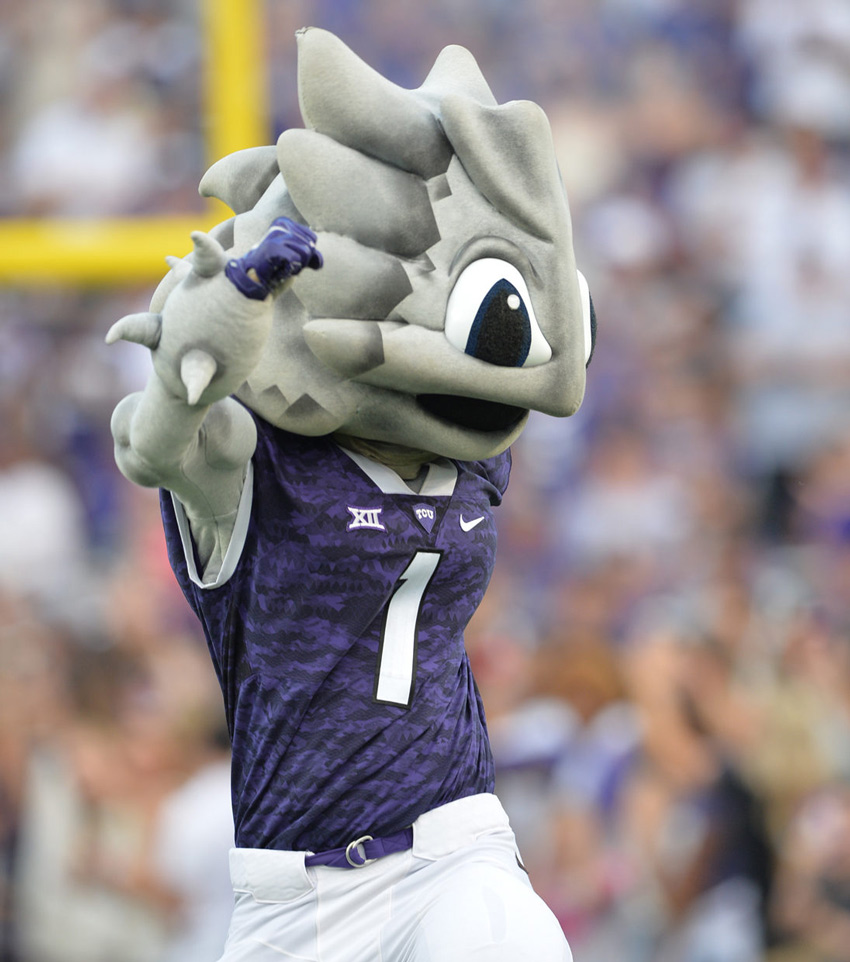
Students who perform as SuperFrog get a chance to experience major college football from a unique perspective.
Courtesy TCU Athletics
A quality university education includes experiences beyond the classroom which help prepare a student for a productive career. With that in mind, many TCU undergrads do internships. Others study abroad. And a select few augment their formal studies by dressing up as an anthropomorphic reptile.
The TCU Spirit Department includes student dancers, cheerleaders, and the embodiment of the school’s Horned Frog mascot, SuperFrog. The costumed character adds an element of merriment to university functions, with a special appeal to children. For those who wear the suit, serving as the frontperson for the whole institution represents part of the position’s attraction.
“It genuinely is an honor to represent the school and just be the face of the university for the short time that we have,” said Connor Beattie, who served as SuperFrog from 2021 through 2025.
Former SuperFrog Chris Curtis agrees. “I felt like I was a part of the athletic department. I was as close to being involved in the sports teams as I couldbe.”
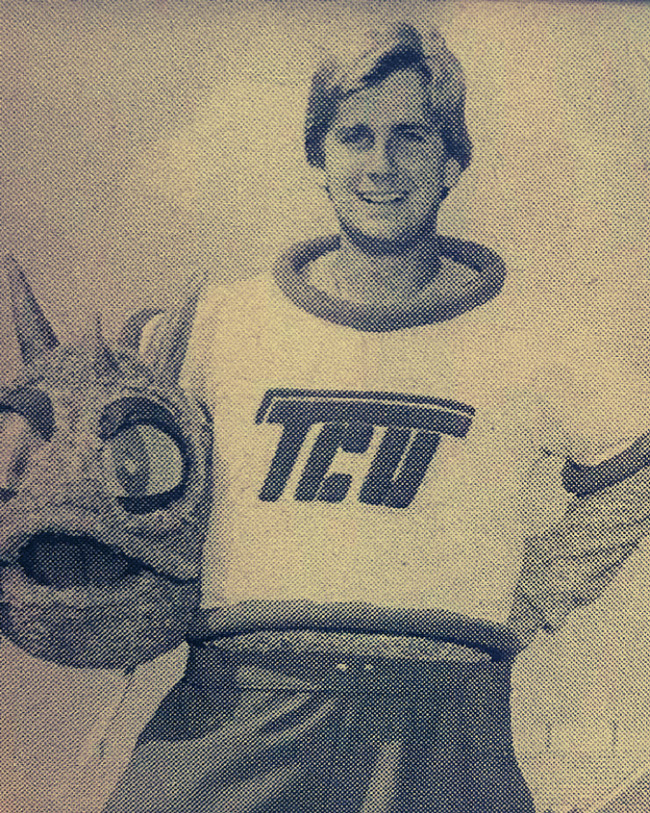
Curtis wore the original SuperFrog suit, donning it shortly after its 1979 introduction and continuing through his 1983 graduation. A mascot named Addie had previously existed, but the athletics promotion director, John Grace, decided to replace it with a more dynamic creature to go along with his marketing concepts.
Performing as SuperFrog during his time as a TCU student from 1979 to 1983, Chris Curtis has continued to support the university as an alum. Courtesy TCU/Chris Curtis
“He had created a campaign called Frog Fever, and he created SuperFrog,” remembered Curtis, who was not the first to wear the suit but was pressed into service quickly after one of the original occupants breached mascot etiquette at a football game.
“One of them was an older fraternity brother of mine,” Curtis recalled. “The other one got kicked off being SuperFrog the first game. He just took it too far, like he was over on the other sideline, standing next to the coach. He went out on the field, like behind their huddle during the timeout, acting like he was listening to their huddle and hollering over to our sideline, and so they removed him, so now there was only one, and he needed some help filling in from time to time, and so I started.”
To continue in the role, which was innovative for a time when few sports entities had developed prominent mascots, Curtis had to try out. “They interviewed you, and then they gave you, like, 5 minutes to do whatever you do. I guess I just kind of danced and fiddled around and did some stuff, did some crazy stuff, then just abruptly turned and walked off. And I guess that got it for me.”
By the time Beattie arrived at TCU, SuperFrog was established enough that his admissions counselor could suggest it to him when he expressed an interest in dance and sports.
Beattie recalled, “I’m like, ‘That’s not who I am. That’s not what I do.’ [The counselor] kept trying to convince me on it, so I eventually just went to the tryout for it, and they brought me in. It started off as something that was zero interest, and then quickly became just my sole existence at TCU almost.”
Despite his passion for the position, Beattie told very few about his role. The multiple undergrads who portray the character keep their true identities hidden under their lizard heads until they leave the school. Beattie considers that anonymity crucial to remaining effective in the position. “The best way that I can describe it is just ‘Disney movie magic.’ The second that you know what happens behind the scenes, that’s all that you see, and the magic of SuperFrog is dead, and all you see is some random sweaty college sophomore running around the field trying not to fall over.”
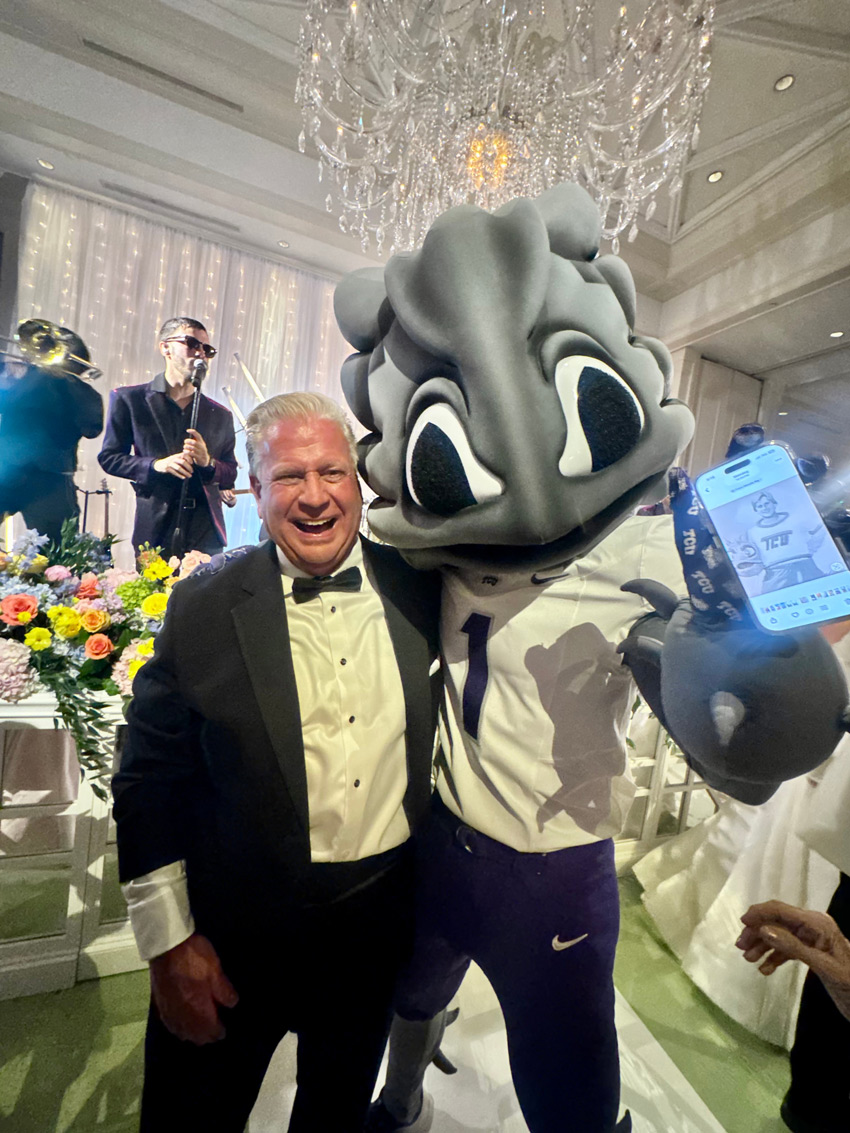
Chris Curtis performed as SuperFrog and joked that it’s all people still know him for (though he is, to be sure, a successful businessman in his own right). SuperFrog made an appearance at his son’s wedding, so, of course, Curtis had to get a photo with him. Courtesy Chris Curtis
Communicating the policies that govern the position to the rest of the squad, and thus avoiding a repeat of the 1979 incident that gave Curtis his chance, became part of Beattie’s mandate when he became a squad captain midway through his freshman year. Over the course of his career, he implemented best practices based on his experiences. Best practices for a mascot role, of course, aren’t the ones a candidate looks to master for a normal job interview. “I made a new requirement for the next round of tryouts to be: Everyone has to be able to do a worm, everyone has to be able to do a cartwheel, everyone has to be able to do a one-handed handstand.”
Such skills come in handy on gamedays. Athletic department functions remain SuperFrog’s No. 1 priority. Beattie listed football, men’s and women’s basketball, volleyball, baseball, and soccer as the most frequent spots for the mascot to appear.
“All six of those, we were at every single home game, unless it was conflicting with another home game at the same time,” he said.
Beattie also cited requests from the chancellor’s office and the admissions department as priorities. SuperFrog can also be hired for private events.
Curtis noted that even from the early days, the mascot did more than just game appearances, though with only two students rotating in the suit, they couldn’t do many civic functions or birthday parties. And Curtis had a full-circle moment in that area this past weekend, he told us while making time for an interview during a busy time for his family last week.
“My son is getting married Saturday night, and he’s marrying a TCU girl — SuperFrog will be appearing at their wedding,” he said, suggesting he might sneak out of the room when the mascot walked in to stir up some speculation that he had once again donned the suit.
With so many appearances at sporting events, it helped both Beattie and Curtis to have had a background as athletes themselves. Beattie loved to be active growing up, listing football, gymnastics, baseball, wrestling, track and field, and rock climbing as sports in which he’d participated. “My dad was actually my coach for my football team, and I think that whenever I was on the field [as SuperFrog], it was like I was just back there again. I’d be standing in the tunnel, running the team out, and I’d feel my dad, like, up in the stands or back home watching on TV, just, like, screaming at me to just run faster and all those things.”
Curtis described himself as a “huge sports fan” and said that his understanding of the sport of basketball paid off the most in terms of knowing the ideal moments to interact with the crowd. That sport also provided one of the favorite periods of his mascot career. “One of my great memories is I was there for the birth of Killer Frogs, which was a thing for a while. The basketball coach’s name was Jim Killingsworth. We hadn’t been very good, and we went to College Station as a 9-versus-8 playoff play-in game to the conference tournament and beat [Texas A&M] on a last-second shot,” recalling the TCU men’s basketball teams whose early-’80s success created a buzz around the program. “They started calling them the Killer Frogs.”
Both he and Beattie emerged from their stints as SuperFrog with positive memories of the mascot and the school.
“I had a great TCU experience,” Curtis said. “I’ve been on the board. I was the president of the National Alumni Association and, before that, president of the Frog Club.”
Both have taken the creativity they had to display as SuperFrog and applied it in their careers. Curtis came up with a plan for using portable video screens for marketing and other corporate purposes and created the successful GoVision company.
Beattie found work even more directly related to the athletics marketing internship he did at TCU and his time in the SuperFrog suit.
“I work [in marketing] for a corporate convenience store chain here in Texas, and I’m their mascot as well,” he said. “They hired me out my senior year in December. I came back for another photoshoot in May, and I’m the only person that’s really ever done it, and then on that last one, they’re like, ‘Hey, do you want a job?’ ”
Turning college experiences into a career a student loves is what a university strives to do, even — or especially — when that career involves spending time as Cluck, the Chicken.
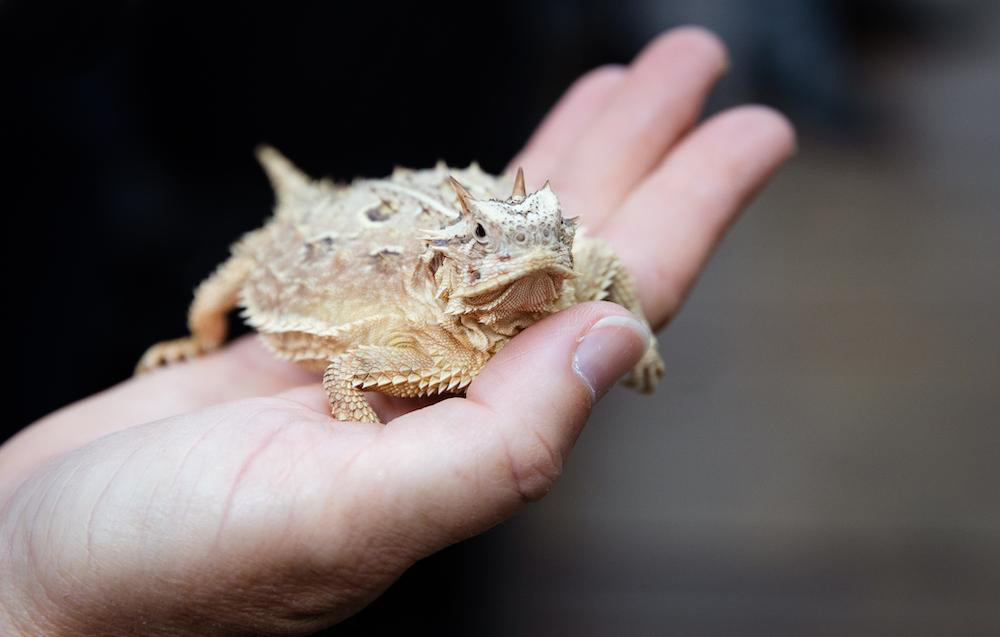
Curtis and Beattie both love animals but have seen real horned lizards only at the Fort Worth Zoo. Courtesy TCU
Both Curtis and Beattie love animals (real ones). Curtis considers himself a dog person. Beattie especially bonds with the cows his family owns and lives with a former feral cat named Alex. Curtis and Beattie have seen real horned lizards only at the Fort Worth Zoo.
“They’re very weird looking,” Beattie said. “I kind of prefer the giant, gray, spiky monster that we put on, and we don’t actually shoot blood out of our eyes.”