

At a time when the White House and even WNBA players are encouraging people to hate and persecute our transgender friends and neighbors, I’m pleased to report that a trans writer-director who uses they/them pronouns is rapidly becoming one of America’s best filmmakers. Don’t take my word for it: New York magazine agrees with me about Jane Schoenbrun, whose I Saw the TV Glow played in Tarrant County theaters and made my top 10 list in 2024. Their Teenage Sex and Death at Camp Miasma expands to a surprisingly large number of Tarrant County multiplexes this week, and while I won’t pretend that I completely understand it after one viewing, it’s a trip and a half.
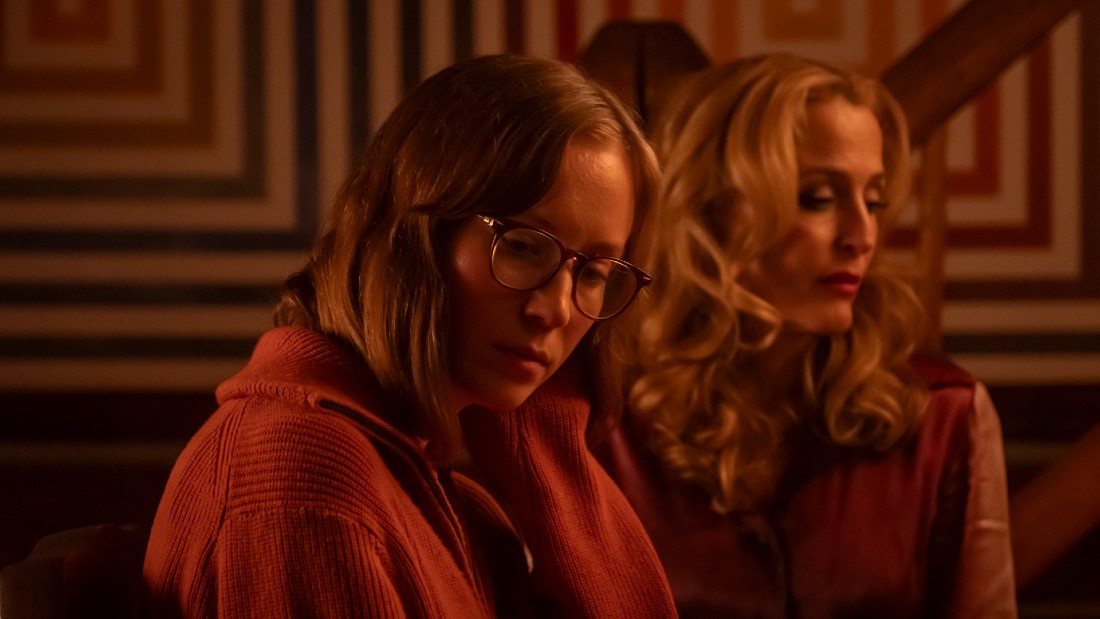
You can see Schoenbrun’s skill and attention to detail in the opening credits, a montage of movie memorabilia and newspaper clippings that chronicles the Camp Miasma horror franchise’s descent from 1990s cultural sensation to Razzie-winning joke over the course of 14 films. The story picks up in the present day, with 29-year-old queer filmmaker Kris Williams (Hannah Einbinder) receiving the opportunity to reboot the series. Camp Miasma has a history of transphobia, and Kris is well aware that the studio is using her/them — Kris uses both pronouns — to make the franchise marketable to modern sensibilities. On a snowy winter’s day, she drives deep into the Pacific Northwest wilderness to the campsite where the original film was shot to meet Billy Presley (Gillian Anderson), the lead actress who quit show business after starring in the original, and who now lives alone at the site.
The movie turns on the attraction between the two women, as Billy knows that Kris half expects her to be some crazed recluse and is happy to play that up, claiming that “Little Death,” the killer from the movies who wears an A/C collar and faceplate as a mask, will rise again from the bottom of the nearby lake. Under Billy’s sway, Kris admits that she can’t have orgasms unless she’s imagining herself as a character in the Camp Miasma movies. I haven’t seen TV’s Hacks, but Einbinder’s acting here as a movie nerd with no self-confidence in bed makes me think I’ve been missing out. She’s excelled only by Anderson, whose dime-store Southern accent can’t mar her best film performance since 2000’s The House of Mirth, brimming with macabre humor and teasing sexuality.

A solid half-hour of the film’s 111 minutes is given over to footage from the original Camp Miasma, in which a young Billy (Amanda Fix) portrays the heroine who loses her virginity. We could have forgiven Schoenbrun for intentionally making the film-within-the-film as crappy as those old slasher flicks were. Instead, they show off their chops as well here, in a bravura one-take shot during Little Death’s murder spree that shifts the point of view from the killer’s to the victims’ to a spot directly in front of the killer. It’s all set to Counting Crows’ “A Long December,” which is about as ’90s as it gets.
Camp Miasma’s origin story depicts Little Death (played by Jack Haven, the Dallas native formerly known as Brigette Lundy-Paine) as a gender non-conforming boy who’s murdered by his fellow campers and whose spirit rises up to take revenge on future generations at the camp. Kris tags this as the transphobic part, but that’s more complicated than it seems: Little Death’s first victim is a punk rocker (Eva Victor) who really hates trans people. All this is absorbing in itself, but it has another layer in older Billy’s weird and frankly alarming reactions to watching the sex scenes in Camp Miasma as she sits beside Kris. Their relationship culminates in a sex scene when Kris finally achieves orgasm by imagining Little Death impaling her and Billy with his spear, a loaded image if ever there was one.
There are enough images like this for feminist and queer film theorists to pick over for years, but the movie’s value is more than just academic. Kris’ Zoom pitch to an uncomprehending group of Hollywood executives hits something deep about horror movies, as Kris makes Little Death into the filmmaker conjuring the Camp Miasma movies from our subconscious fears. The Scream movies look childish next to Schoenbrun’s complex layers of metafiction, and their satire on the film industry is mordantly funny, never more so than when Kris conjures the executives and her agent (Sarah Sherman) into the forest to be slaughtered by Little Death.
The movie works as a lesbian romance as well, with Schoenbrun and cinematographer Eric Yue manufacturing Day-Glo pink skies when our heroines meet on the lake’s frozen surface, as well as the camp’s wintry landscape turning to an idyllic summer when the ladies walk off into the sunset. Most slasher movies don’t bother giving us anything so intensely beautiful, but that’s what this transcendently talented filmmaker can do. The sense of self bleeding into another is a feature of all of Schoenbrun’s films, and here it’s used for the love story as Kris finds fulfillment in her love for Billy. Maybe it takes a trans filmmaker to give us that. Jane Schoenbrun takes 1990s nostalgia, genre horror, and a dash of Charles Busch’s theatrical camp pastiches (like Vampire Lesbians of Sodom and Psycho Beach Party), and makes something that’s thrillingly new and works as a great many things. All this adds up to the prodigious achievement that is Teenage Sex and Death at Camp Miasma.
Teenage Sex and Death at Camp Miasma
Starring Hannah Einbinder and Gillian Anderson. Written and directed by Jane Schoenbrun. Rated R.