

As the white father of a Black boy, I’ve come across what I’m calling the degrees of Blackness. Regarding skin color, darker is worse — my kid has been called “burnt” by fellow Black students because he’s directly from West Africa. (I won’t repeat all the lovely epithets hurled at him by the non-Black kids.) Achieving the epitome of Blackness in the world of kiddom and perhaps beyond requires: A.) not being burnt and B.) possessing some relationship to overcoming The Struggle. Through entertainment is one way to transcend. One of my son’s lighter-skinned friends raps on TikTok to hundreds of viewers, and like some blue-chip baller racking up touchdowns or slam dunks, his classmates — and the staff — essentially defer to this rhymemaker. Through academics is another though admittedly less cool means by which Otherness can be sublimated. The few rich Black kids have no outward problems or social hangups at all. None of them appears to be “burnt,” though.
My son, a burgeoning photorealist penciler himself, joined me the other day to take in A Poem for Deep Thinkers at the Modern Art Museum of Fort Worth. The largest exhibit to date and first major museum survey in over a decade by Chicago multimedia star Rashid Johnson does a superb job of approaching this apotheosis of Blackness sideways. Codes and references abound. Understand that you do not need to be Black or the parent of a Black child to marvel at this collection of more than 90 artworks encompassing painting, sculpture, film, collage, and installation. To interrogate history, identity, masculinity, parenthood, art history, self-care, and more, Johnson employs a lot of nontraditional materials in mostly traditional forms (black-soap paintings, spray-painted text on mirrors, shea butter, lots of shea butter), plus there are his early media of film and video. In whatever medium, the form is sometimes more impressive than the content. And that’s the point.
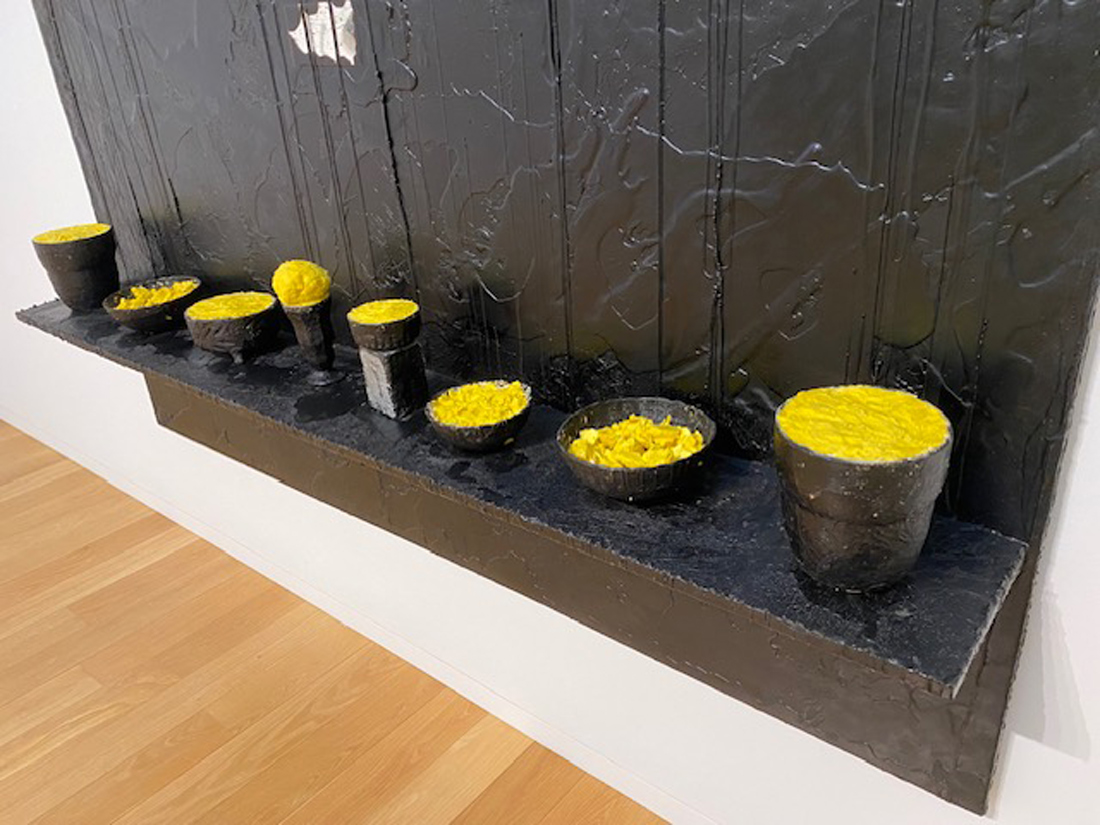
Photo by Abeeku Yankah
When evaluating art, to me, uniqueness often matters more than observable manual dexterity, implied sweat equity, or even emotion. Johnson’s work is cold and detached, yet in its shadowy, icy neatness — even when made of fragmented mirrored tile, even when giving the appearance of melting — resides a sublime, friendly intellectualism that prefigures “deep” engagement.

Part of this attraction lies in his familiar forms. Shelves bordering on altars, potted plants, almost narrative films — they all activate the viewer’s tame, domesticated, possibly (these days) lobotomized psyche while hitting those oh-so-rewarding pleasure sensors. “Triple Consciousness” may look like an homage to Al Green plundered from your bachelor uncle’s sunken, shag-carpeted living room, but look closer. It’s another one of Johnson’s shelves, this one boasting three copies of Rev. Al’s Greatest Hits from 1975, the LP with his skinny bod shirtless on the cover doing some kind of hand jive. The accompanying wall text puts us all on the same page: “… this piece reflects Johnson’s belief that Blackness is not monolithic but encompasses diverse experiences and realities.” Yeah, but try telling that to the eighth graders out by my house.
Johnson makes his diverse, nontraditional materials count. “Don’t use anything else when paint will do” is a timeless axiom, and, true, the artist could have pulled off some of this stuff with oil paint instead of soap, shea butter, or collage, but the results might not have exuded that tangible, domesticated (there’s that word again) aspect that — I’m just going to say it — looks appetizing. Observing the black pots of yellow goo in the shelf-like “The Crisis of the Negro Intellectual (The Power of Healing),” I, perhaps obviously, perhaps because I hadn’t eaten recently, thought of butter — warm, delicious butter.
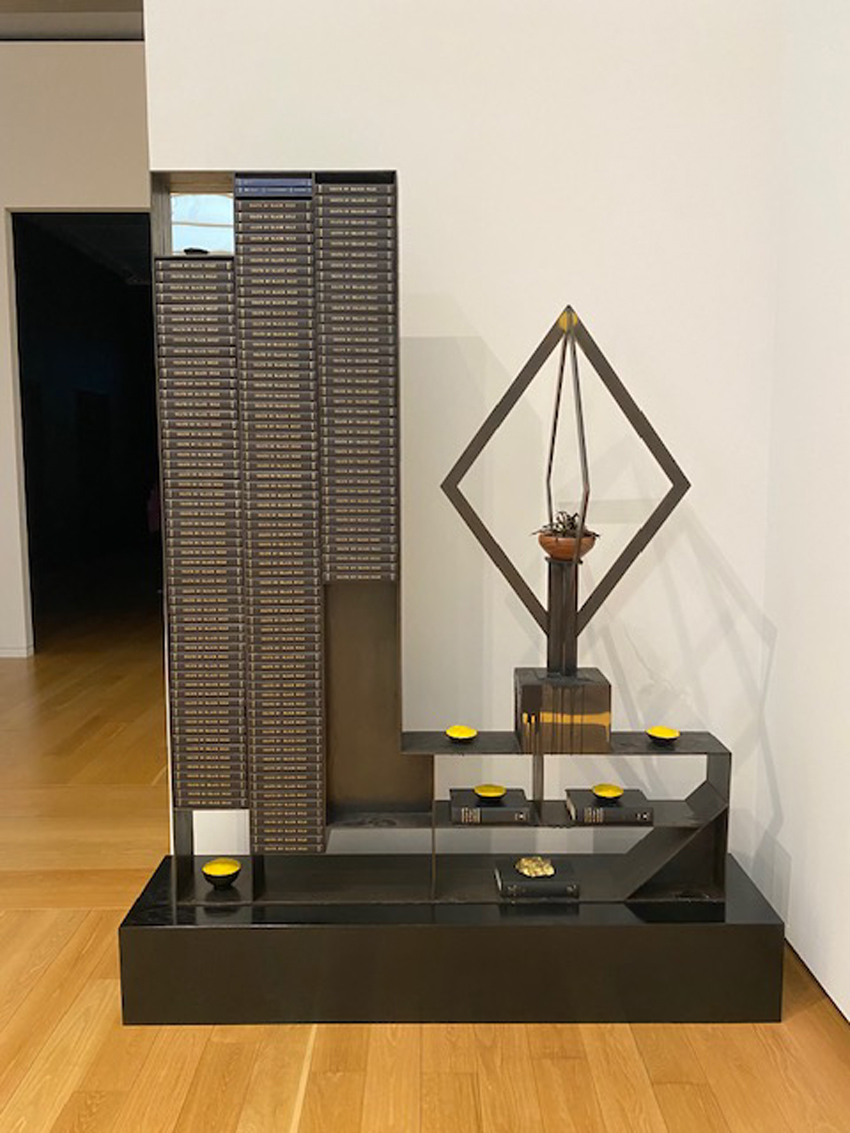
Photo by Abeeku Yankah
It’s a coup really. Largely two-dimensional art that gets all the senses working (even, as the plants here indicate, the sense of smell) should be what all multidisciplinary artists aspire to. Johnson is a master. And while you can’t touch any art unless you own it, a square bench of sorts outfitted with zebra-print “seats” surrounding a panopticon tower of red oak effectively dabs up that part of the brain hardwired for comfort. And since the kid and I had been on our feet looking at art all morning, plopping down would have been grand. Alas …
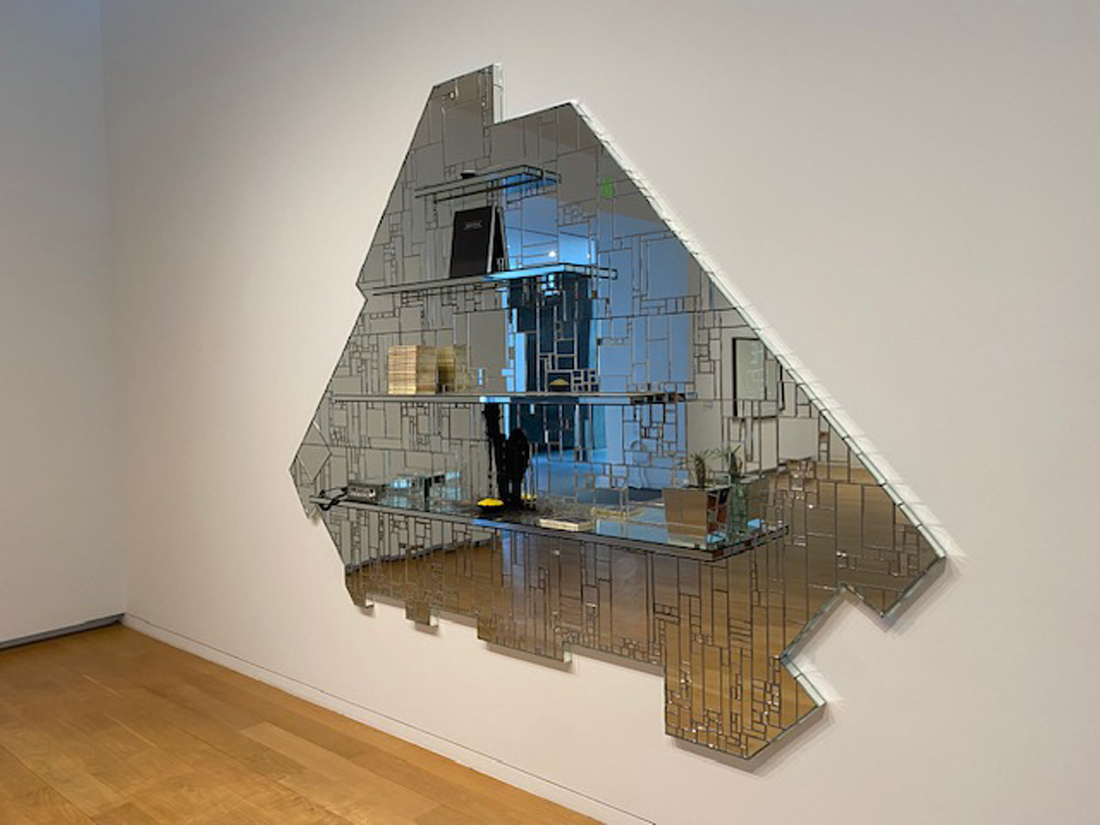
The tableaux I’ll keep thinking about, though, go straight for the eyeballs. Effectively one big, fractured mirror, “The Shuttle” is shaped like a hang-glider wing, the point facing upward. Another sort of fabulous bookcase, the piece houses several shelves, including one that holds over a dozen neatly stacked copies of Dick Gregory’s Write Me In!, the Black comedian and activist’s 1968 manifesto for his failed write-in campaign for U.S. president. For some reason, “The Shuttle” includes a CB radio, which for some even more mysterious reason had me thinking of NASA. The connections between Johnson’s pieces, and between them and your historical reference points, go on forever, another sign that you’re in the hands of an artist at the height of his powers.
The other work that has stuck with me is “Death by Black Hole ‘The Crisis.’ ” Below and to the side of a massive vertical stack of black hardcover copies of the titular collection of essays by famed astrophysicist Neil deGrasse Tyson sit three copies of 1967’s The Crisis of the Negro Intellectual laid flat, a yellow disc resting upon their covers. The verticality of the Black Hole stack matches a narrow column for a small plant inside a diamond shape, also of the same wood as the rest of the “shelf.” It’s furniture for the future that will never come but has always been.
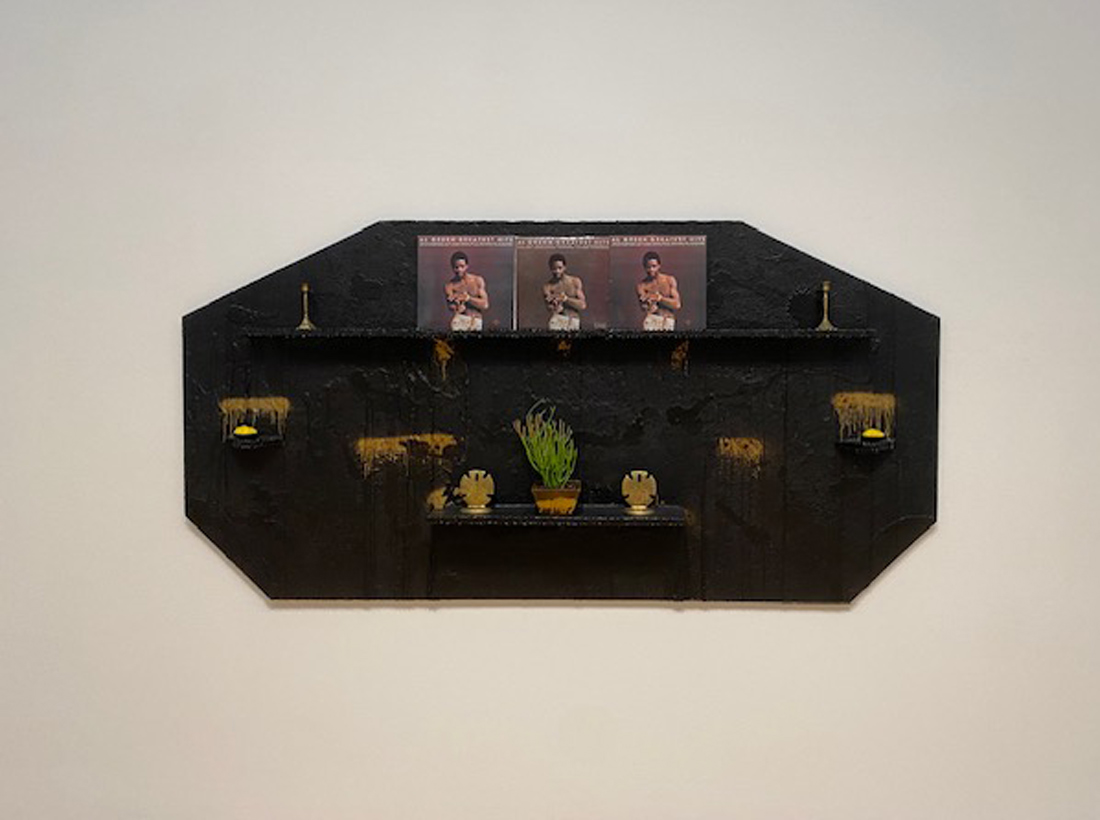
Photo by Abeeku Yankah
The installation process for A Poem for Deep Thinkers itself deserves applause. High above the steps leading to the second-floor galleries, lush green plants hang from the ceiling. How’d they get there? How are they watered? I love this sense of the fantastical from the Modern. Double applause to Chief Curator Andrea Karnes for transforming portions of the overall exhibition space into totalizing environments. Another plant droops outside a gallery window facing the reflecting pool outside. Maybe Miles Morales pitched in.
True Blackness may have degrees to it, but as Johnson proves in his stellar A Poem for Deep Thinkers, because they’re mostly societally imposed does not mean they’re fixed or permanent. Nothing ever really is.
Except maybe the color of your skin.
Rashid Johnson: A Poem for Deep Thinkers
Thru Sep 27 at the Modern Art Museum of Fort Worth, 3200 Darnell St, Fort Worth. $10-16. 817-738-9215.