

This past Tuesday, North Texas hosted its final World Cup match, and the likes of Javier Bardem and Timothée Chalamet watched Spain snuff out the mighty French offense and head to the final. By the time this article reaches you, we’ll likely know whether La Roja will be facing either Argentina or England in that last game. Let’s get to our questions.
What is the “Mexican wave” that Fox’s British broadcasters keep talking about?
It’s what foreigners call “The Wave.” Even though the celebration was invented in the early 1980s at college football games in Northern California, the rest of the world calls it the “Mexican wave” because they first saw Mexican crowds doing it at World Cup 1986.

Why are we starting with that?
Because now Norwegian fans have given us the “Viking row,” which came about late last year and exploded in popularity this summer as Norway reached the quarterfinals, especially after superstar striker Erling Haaland took part in it with his country’s fans. The celebration isn’t as electrifying as Iceland’s “Viking clap,” but it does look like a lot more fun to take part in, as well as visually pleasing.
Is that why Haaland has become such a big star?
It’s not just that. The Manchester City forward scored seven goals in five matches at the World Cup and possesses superhuman agility for someone so large (6’5” and 207 pounds), comparable only to Victor Wembanyama’s on the basketball court. He’s also a dorky goofball who came home from America with a stuffed raccoon for some reason. He and Norway wound up losing to England in the Miami heat, but they captured a share of World Cup fans’ hearts.
What about England?
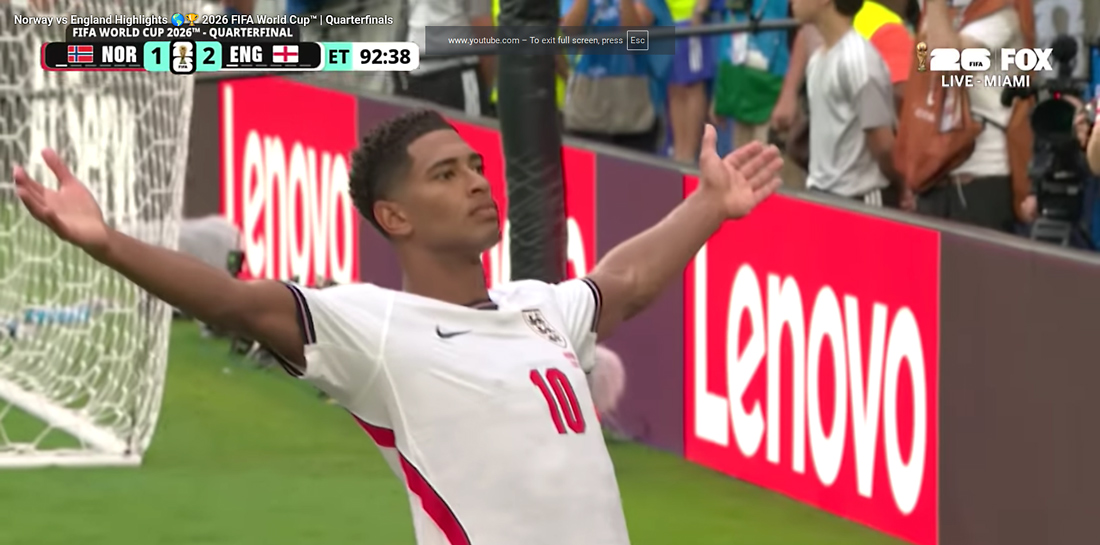
Between France’s overwhelming force and Argentina’s narrow escapes, the Three Lions have flown under the radar, which is probably the best thing for them. Much of the press about England has been about Harry Kane for solid reasons, but people overlook the fact that Jude Bellingham has emerged as a stone-cold killer. The Real Madrid attacker scored both goals against Norway and two more in quick succession (what the British call a “quickfire double”) in the win over Mexico. Two years ago, he executed a wondrous bicycle kick goal to eliminate Slovakia at Euro 2024. The dude is clutch, and England’s fans serenaded him with — what else? — “Hey Jude.” Even though he’s facing another clutch guy in Lionel Messi in the semis, I wouldn’t lay money against him.
Bellingham’s first goal against Norway is controversial. What is it all about?
Broadcasters and Norway’s bench saw Ørjan Nyland’s goal kick hit a cable over the pitch for the TV cameras. The ball then came down to Elliot Anderson, who assisted Bellingham on the equalizing goal just before the half. FIFA says that the microchip in the ball did not detect a change in the ball’s trajectory, therefore the goal should stand. Had the ball hit the wire, that would have taken away England’s goal. The rules state that if the ball strikes a foreign object on the pitch (or above it, in this case), play has to stop for a drop ball.
What does this have to do with beach balls?
Everyone became aware of this rule during a 2009 game between Sunderland and Liverpool. A 16-year-old Liverpool fan threw a beach ball onto the pitch near Liverpool’s goal when the (soccer) ball was at the other end. The joke was on the kid, because a few seconds later, Sunderland launched a fast-breaking counterattack, and Darren Bent’s shot hit the beach ball before deflecting into Liverpool’s net. By rule, the goal should not have stood, but the referee was not aware of this and allowed the goal, which turned out to be the only marker in Sunderland’s 1-0 victory. The deflated ball is now in a soccer museum in Manchester, and Liverpool defender Jamie Carragher summed it up best: “Who takes a beach ball to the northeast [of England] in the middle of October?”
Why isn’t Kane a bigger star?
The England striker certainly has the looks for stardom and has claimed many of his country’s goal-scoring records. He went quite a long time without winning a trophy but shed that particular gorilla from his back when he joined Bayern Munich from Tottenham Hotspur. For all that, we’ve seen a lot more TV commercials in this World Cup with Messi (who doesn’t speak English) and Sir David Beckham (who retired in 2013). The New York Times figures Kane just isn’t interested in being a commercial pitchman. I say it’s fine that he’s focused on scoring goals and bringing that World Cup title back to England. Cozying up to Donald Trump, not so fine.
What do you see happening in England’s semi against Argentina?
All due respect to Argentina’s opponents, the South Americans haven’t run into anyone who have been able to pressure their midfield and defense. They won the last World Cup thanks to some stellar play by their midfield of Enzo Fernández, Alexis Mac Allister, and Rodrigo de Paul, but both de Paul and Mac Allister fell off dramatically this past season. Argentina’s offense still gives them a puncher’s chance, especially if Coach Lionel Scaloni has gotten over his weird reluctance to start Julián Álvarez. (The Atlético Madrid striker gives Argentina’s offense a more powerful, physical presence, and you saw his quality in his magnificent strike to beat Switzerland.) I don’t like how unnecessarily tense Argentina made things against both Cape Verde and Egypt, and I prefer England’s balance of talent from back to front.
What went wrong with Belgium?
I wrote previously about how Belgium’s midfield of Youri Tielemans, André Onana, and Nicolas Raskin overwhelmed USA, but Onana was hurt during that game, then Tielemans got injured in the warm-ups for Belgium’s quarterfinal match against Spain. Coach Rudi “Resting Bitch Face” Garcia had little choice but to start Kevin de Bruyne for that game, and de Bruyne once again did the square root of hot garbage. Had the Red Devils enjoyed their full complement, they might have stood a chance against a Spain team whose possession was mostly sterile.
How did Spain beat the favored French?
You hear “the best defense is a good offense,” and that is truer in soccer than it is in other sports. The Spanish midfield dominated possession in the early going and kept the ball away from France’s dangerous front line. Doughty France left-back Lucas Digne lost track of the speedy Lamine Yamal and kicked him in the penalty area while trying to control the ball. Mikel Oyarzabal converted the resulting penalty, and even the substitutions by France Coach Didier Deschamps couldn’t make a difference. Spain Coach Luis de la Fuente came in for much criticism because his team’s offense looked so stagnant aside from Yamal and super-sub Mikel Merino (who scored the match-winners against Portugal and Belgium), but he broke out exactly the right game plan in the semifinal. Les Bleus registered three shots on target for the game, and it didn’t even feel like that many. The Spanish defense is doing its part, too, with Pau Cubarsí showing poise beyond his 19 years. Whoever faces them in the final will have to do some serious thinking to prevail.
How’s your mother’s health?
She is back at home and slowly regaining strength thanks to a physical therapist. It is still problematic with her respiratory system, but she is much better than she was this time last week.