
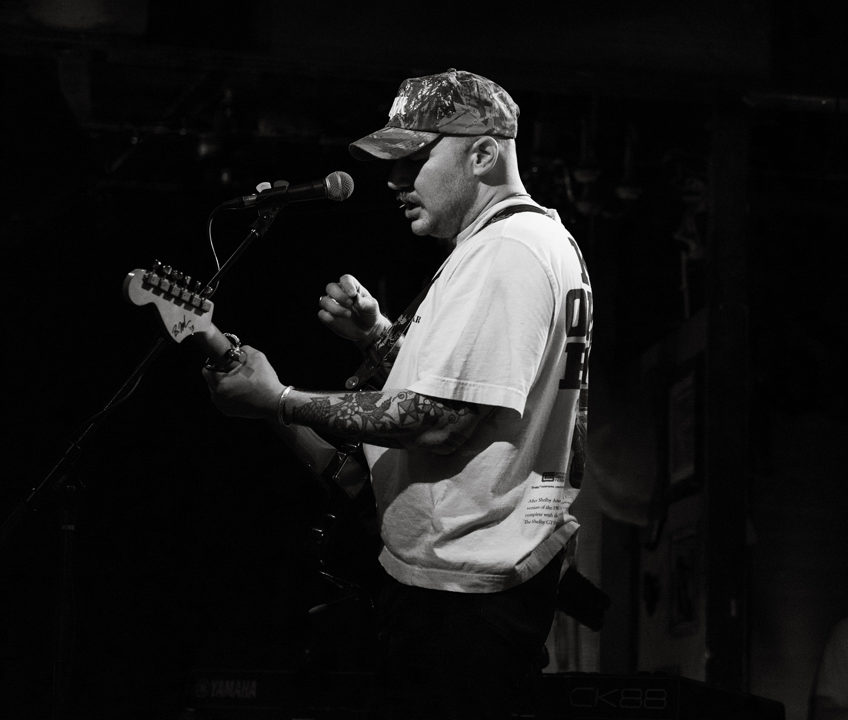
We finally caught up with Matthew McNeal after he took home the Mullen & Mullen Music Project’s inaugural JAMBALOO Music Prize for his 2025 album HIGHLONESOME. Besides a bevy of local-music-industry-related boons, the prize package included $20,000 cash, a sum at which anyone (let alone those engaged in the perennial struggles endemic to an independent music career) would be hesitant to sneeze. I’ve been thinking about what that prize might do for an artist. Would it fund touring? A follow-up album? Maybe even a new amp?
For Fort Worth roots rocker McNeal, that money ultimately goes right back into his music — and, by extension, the local music scene.
“Everything I do under the Matthew McNeal banner, it runs through Matte Black Sound,” McNeal said, referring to the company he founded in 2017 with friend and fellow musician Andre Black which operates as a label, studio, and audio production company. “Instead of cutting a check to me, personally, it goes to the company I run, and so it gets to kind of, essentially … fund all the bullshit we always do. Like, we had a bunch of little interview stuff asking, like, ‘Oh, what are you going to do if you win?’ And it’s like, ‘Well, the same shit I’d be doing if I don’t win, just not be so fucking stressed.”

Touring is one of the things he would be doing anyway that is routinely stressful, and in 2026, more than ever before, getting in the van and hitting the road to rock the nation’s small-to-mid-size bars and clubs remains a financially dicey endeavor.
“We used to hit the road, you know, 150 shows a year, coast to coast, just all independent booking, doing our thing,” McNeal said, “then when COVID happened, you know, we lost a lot of venues and DIY spaces. … Everything just got more expensive, and, unfortunately, you know, transportation, lodging, food, all of these things are what you have to deal with daily when touring, especially at an independent level. And so the times of being able to be gone for four months, just hitting the road, that kind of changed. So, now we’re like, ‘Cool, we’ll go out for a week or 10 days and make it really count and then spend a lot of our time, you know, doing a little regional hit or just doing much more writing, recording, collaborating.’ ”
McNeal and Black are also co-owners (along with an unnamed third party) of a different production company. Through Roadrunner, McNeal said, “we staff folks to work backstage at a bunch of venues and try to put money in musicians’ pockets. … There are a lot of the DFW music homies that work with us, and so that’s what makes it fun. It’s like, honestly, it’s so hard to make everything work if you just want to stay in the music industry, especially as an artist. I think you kind of have to diversify what you do.”
Matte Black Sound and Roadrunner, McNeal went on, “work completely independently, but they’re both in the music space. One is for helping the artists — record music, release music, tour, whatever we can do to help — and then Roadrunner is more of like building a music industry ecosystem in North Texas because there are [production] needs, so why not put local musicians in those places?”
For me, who has been participating in and covering Fort Worth music for a really long time, I’ve had the idea of a “DFW music industry ecosystem” on my mind for years — I’ve always been captivated by the hyper-local ecosystems that develop in individual neighborhoods and their endemic scenes — but lately, my thoughts have focused on the audience part of it. I suppose my own localized myopia has a forest-for-the-trees problem. In terms of show promotion, McNeal’s view is higher-level than mine (given his own extensive touring experience and what his companies both do), and I wanted to know what he thought, if anything, might be missing from those of Fort Worth and Dallas.
“I mean, I’ve been doing the behind-the-scenes production shit since I was 17,” he said. “I worked at a peach orchard in high school, sold peaches to a guy who was getting them for a band. He knew I played music, and he was like, ‘Why don’t you come see what I do?’ And I just didn’t tell anyone I was underage. So, I’ve been doing this since I was a kid. I was part of this DIY scene, like throwing pop-up shows in parking lots and libraries and VFW halls, and from a very early age, I was like, ‘How can I apply this shit going on at the biggest level to the smaller spaces where I am?’
“My heart and soul is in the independent and DIY spaces, because that’s where I operate,” McNeal continued. “That’s what I love. … When we help these larger shows happen [via Roadrunner], we try to put people from our actual music community into those roles, to then learn more and bring it back to our scene. So, long answer, what I think we are missing? We have really great [live music] spots, and we have people that fuck with live music. But I think something that I would like to see is more reaching out to younger people, like college students. We have TCU here, for example. We have this revolving door of young people who [go to school] there that love art and music, but maybe they don’t know about Tulips or whatever, and it’s like, ‘Cool, how can we tap into that?’ because those are the people who lead the next wave of culture, and I try to think when I was young, I wished somebody would’ve looked for ways to involve the youth rather than just making you feel like you’re separate from the cool shit going on.”
McNeal said he listens to all sorts of music but that it was “the underground stuff” that really moved his meter when he was a kid. “It was the stuff that you weren’t hearing on the radio, you would have to hear from like a friend or older brother or sister or go to a show, and you see people moshing, and you’re like, ‘Yo, this makes me feel something I haven’t felt elsewhere.’ ”
So, how do you get people to find the kinds of happenings that hook people on live music for the rest of their lives? McNeal started taking his show on the road as soon as he was able to, and he hasn’t really stopped, even with touring ROI being what it is now. He said that when he hit the road way back when, he was banking on the audience’s lived experience and the community that came out of that.
“I found the only way I was able to make any of that work and build anything … it came from community building … where you’re like, ‘Yo, I’m gonna hunt down bands that I like in any area and reach out to them, figure out if I have friends or friends of friends, try to connect with them and be like, “Yo, let’s do something cool together.” ’
“So, you can find these likeminded people and build something. This is how I would always do it in the touring space, and I think it’s similar in Fort Worth. I mean, that’s how we’re all homies and, you know, have been running around together, whether we hang out all the time or just see each other at shows. … I think we’re really fortunate in North Texas to have a ton of great artists, incredible bands all over the place, and it’s not a matter of like, ‘Do we have something cool going on?’ It’s a matter of, ‘How do we get people there to see it?’ I think once you see that [band that changes your life] in person, outside of your phone, it’s like, ‘Oh, this is rad,’ and you keep coming back for it.”
Winning the JAMBALOO Music Prize will keep Matthew McNeal in the business of making music by helping other musicians make their own music, too.